Vienna police tighten security over terrorist attack threat

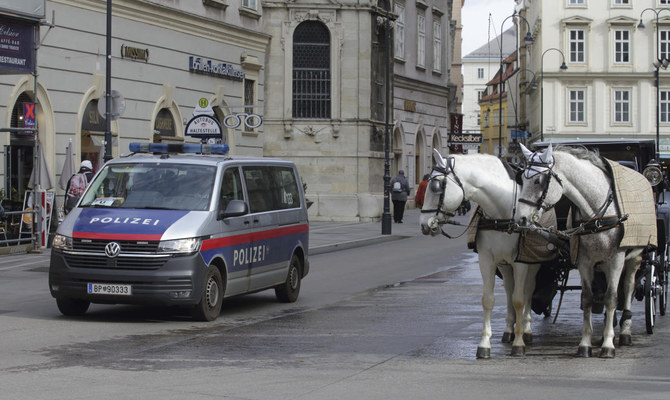
A police van drives past Fiaker horses at St. Stephen’s cathedral in Vienna on Mar. 15, 2023. (AP)
Short Url
Updated 15 March 2023
Follow

Vienna police tighten security over terrorist attack threat

  • The police said the precautionary measures would remain in place "until further notice"
  • In case of imminent danger "at a certain location, we'll issue a warning immediately," the police added

VIENNA: Austrian police tightened security measures at several sensitive sites in the country’s capital on Wednesday after its intelligence service received information that indicated a possible extremist attack.
“Our intelligence services have reason to believe that an assault with an Islamistic motive is planned to be carried out in Vienna,” the police wrote on Twitter.
“As a precautionary measure” particularly sensitive “points of interest have been put under increased guard by regular and special operation police forces,” Vienna police said.
After initially warning of a “non-specific threat” of an attack against churches in Vienna that caused widespread confusion among the public, the police later specified that not only Christian churches “but also houses of worship of various confessions” are concerned.
The police said the precautionary measures would remain in place “until further notice.”
In case of imminent danger “at a certain location, we’ll issue a warning immediately,” the police added.
In the wake of Austria’s first deadly miltant attack in 2020, the Alpine nation adopted a heavily criticized anti-terror law that allows for increased surveillance.
Convicted Daesh group sympathizer Kujtim Fejzulai went on a shooting rampage on November 2, 2020 in downtown Vienna, killing four and wounding 23 others before police shot him dead.
Last month a Vienna court sentenced two alleged accomplices of Fejzulai to life in prison, while two others received prison terms of 19 and 20 years.


Nepal’s rapper-turned-politician takes early lead in key polls

Updated 5 sec ago
Follow

Nepal’s rapper-turned-politician takes early lead in key polls

  • The polls are one of the most hotly contested elections in the Himalayan republic of 30 million people since the end of a civil war in 2006

Nepal’s centrist party of rapper-turned-politician Balendra Shah took an early lead in the high-stakes parliamentary election on Friday, as slow counting continued after the first polls since last year’s deadly uprising.
But despite Shah’s party loyalists dancing on the streets of Katmandu in celebration — the numbers of votes counted remain too low to be confident that it will translate into concrete wins.
By Friday afternoon, 24 hours after polls closed, early trends issued by the Election Commission put Shah’s Rastriya Swatantra Party ahead.

HIGHLIGHT

Alongside Shah, key figures vying for power include Marxist leader KP Sharma Oli, four-time prime minister who was ousted by the September 2025 anti-corruption protests, and the newly elected leader of the Nepali Congress party, Gagan Thapa.

Alongside Shah, key figures vying for power include Marxist leader KP Sharma Oli, four-time prime minister who was ousted by the September 2025 anti-corruption protests, and the newly elected leader of the Nepali Congress party, Gagan Thapa.
At 5:00 p.m. (1115 GMT), RSP was leading in more than half of the 165 constituencies.
But there were only two declared results, and RSP had been confirmed only in one, the same as Nepali Congress.
Prakash Nyupane, a spokesman for the Election Commission, said that counting was ongoing “in a peaceful manner” across the Himalayan nation, from snowbound high-altitude mountain regions to the hot plains bordering India.
Voters have chosen who replaces the interim government in place since the September 2025 uprising, in which at least 77 people were killed, and parliament and scores of government buildings were torched.
Youth-led protests under a loose Gen Z banner began as a demonstration against a brief social media ban, but were fed by wider grievances at corruption and a woeful economy.
Kunda Dixit, publisher of the weekly Nepali Times, told AFP that if trends did reflect final wins, the political shift was dramatic.
“This is even a bigger upset than we expected — it underscores the level of public disenchantment with the old parties for under-performance, as well as anger over the events of September,” he said.

 ‘Fate of the country’ 

The polls are one of the most hotly contested elections in the Himalayan republic of 30 million people since the end of a civil war in 2006.
All eyes are watching the results in the key head-to-head battleground constituency of Jhapa-5, a usually sleepy eastern district, where 35-year-old Shah challenged directly the veteran Oli, aged 74.
Shah, better known as Balen, snappily dressed in a black suit and sunglasses, has cast himself as a symbol of youth-driven political change.
At 5 p.m. local time, at 10 percent of the votes counted in Jhapa-5, Shah was ahead by nearly five times as many votes as Oli.
Soldiers with armored trucks manned barbed wire barricades around the counting center in Jhapa.
“I hope this result changes the fate of the country for the better,” Bhagawati Adhikari, 38, told AFP, who was among a crowd of dozens at Jhapa gathered outside the security cordon.
“The country should be peaceful and secure, youth should get opportunities, corruption should stop — that’s my appeal.”

’Rest peacefully’ 

More than 3,400 candidates ran for 165 seats in direct elections to the 275-member House of Representatives, the lower chamber of parliament, with 110 more chosen via party lists. Turnout was 59 percent.
Full nationwide tallies could take several days.
Dixit raised the possibility that Shah’s RSP could stage a dramatic win.
“If RSP hits the magic 138 seats, Balen will become prime minister — and hopefully a cabinet of technocrats,” added Dixit.
Sushila Karki, the interim prime minister, praised the peaceful conduct of a vote she has said was critical in “determining our future.”
Karki, a 73-year-old former chief justice who reluctantly left retirement to lead the nation, now faces the challenge of managing the reaction to results.
The election saw a wave of younger candidates promising to tackle Nepal’s dismal economy, challenging veteran politicians who have dominated for decades and argue that their experience guarantees stability and security.
In Jhapa, 68-year-old shopkeeper Ved Prasad Mainali sat listening to a radio.