

Activists urge UN Security Council to refer Myanmar to court

1 / 2
UN Secretary-General's Special Envoy on Myanmar Noeleen Heyzer attends a press conference at the Parliament House in Kuala Lumpur, July 26, 2022. (AP)
2 / 2
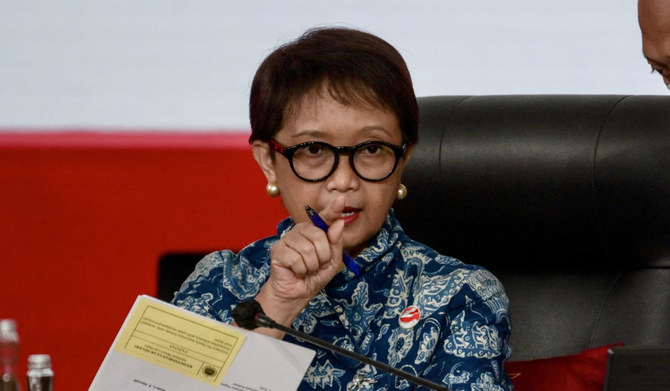
Indonesiaís Foreign Minister Retno Marsudi (L) attends the ASEAN (Association of Southeast Asian Nations) Foreign Ministersí Retreat in Jakarta on February 4, 2023. (AFP)
Short Url
Updated 15 March 2023
Follow

Activists urge UN Security Council to refer Myanmar to court

  • Myanmar’s military has long been accused of human rights violations, most notably during a brutal 2017 counterinsurgency campaign against Rohingya Muslims in the western state of Rakhine

UNITED NATIONS: Human rights activists urged the UN Security Council on Monday to refer Myanmar’s military rulers to the International Criminal Court and urged neighboring Southeast Asian countries to support the opposition pro-democracy movement.
The leaders of two women’s rights organizations spoke to reporters ahead of a closed council meeting on Myanmar. Members heard briefings by UN special envoy for Myanmar Noeleen Heyzer and Indonesia’s Foreign Minister Retno Marsudi, whose country chairs the 10-member Association of Southeast Asian Nations.
May Sabe Phyu, director of the Gender Equality Network, a coalition of organizations promoting women’s rights in Myanmar, accused Myanmar’s military of conducting “a terror campaign” and committing “heinous acts” that constituted crimes against humanity. She said the Security Council should refer the junta’s actions to the International Criminal Court for prosecution.
Myanmar’s military has long been accused of human rights violations, most notably during a brutal 2017 counterinsurgency campaign against Rohingya Muslims in the western state of Rakhine. International courts are considering whether that crackdown was genocide.
In 2021, the military ousted Myanmar’s elected civilian government, then moved to violently suppress public opposition to the takeover. Some experts now consider the situation in Myanmar to be a civil war in which the army has conducting major offensives against widespread armed resistance.
ASEAN adopted a five-step consensus on restoring peace in April 2021 to which Myanmar agreed but has not implemented, leading to Myanmar’s exclusion from some top-level ASEAN meetings since then.
The Security Council approved its first-ever resolution on Myanmar in December, demanding an immediate end to violence, urging its military rulers to release all “arbitrarily detained” prisoners including ousted leader Aung San Suu Kyi and to restore democratic institutions. It also reiterated a call for dialogue and reconciliation and urged all sides “to respect human rights, fundamental freedoms and the rule of law.”
The activists called for an arms embargo, for the UN special envoy to have public engagements with pro-democracy actors, and for accountability for crimes perpetrated by the military.
Phyu, who left Myanmar after the takeover and is now based in the United States, asked the Security Council to pressure Myanmar’s neighbors not to support the government but to publicly support democratic forces, including the National Unity Government, which she said has the support of the people of Myanmar.
And she criticized UN envoy Heyzer for meeting Senior Gen. Min Aung Hlaing but not meeting publicly with pro-democracy groups including the National Unity Government, which operates underground and calls itself the country’s legitimate government.
Naw Hser Hser, head of the Women’s League of Burma, said supporters of democracy feel forgotten by the international community.
Before Monday’s council meeting, Britain’s UN Ambassador Barbara Woodward said the Security Council fully supports ASEAN and the five-point council, but stressed that it’s time for progress now.
“The people of Myanmar have been suffering for too long,” Woodward said. “Myanmar is the second deadliest place in the world for civilians and the people of Myanmar really can’t wait.”
France’s deputy UN ambassador Nathalie Broadhurst told The Associated Press after the council meeting that Marsudi presented the implementation plan which calls for action on all five points in parallel, not sequentially.
“They say they don’t want megaphone diplomacy,” Broadhurst added, expressing hope that the ASEAN effort will eventually lead to a national inclusive effort and end the “desperate situation” in Myanmar.
Brazil’s UN Ambassador Ronaldo Costa Filho told AP that council members supported ASEAN, and some said the Security Council should be prepared for further action, but no new council action is expected “for the time being.”
The Security Council in New York has been increasingly divided due to a major rift among its five permanent members: China and Russia on one side, Britain, France and the United States on the other.


Russia committed ‘crimes against humanity’ in deporting Ukrainian children: UN inquiry

Updated 6 sec ago
Follow

Russia committed ‘crimes against humanity’ in deporting Ukrainian children: UN inquiry

  • The inquiry said Russia had deported or transferred “thousands” of children from occupied areas of Ukraine, of which it had so far confirmed 1,205 cases
  • “Four years on, 80 percent of the children deported or transferred in the cases investigated by the commission have not returned,” it said

GENEVA: Moscow’s deportation and forcible transfer of children from Ukraine to Russia amounts to a crime against humanity, a United Nations team of investigators said Tuesday.
The UN’s Independent International Commission of Inquiry on Ukraine said it had collected evidence leading it to conclude that “Russian authorities have committed the crimes against humanity of deportation and forcible transfer, as well as of enforced disappearance of children.”
The probe was established by the UN Human Rights Council shortly after Moscow launched its full-scale invasion of Ukraine in February 2022.
The inquiry said Russia had deported or transferred “thousands” of children from occupied areas of Ukraine, of which it had so far confirmed 1,205 cases.
“Four years on, 80 percent of the children deported or transferred in the cases investigated by the commission have not returned,” it said.
Moscow has failed to establish a system facilitating returns, and has instead focused on long-term placement of the children with families or institutions in Russia, while relatives were not informed of their fate.
The commission confirmed its previous finding that Russian authorities had unlawfully deported and transferred children — as a war crime — “and that they have unjustifiably delayed their repatriation, which is also a war crime.”
These measures “were not guided by the best interests of the child,” and have violated international law, the probe found.

- Putin cited -

It said the involvement of Russian President Vladimir Putin, “including through his direct authority over entities that have steered and executed this policy, has been visible from the outset.”
In 2023, the International Criminal Court issued a war crimes arrest warrant against Putin, accusing him of “unlawfully deporting” Ukrainian children.
The issue is highly sensitive in Ukraine and remains central to negotiations for a potential peace agreement between Kyiv and Moscow.
According to Kyiv, nearly 20,000 Ukrainian children have been forcibly removed since Russia’s full-scale invasion.
Russia insists it has moved some Ukrainian children from their homes or orphanages to protect them from hostilities.
As for Russian trials in the context of its invasion of Ukraine, the commission found that Russian authorities have “systematically fabricated evidence” and “systematically violated a range of fair trial guarantees,” while judges “have not acted with independence and impartiality.”

- ‘Extreme violence’ -

The commission also probed the situation of nationals from 17 countries who were recruited — either voluntarily or through deception — to fight with Russian troops in Ukraine.
They included men from Azerbaijan, Belarus, Brazil, Cuba, Egypt, Ghana, India, Iraq, Kazakhstan, Kenya, Nepal, Somalia, Sri Lanka, Tajikistan, Turkiye and Yemen.
“After training, usually lasting between one week and 30 days, they were forced to serve on frontlines in Ukraine, often assigned extremely dangerous duties,” the commission said in its report.
Commanders arbitrarily imposed “extreme violence” as punishment for refusing orders that meant almost certain death, with soldiers describing being treated like “cannon fodder,” sent on “meat assaults” without training or necessary equipment, and “forced to advance at all costs.”
“The evidence collected demonstrates abusive behavior, cruelty, humiliation, inhuman treatment, and a total disregard for human life and dignity, perpetrated with a sense of impunity,” the report said.
Regarding Ukraine, the report voiced concern about the overly broad definition and sometimes distorted interpretation of the crime of “collaboration.”
The commission also said reports regarding violent treatment of conscientious objectors during Ukrainian mobilization were “a source of concern.”
The report will be presented at the Human Rights Council in Geneva on Thursday.
Moscow does not recognize the commission and does not answer its requests for access, information and meetings.