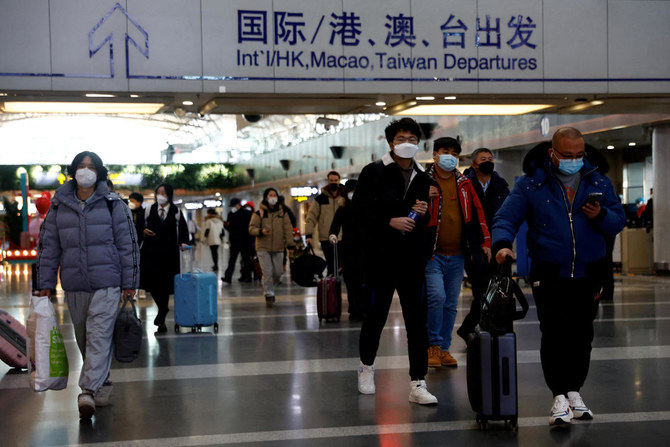
BEIJING: China will reopen its borders to foreign tourists for the first time in the three years since the COVID-19 pandemic erupted by allowing all categories of visas to be issued from Wednesday.
The removal of this last cross-border control measure imposed to guard against COVID-19 comes after authorities last month declared victory over the virus.
Tourist industry insiders do not expect a massive influx of visitors in the short run or significant boost to the economy. In 2019, international tourism receipts accounted for just 0.9 percent of China’s gross domestic product.
But the resumption of visa issuance for tourist marks a broader push by Beijing to normalize two-way travel between China and the world, having withdrawn its advisory to citizens against foreign travel in January.
Areas in China that required no visas before the pandemic will revert to visa-free entry, the foreign ministry said on Tuesday. This will include the southern tourist island of Hainan, a long-time favorite destination among Russians, as well as cruise ships passing through Shanghai port.
Visa-free entry for foreigners from Hong Kong and Macau to China’s most prosperous province, Guangdong, will also resume, a boon particularly to high-end hotels popular among international business travelers.
“The announcement that China will resume issuing nearly all type of visas for foreigners from tomorrow is positive for Australian businesses whose executives would like to travel to here to visit their China-based teams, customers and suppliers and to explore new business opportunities in the mainland market,” said Vaughn Barber, chairman of the Australian Chamber of Commerce in China.
Chinese events open to foreign visitors — such as the China Development Forum in Beijing later this month and the Shanghai Autoshow in April — are gradually resuming. The once-every-four-years Asian Games will also take place in the eastern city of Hangzhou in September after being postponed last year due to China’s COVID concerns.
But prospective visitors might not immediately arrive in droves.
Unfavorable views of China among western democracies have hardened due to concerns over human rights and Beijing’s aggressive foreign policy, as well as suspicions surrounding handling of COVID-19, a global survey by the Pew Research Center in September showed.
“In terms of tourism, China is no longer a hotspot destination,” said an executive at China International Travel Services in Beijing, declining to be named due to the sensitivity of the matter.
“Commercially, the wish of foreigners to run events in China also decreased after COVID, because too many things here are impacted by politics which has scared them off.”
In a further relaxation of controls on outbound tourism, China added another 40 countries to its list for which group tours are allowed, bringing the total number of countries to 60.
But the list still excludes Japan, South Korea, Australia and the United States. Ties between those countries deepened as Washington faced off with Beijing over issues from Russia and Ukraine to Chinese military presence in the South China Sea.
“It’s common to use tourist visas to come to China on business, but I don’t know how enthusiastic institutional investors will be to do so, after all the drumbeat of scary news,” said Duncan Clark, founder of BDA, a Beijing-based investment consultancy.
In 2022, just 115.7 million cross-border trips were made in and out of China, with foreigners accounting for around 4.5 million.
By contrast, China logged 670 million overall trips in 2019 before the arrival of COVID, with foreigners accounting for 97.7 million.


![]()

China to fully reopen borders to foreigners but near-term hurdles remain
Short Url
https://arab.news/bxdjf
China to fully reopen borders to foreigners but near-term hurdles remain
- Tourist industry insiders do not expect a massive influx of visitors in the short run or significant boost to the economy
- But resumption of visa issuance for tourist marks a broader push to normalize two-way travel between China and the world


Latest updates


© 2026 SAUDI RESEARCH & PUBLISHING COMPANY, All Rights Reserved And subject to Terms of Use Agreement.