

Police say attack on headquarters, growing extortion menace signal return of Taliban to Karachi

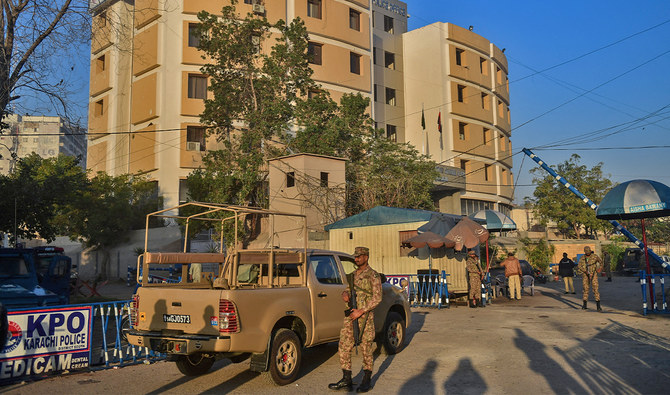
Pakistani army soldiers stand guard outside the Karachi Police Office compound a day after an attack by Pakistan's Taliban in Karachi on February 18, 2023. (AFP)
Short Url
Updated 14 March 2023
Follow

Police say attack on headquarters, growing extortion menace signal return of Taliban to Karachi

  • Militants launched a deadly suicide attack on the police headquarters of Pakistan’s largest city last month
  • On Monday, Karachi’s Counter Terrorism Department said suspected mastermind of police HQ attack killed

KARACHI: An attack on the police headquarters of Pakistan’s largest city last month and a spike in reported cases of extortion in the metropolis have stirred fears of insurgents regaining a foothold in the city, officials and experts said on Monday.

Karachi, Pakistan’s commercial capital, was marred by political, militant and gang violence until 2013 when a paramilitary Rangers-led operation cleaned up the city’s mean streets. Terror attacks also saw a decline across the country starting 2014 after the military launched a number of major operations in the tribal areas where most Pakistani Taliban (TTP) and allied militants were harboring. Many fighters and commanders of the group were killed in the operations while others fled across the border to neighboring Afghanistan.

But the Pakistani militants were emboldened once more after the Afghan Taliban, who the TTP is allied with, seized power in Kabul in August 2021 after US and NATO troops withdrew. Last year, the Afghan administration brokered a number of cease-fires between the Pakistan government and the TTP, the last of which was unilaterally called off by the militant group in November. The outfit has since increased its attacks on security forces, including the brazen assault on Karachi’s police headquarters last month.

On Monday, officers of Karachi’s Counter Terrorism Department said they had killed the suspected mastermind of the police HQ attack.

“[The] group which we busted comprised militants living in Karachi, [which] is one indicator,” CTD top official Raja Umar Khattab told Arab News when asked about signs of a return of the Taliban to Karachi.

“The second major indicator of the Taliban’s presence is the rise in extortion cases,” said Khattab, who runs the transnational terror cell at the city’s CTD.

The official did not provide figures for the rising extortion demands but businesses in Karachi have for decades dealt with the menace, especially from criminal gangs. The vast majority of extortion demands go unreported, police say, and victims usually decide to pay. There is no way to know the sums involved, but police say payments run into tens of millions of dollars annually in Karachi, home to Pakistan’s main stock market, and the city that handles all of the cash-strapped country’s shipping and also generates most of Pakistan’s tax revenue.

Experts tracking militancy in the region said after the breakdown of the truce with the government in November, it was unsurprising that the TTP was trying to make inroads in major city centers.

“The TTP network in Karachi is not surprising as they have moved toward urban terrorism in last few months,” Abdul Basit Khan, a research fellow at the S. Rajaratnam School of International Studies in Singapore, told Arab News. “There has been Taliban’s ingress in Pashtun areas in cities, especially Karachi.”

The Taliban’s comeback to cities like Karachi, he said, was consistent with their recent track record.

“The militants have come back to Pakistan in large numbers and have spread in cities in [the] form of small networks,” Khan said. “There are Taliban cells in all cities and they have shown their ingress in Rawalpindi, Peshawar, and recently in Karachi.”

“There are troubling signs of the TTP’s resurgence in Karachi, most significant of which is the group’s stepped up extortion activity and the audacious attack on the office of the Karachi police chief,” Dr. Asfandyar Mir, a senior expert at the US Institute of Peace, told Arab News.

At the same time, he said, the TTP appeared to be treading cautiously and had not yet announced a shadow government structure or a dedicated leader for the city as part of its recent reorganization.

“Nevertheless, as the group gains in eastern Afghanistan and along Pakistan’s western border, TTP will seek to accelerate recruitment, fundraising, and expansion of operational cells in the city,” Mir said.


Pakistani fodder exporters target $1 billion in five years but need Saudi, China market access

Updated 10 sec ago
Follow

Pakistani fodder exporters target $1 billion in five years but need Saudi, China market access

  • Pakistan exported $112.2 million in animal feed last fiscal year, industry targets nine-fold increase
  • Heavy dependence on UAE market raises risk of oversupply as Pakistan’s fodder production expands

KARACHI: Pakistan’s fast-growing fodder industry is targeting up to $1 billion in annual exports within five years, but growers say reaching that goal depends on Islamabad securing market access to major buyers such as Saudi Arabia and China.

The country exported 930,802 tons of “feeding stuff for animals” worth $112.2 million in the fiscal year ending June, according to the Pakistan Bureau of Statistics (PBS) data shared with Arab News. The United Arab Emirates accounted for the largest share at $33.2 million, leaving exporters heavily reliant on a single market.

Industry representatives say expanding cultivation without opening new destinations risks a supply glut that could depress farm prices and undermine a rapidly emerging export niche.

“We have mainly one country, the UAE, which is a purchaser,” said Sarfaraz Ali Janjua, chief executive of GRJ Agriculture and Livestock Farms and head of the Pakistan Hay Association.

He urged authorities to engage major importing countries “at the government-to-government level.”

The appeal reflects the growing importance of a specific export crop driving the sector’s expansion.

Rhodes grass — a high-protein tropical fodder crop used to feed dairy cattle, horses and camels — has gained commercial value as water-scarce Gulf states rely on imports rather than domestic cultivation.

“There is no agricultural land there (Gulf region). There is mostly desert due to shortage of water,” said Irfan Mahmood, an animal feed expert managing GRJ farms in Sindh province.

“In Saudi Arabia, agriculture is limited. In Dubai, there is no agriculture. Sometimes, if it rains once or twice a year, then grass grows. There are big animal farms, such as horses, camels, goats and sheep. They have to import fodder from other countries. Pakistan is one of them.”

Pakistan’s exports to Saudi Arabia remain minimal at $307,000 annually, compared with much larger imports from Sudan, while China has yet to approve the product for import.

“China could be a big buyer if the government takes initiative because the product is not registered there,” Janjua said.

“Saudi Arabia imports [more] Rhodes grass from Sudan, not from Pakistan. If there is an agreement at the government level, then definitely Saudi Arabia is a bigger market than the UAE, and our Rhodes grass can go there as well.”

RAPID EXPANSION AT HOME

Farmers have rapidly expanded acreage in response to Gulf demand. Rhodes grass cultivation has increased more than 60 percent in three to four years to roughly 120,000 acres nationwide.

On GRJ’s farms in Mirpurkhas district, workers harvest up to 60 tons daily.

“Sometimes they earn Rs1,000 ($3.6) a day, sometimes Rs1,500 ($5.4) a day. It depends on the amount of work,” said labor supervisor Muhammad Soomar.

“If they harvest fewer acres, they earn less.”

GRJ plans to boost exports 36 percent to 30,000 tons this year but may pause expansion due to oversupply fears.

“If Pakistan’s agricultural setup exceeds 100,000 acres, naturally the market will not be local. People will be worried,” Janjua said.

“If no other country comes in, then there will be problems. Farmers will suffer and will not get proper market rates.”

The shift toward export crops is partly policy-driven rather than purely market-led.

The growth comes as Pakistan reduces crop subsidies under a $7 billion IMF stabilization program approved in September 2024, pushing farmers toward export-oriented agriculture instead of state-supported staples.

“There is no rate support for other crops. There is no government policy, no government subsidy, no cover,” Janjua said.

He said Pakistan’s Trade Development Authority should actively negotiate access abroad.

“There is a Trade Development Authority (of Pakistan). They should engage at the government level and send delegations,” he said.

“Buyers should be briefed. Our products should be sampled.”

Pakistan enjoys “very good relations” with China but must complete regulatory registration before exports can begin, according to Janjua.

“We should talk at the government level and get it registered. To China, we can also export animal feed by road, which would be a breakthrough,” he said

POTENTIAL AND OBSTACLES

Beyond regulatory approval, exporters cite taxation on imported machinery, foreign exchange conversion losses and customs duties as barriers to scaling production.

“Exporting is very difficult. When we bring in foreign exchange, we do not get favorable rates. We face customs and regulatory issues,” Janjua said.

“There should be zero taxes on machinery. Heavy machinery and tractors are not made locally, so we have to import them, and taxes are high.”

Despite the challenges, industry participants say Pakistan’s fodder quality now rivals established suppliers.

“There is also alfalfa and other animal feed products going from Pakistan, but not on a large scale,” Janjua said.

“We need to work on expanding other products as well. If these matters are addressed at the government level, exports can grow.”

Agriculture accounts for about 24 percent of Pakistan’s economy and employs roughly 38 percent of the labor force. Growers believe opening major markets could transform fodder into a major non-traditional export sector.

“If China and Saudi Arabia start importing from us, it (exports) can increase tenfold because there is a strong need for fodder,” Janjua said.

“They have a culture of keeping animals, and dairy products are needed everywhere.”

He identified Saudi Arabia and China as the two decisive markets:

“If our product goes to Europe, that would be very good. But the two big markets that can be worked on are China and Saudi Arabia.”