

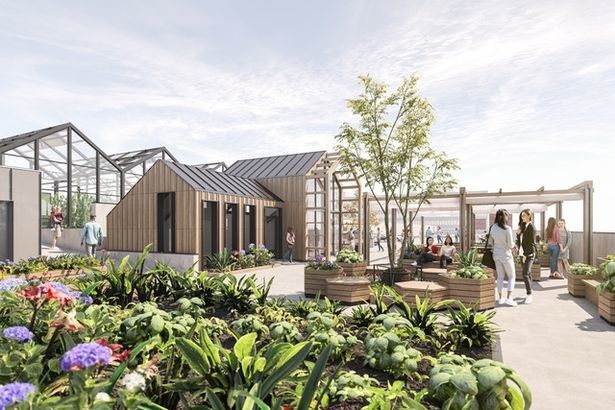
British authorities considers plan for a farm on top of multistory car park in Birmingham

If approved, the farm would provide locally-produced food for the community, promote the benefits of sustainable farming, and help to reduce carbon emissions. (Urban Design Hub/File)
Short Url
Updated 14 March 2023
Follow

British authorities considers plan for a farm on top of multistory car park in Birmingham

  • The proposal by Slow Food Birmingham aims to promote hyperlocal food production and the productive repurposing of urban spaces
  • Slow Food, a global network that began in Italy in 1986 to preserve and promote local, traditional food, is in the process of building a network in Saudi Arabia

LONDON: Birmingham City Council is set to consider a plan to build an urban farm on the roof of a multistory car park in the British city.

The proposal was put forward by Slow Food Birmingham, a grassroots organization that promotes hyperlocal food production, with the aim of “turning gray space to green, productive space” that benefits the local community.

“We hope that the project will foster valuable conversations about the city’s food system and create a model for change, championing hyperlocal food production and education,” the organization said.

It is part of Slow Food, a global initiative founded in 1986 in Bra, northeastern Italy, that promotes localized food production and traditional cooking. Through its worldwide network of community-focused projects it works to preserve local food cultures and traditions, counteract the rise of fast food, and boost awareness and interest in what people eat and where it comes from.

In Saudi Arabia, Slow Food is in the process of creating a network of communities in all 13 regions of the country, with the objective of safeguarding and promoting traditional Saudi food heritage.

In Birmingham, meanwhile, in addition to the urban farm proposal, the local Slow Food group’s plans for the Jewellery Quarter, a major district in the city, which is located in England’s West Midlands region, include greenhouses, a communal space and garden, an educational center and a cafe.

If approved, the farm would provide locally-produced food for the community, promote the benefits of sustainable farming, and help to reduce carbon emissions.

“Our proposal is part of a system rethink designed to provide food security as we cope with a changing world,” said Kate Smith, Slow Food Birmingham’s founder and projects lead.

“One of the goals is to be able to show people that we are in the middle of a city and we are growing food 12 months of the year.

“We want to be bringing the community in and giving them an opportunity to get their hands dirty, talking about what food they can buy and how they might cook it.”

Urban Design Hub, which produced the plans for the project, said it hopes it is given a green light by the council and can function as a “catalyst for reconnecting the local community to healthier and locally grown food.”

Smith added that the initiative, described as the first of its kind, might serve as a model for other communities, not only in the UK but worldwide, and expressed hopes that her group will be able to teach others how to replicate it in the near future.

A Cup of Gahwa
The taste and traditions of Saudi coffee

Enter


keywords

Cambodia takes back looted historic artifacts handled by British art dealer

Updated 28 February 2026
Follow

Cambodia takes back looted historic artifacts handled by British art dealer

  • The objects were returned under a 2020 agreement between the Ministry of Culture and Fine Arts and the family of the late Douglas Latchford, a British art collector and dealer who allegedly had the items smuggled out of Cambodia

PHNOM PENH, Cambodia: Cambodian officials on Friday received more than six dozen historic artifacts described as part of the country’s cultural heritage that had been looted during decades of war and instability.
At a ceremony attended by Deputy Prime Minister Hun Many, the 74 items were unveiled at the National Museum in Phnom Penh after their repatriation from the United Kingdom.
The objects were returned under a 2020 agreement between the Ministry of Culture and Fine Arts and the family of the late Douglas Latchford, a British art collector and dealer who allegedly had the items smuggled out of Cambodia.
“This substantial restitution represents one of the most important returns of Khmer cultural heritage in recent years, following major repatriations in 2021 and 2023 from the same collection,” the Culture Ministry said in a statement. “It marks a significant step forward in Cambodia’s continued efforts to recover, preserve, and restore its ancestral legacy for future generations.”
The artifacts were described as dating from the pre-Angkorian period through the height of the Angkor Empire, including “monumental sandstone sculptures, refined bronze works, and significant ritual objects.” The Angkor Empire, which extended from the ninth to the 15th century, is best known for the Angkor Wat archaeological site, the nation’s biggest tourist attraction.
Latchford was a prominent antiquities dealer who allegedly orchestrated an operation to sell looted Cambodian sculptures on the international market.
From 1970 to the 1980s, during Cambodia’s civil wars and the communist Khmer Rouge ‘s brutal reign, organized looting networks sent artifacts to Latchford, who then sold them to Western collectors, dealers, and institutions. These pieces were often physically damaged, having been pried off temple walls or other structures by the looters.
Latchford was indicted in a New York federal court in 2019 on charges including wire fraud and conspiracy. He died in 2020, aged 88, before he could be extradited to face charges.
Cambodia, like neighboring Thailand, has benefited from a trend in recent decades involving the repatriation of art and archaeological treasures. These include ancient Asian artworks as well as pieces lost or stolen during turmoil in places such as Syria, Iraq and Nazi-occupied Europe. New York’s Metropolitan Museum of Art is one of the prominent institutions that has been returning illegally smuggled art, including to Cambodia.
“The ancient artifacts created and preserved by our ancestors are now being returned to Cambodia, bringing warmth and joy, following the country’s return to peace,” said Hun Many, who is the younger brother of Prime Minister Hun Manet.