

AlUla Camel Cup set to launch with revamped venue, offerings

1 / 2
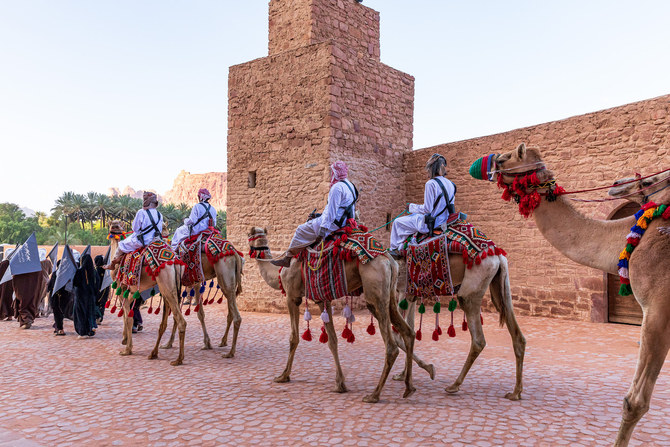
The AlUla Camel Cup (March 14-17) was preceded by a parade on Saturday. (RCU)
2 / 2
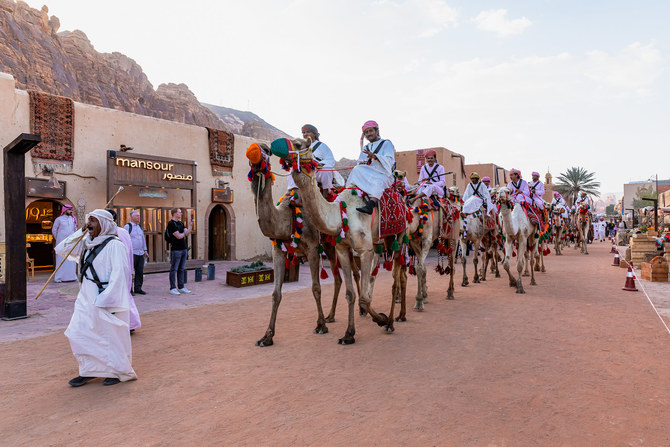
The AlUla Camel Cup (March 14-17) was preceded by a parade on Saturday. (RCU)
Short Url
Updated 13 March 2023
Follow

AlUla Camel Cup set to launch with revamped venue, offerings

  • Details of AlUla Camel Racing Field unveiled ahead of March 14-17 event
  • Champion of champions to be crowned at inaugural cup competition

ALULA: The countdown has begun for the inaugural AlUla Camel Cup, the pinnacle of camel racing, as details of the revamped AlUla Camel Racing Field were unveiled along with a fashion guide, retail offerings, and dining outlets.

Held under the patronage of Crown Prince Mohammed bin Salman, chairman of the Royal Commission for AlUla, more than 40 of the region’s finest racing camels have qualified for the tournament.

Phillip Jones, the RCU’s chief tourism officer, said: “Much time and effort has been spent ensuring that the AlUla Camel Cup has a venue showcasing the stunning backdrop of AlUla in which the pinnacle of camel racing will be held.

“As a place that helped enhance and expand Saudi Arabia’s traditional pastime of camel racing across the region, the AlUla Camel Racing Field is an important venue in the history of the sport. The AlUla Camel Cup now marks another milestone moment in both the AlUla Camel Racing Field and camel racing’s glorious journey.

“We look forward immensely to Tuesday for the beginning of what will be a major highlight in Saudi Arabia’s sporting calendar,” he added.

Organized by the RCU – as part of the AlUla Moments calendar – in collaboration with the Saudi Camel Racing Federation, a champion of champions will be crowned at the refurbished, state-of-the-art AlUla Camel Racing Field.

The AlUla Camel Racing Field now has a total area of approximately 20 square kilometers, with a capacity of 900 people. The main track is 6 sq km in size, with the length of the racetrack 8,140 meters, and the width ranging from 20 to 38 meters. There are five turns and two sides of balustrade running for 16 km.

SCRF executive director, Mahmoud Suleiman Albalawi, said: “The revamped AlUla Camel Racing Field, a venue of historical significance in our illustrious sport, is truly befitting a tournament of the magnitude of the AlUla Camel Cup.

“As well as being the pinnacle for the elite of camel racing, the AlUla Camel Cup helps us introduce our sport to a wider audience, ensuring that our revered national pastime remains attractive and exciting to new generations.”

Advanced technology has been used to ensure the safety and efficiency of the races while still preserving the sport’s cultural and traditional values.

The four-day event will offer a heritage village featuring a range of local Saudi fashion, jewelry, and homeware and the Madrasat Addeera store will be selling handmade crafts and jewelry from local artisans.

Al-Qafila market will offer locally made souvenirs and handicrafts, and immersive experiences such as watching live camels and learning about their feats and attributes, while painting camel monuments, henna, calligraphy, and sand art areas will also be available, plus a variety of dining options.

The activities follow on from a parade held on Saturday which featured 15 camels and a group of performers in traditional Saudi attire.

One of the performers showcased Alheda’a, the oral tradition of calling camel flocks. The ancient art is inscribed in the UNESCO list of Intangible Heritage of Saudi Arabia. The camel parade aimed to highlight how the cup was bringing together ancient and modern, sport and culture, elemental and opulent, in the Kingdom’s sporting calendar.

AlUla Camel Cup is one of the flagship sporting occasions of the AlUla Moments 2023 calendar of events and festivals, which includes five major festivals and six marque events.

So far this year, AlUla has hosted The Custodian of the Two Holy Mosques Endurance Cup, the AlUla Trail Race, and the Saudi Tour.


Why 2026 could be Saudi Arabia’s most important sporting year yet

Updated 01 January 2026
Follow

Why 2026 could be Saudi Arabia’s most important sporting year yet

RIYADH: As Saudi Arabia accelerates toward hosting some of the world’s biggest sporting events, the focus has shifted from spectacle to systems.

Under Vision 2030, building long-term capability in event-hosting has become as important as attracting the events themselves. And 2026 may be the year where that strategy is comprehensively tested more than ever.

The calendar alone hints at its significance. A mix of returning global fixtures and first-time arrivals will have Saudi Arabia host a near-continuous run of major events across multiple sports, creating an opportunity to refine and scale its hosting model.

The year begins with the Dakar Rally, which returns to Saudi Arabia for a seventh edition. More than 900 drivers will traverse over 7,000 km of desert terrain in one of the most logistically demanding events in world sport.

Shortly after, attention shifts to Al-Inma Stadium, with the Spanish Super Cup bringing Barcelona, Athletic Bilbao, Atletico Madrid and Real Madrid to Jeddah.

A new arrival will make its way to Saudi Arabia just a day prior: the AFC U-23 Asian Cup, a key tournament on the road to AFC Asian Cup 2027.

Sixteen nations will compete, offering a rehearsal not just for players, but also organizers and infrastructure ahead of the Kingdom’s first continental flagship event.

January 2026 also marks a milestone beyond the confines of traditional sport. The WWE Royal Rumble — part of the WWE’s “Big Four” Premium Live Events — will be staged outside of North America for the first time.

Riyadh is set to be the stage for the larger-than-life professional wrestling characters that have wowed Saudi fans on many an occasion in recent years.

The remainder of 2026 continues in similar fashion. Events confirmed include the Formula 1 Saudi Arabian Grand Prix, Formula E, AFC U-17 Asian Cup, eSports World Cup, WTA Finals, Gulf Cup and the Asian Indoor and Martial Arts Games.

These events form a calendar that includes elite competition, youth development, mass participation and digital sport.

What makes 2026 particularly important — despite the presence of much larger events in the following years, such as the AFC Asian Cup, the Asian Games and the FIFA World Cup — is not the scale of individual events, but the volume and variety.

These events will allow Saudi Arabia to deepen its operational expertise and test its ability to deliver consistently across a range of disciplines. This approach aligns with the Kingdom’s broader national objectives.

According to the Vision 2030 website, adult participation in physical activity for at least 150 minutes a week reached 59.1 percent in 2025, breaking past the 2027 target.

Also, children’s participation has risen to 19 percent, speeding past the 2029 goal by four years. Major events, in this context, are not endpoints, but catalysts for the rapid growth on show.

That is why tournaments such as the AFC U-23 Asian Cup and AFC U-17 Asian Cup sit alongside the global spectacles on the 2026 calendar.

More than just a way of bringing as many events as possible to the Kingdom, they represent pathways for athletes, fans, volunteers and organizers to engage with sport at every level, while contributing to Saudi Arabia’s growing identity as a capable and credible host.

By the time the Kingdom turns its full attention to the AFC Asian Cup 2027 — just over 12 months from now — much of the groundwork will have already been laid.

In that sense, it is clear to see that 2026 will not just be about headlines, but also building the Kingdom’s readiness for the sheer variety of events to come.