



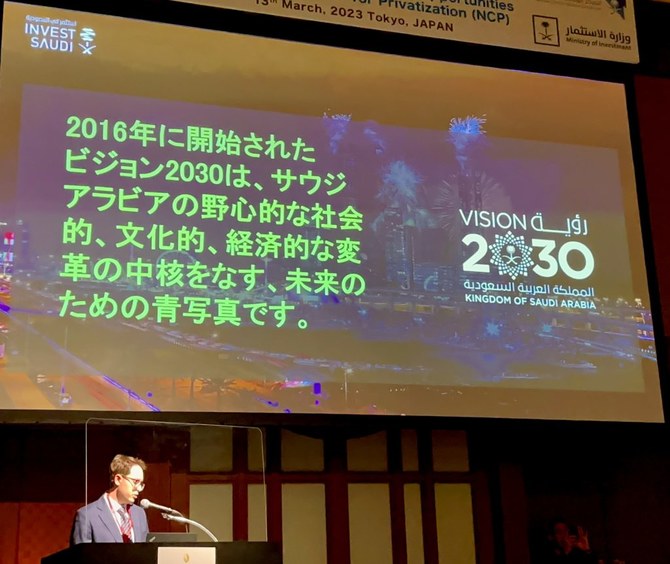


TOKYO: The Japan Cooperation Center for the Middle East (JCCME) held a business forum on investment opportunities with the Saudi Arabian National Center for Privatization (NCP) in Tokyo on Monday.
The event featured Mohannad Basodan, the CEO of NCP; Hani Alsaigh, the NCP’s Vice President, Strategic Marketing and Knowledge Management; Salman Badr, Executive Vice President of the NCP’s Infrastructure Advisory; and Mohammed Al-Dahlawi, Saudi’s Ministry of Investment’s Representative in Japan.
The NCP’s Privatization Program aims to enhance the role of the private sector in provision of services and the availability of government assets.
The Saudi representatives explained that the Saudi market is “ripe for investments,” adding: “There is a strong commitment towards privatization that comes from the KSA leadership. Laws and regulations are geared to safeguard investors rights as well as a clear ecosystem and process put in place to facilitate and push through transactions.”
They noted that there are over 200 projects currently in the pipeline and 300 future opportunities.
“The pipeline has been tested, with about 30 projects awarded and closed to date and multiple success stories,” they said, noting that Saudi Arabia is witnessing significant growth and has excellent credit ratings.
The Saudi side also noted that “in Saudi Arabia we have the largest, broadest, and most successful Privatization and PPP program in the Middle East, and it is a top priority for the Saudi government. The NCP Board includes 11 ministers responsible for all the main economic and infrastructure sectors.”
“Saudi Arabia has long welcomed international investors, building on our experience in oil and petrochemicals. Our sophisticated local banks actively participate in financing PPPs alongside international lenders. There are also strong local players in construction, as well as considerable financial liquidity in the market. These provide a pool of potential consortium partners, sub-contractors, and financial investors.”
The Japanese representatives included Tamura Mitsuo, Managing Director of the Middle East Cooperation Center, and Fujiwara Toshiharu, the International Strategic Information Department General Manager at Mizuho Bank.
Fujiwara noted that “Saudi Arabia has the largest population and economy in the Gulf region and the two largest religious holy sites of Islam. Crown Prince Mohammed bin Salman is garnering increasing support from the people, especially the younger generation, and various economic reforms are being implemented, such as the Giga Projects, the Saudi Green Initiative, and the measures to attract international companies to relocate regional headquarters to Saudi Arabia.”
“One of the key drivers for privatization at the national level is a Housing Program, targeted improvement in service quality and reduction in and improving quality of life for citizens. The government is open to various forms of private sector investment such as full/partial assets sale, IPOs, management buyouts, public private partnerships (PPPs) and outsourcing.”
“PPPs are being increasingly used as a means of attracting more private investment into areas of the Saudi Arabian economy that have traditionally been financed by the public sector. PPPs form a key component of Saudi’s National Transformation Program which is also one of the key programs under Vision 2030, aiming to increase the percentage of private sector from 40% of GDP in 2016 to 65% by 2030.”
“The PPP model provides an important vehicle for both international and regional investors and developers to take advantage of the potential, especially in the water, transportation, education and healthcare sectors of the Saudi market.”
He explained that the benefits of private sector participation include availability and quality of service; increasing efficiency and effectiveness; enhancing the efficiency of the legislative and regulatory environment; and financial sustainability.


