Pakistani filmmakers showcase talent at international women film festival in Islamabad

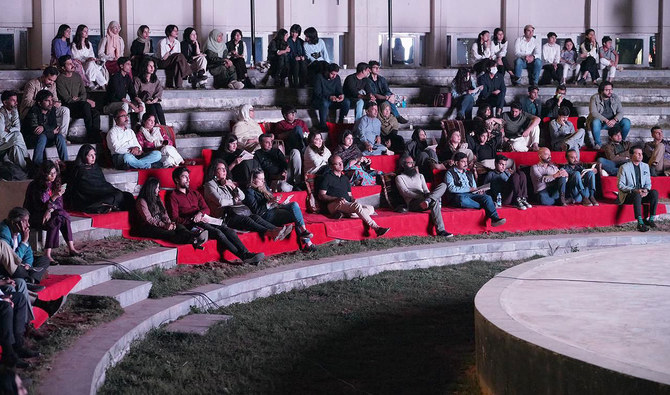
People watch a large screen displaying a short film on day one of the seventh Women's International Film Festival in Islamabad on March 11, 2023. (Photo courtesy: WIFF)
Short Url
Updated 13 March 2023
Follow

Pakistani filmmakers showcase talent at international women film festival in Islamabad

  • Two-day film festival features short films by filmmakers from Argentina, US, U.K, Iran and others
  • Festival will screen short films in Pakistan’s Karachi and Lahore cities on March 16, 18 respectively

ISLAMABAD: Pakistani women filmmakers were among a host of others whose films were showcased at the 7th Women International Film Festival in Pakistan’s capital, Islamabad, on Sunday. 

The two-day film festival, which began on Saturday and concluded on Sunday, featured 18 short films by filmmakers from Argentina, Belgium, Croatia, France, Germany, Iran, Italy, Turkiye, UK and the US Out of the 18 short films, two were by Pakistani filmmakers that were also screened at the festival. 

The Pakistani films included “Baira Gharakh” by renowned director Mehreen Jabbar and “Awaaz” by Halimah Tariq. However, the third Pakistani submission, titled “My Mother’s Daughter” by Ahmen Khawaja and Mariam Khan, was stopped from being screened by the censor board. 
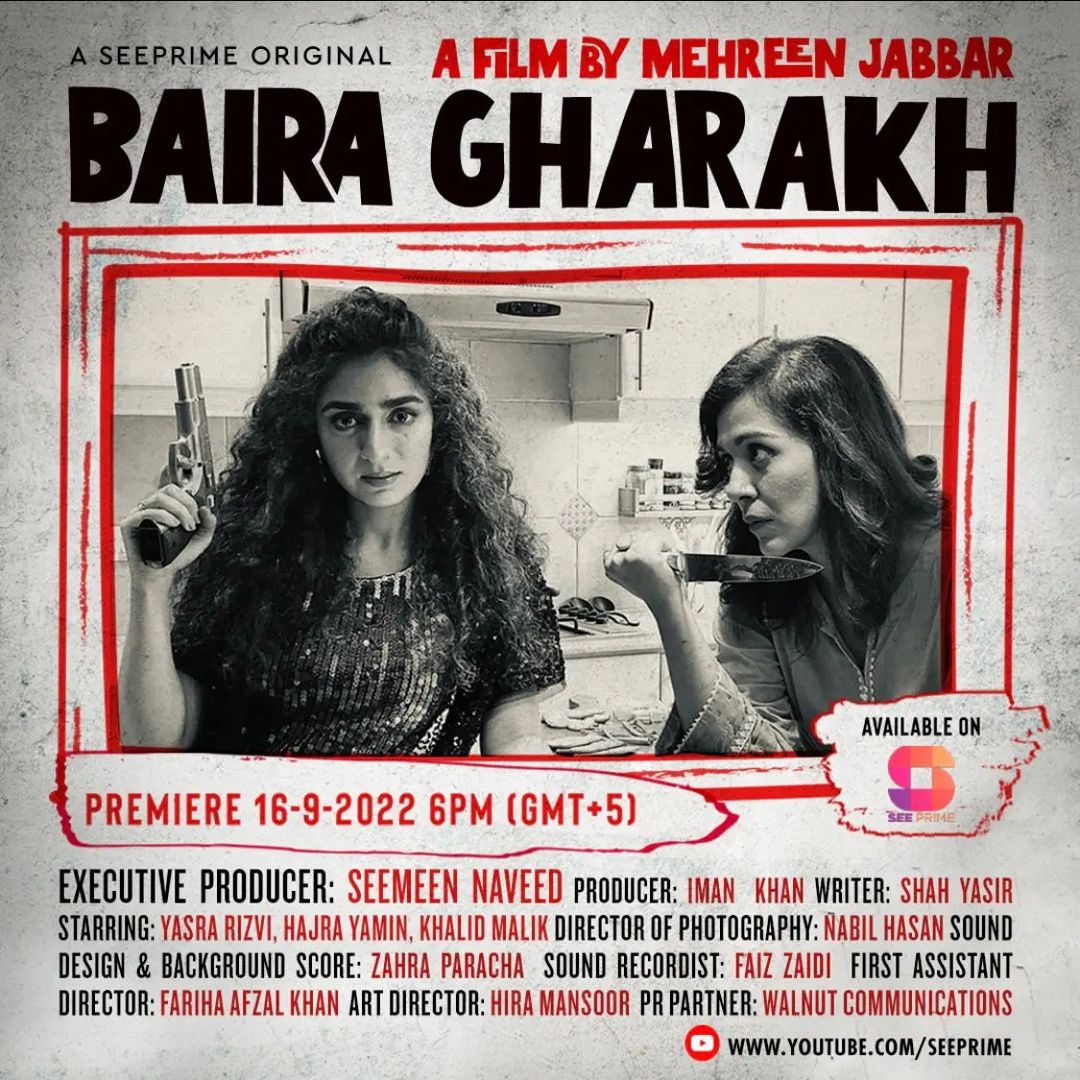


The picture shared by @yasrarizvi on Instagram on September 13, 2022, shows movie posture “Baira Gharakh” by renowned director Mehreen Jabbar. (@yasrarizvi/Instagram)

The short film revolved around the controversial topic of child marriage and featured the story of a Christian girl’s forced conversion. The censor board termed the movie’s plot “propaganda against Pakistani culture and society.”

“We do receive lesser films from Pakistani filmmakers [to showcase in the festival] but we continue to encourage through competition and workshops, so more and more Pakistan women can take part in it,” Madeeha Raza, the festival’s founder, told Arab News on Saturday.

The aim of the event is to promote female filmmakers by building and uniting the next wave of talent and connecting the film community with one another, Raza said. 

“It is evident that we need more such opportunities for women so they can take their stories to the screen and share them with the community,” she added. 


Nicholas Galey (center), French ambassador to Pakistan, and Madeeha Raza (second right), festival's founder, pose for a picture along with other organizers at the 7th Women International Film Festival in Pakistan’s capital, Islamabad, on March 11, 2022. (Photo courtesy: WIFF)

Talking about the ban on screening of “My Mother’s Daughter” the organizer said it is “very unfortunate” that the censor board discourages much-needed voices Pakistan ought to have.

“It’s sad that this festival was able to screen films from France and Iran but we could not screen one of our own films,” she added.

Prashant Thaker, the co-writer of one of the entries from the US, titled “The woman under the tree” hoped more female filmmakers from Pakistan would get the opportunity to showcase a “true representation” of the country.

The 30-minute film is based on a homeless woman, was directed by India’s notable director, Karishma Kohli, and screened during the opening day of the film.

“In this festival, I am happy that it is female-driven,” Thaker said. “I think there is a lot of room at the table for a woman and I hope this trend continues.”

The festival will continue to screen short films in Pakistan’s Karachi and Lahore cities on March 16 and March 18, respectively.


Pakistan joins 22 Muslim states, OIC to condemn Israeli FM’s visit to Somaliland

Updated 08 January 2026
Follow

Pakistan joins 22 Muslim states, OIC to condemn Israeli FM’s visit to Somaliland

  • Israeli Foreign Minister Gideon Saar visited breakaway African region of Somaliland on January 6
  • Muslim states urge Israel to withdraw Somaliland recognition, respect Somalia’s sovereignty

ISLAMABAD: A joint statement by Pakistan, 22 other Muslim states and the Organization of Islamic Cooperation (OIC) on Thursday condemned Israeli Foreign Minister Gideon Saar’s recent visit to Somaliland as a violation of the African nation’s territorial integrity and sovereignty.

Saar’s visit to Somaliland capital Hargeisa on Jan. 6 followed Israel’s move last month to recognize Somaliland, a breakaway region from Somalia, as an independent country. The move drew a sharp reaction from Muslim states, including Pakistan, who said it was in contravention of the UN Charter and international norms. 

Several international news outlets months earlier reported that Israel had contacted Somaliland over the potential resettlement of Palestinians forcibly removed from Gaza. Muslim countries fear Israel’s recognition of the breakaway region could be part of its plan to forcibly relocate Palestinians from Gaza to the region. 

“The said visit constitutes a clear violation of the sovereignty and territorial integrity of the Federal Republic of Somalia, and undermines established international norms and the United Nations Charter,” the joint statement shared by Pakistan’s foreign office, read. 

The joint statement was issued on behalf of 23 Muslim states, including Saudi Arabia, Bangladesh, Pakistan, Egypt, Iraq, Iran, Palestine, Jordan, Kuwait, Türkiye, Oman and others. 

It reaffirmed support for Somalia’s territorial integrity and sovereignty, pointing out that respect for international law and non-interference in the internal affairs of sovereign states was necessary for regional stability. 

“Encouraging secessionist agendas are unacceptable and risk exacerbating tensions in an already fragile region,” the statement said. 

The joint statement urged Israel to revoke its recognition of the breakaway region. 

“Israel should fully respect Somalia’s sovereignty, national unity and territorial integrity and honor its obligations in compliance with international law, and demand immediate revocation of the recognition issued by Israel,” the statement read.

Somaliland broke away from Somalia unilaterally in 1991 as a civil war raged in the country. Somaliland has its own constitution, parliament and currency, a move that has infuriated Somalia over the years as it insists the region is part of its territory.