

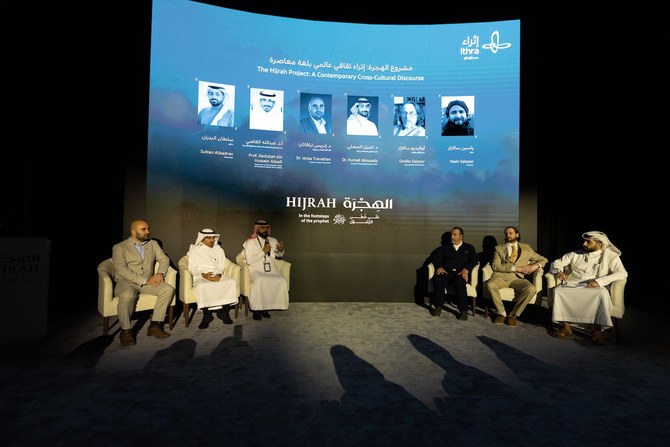
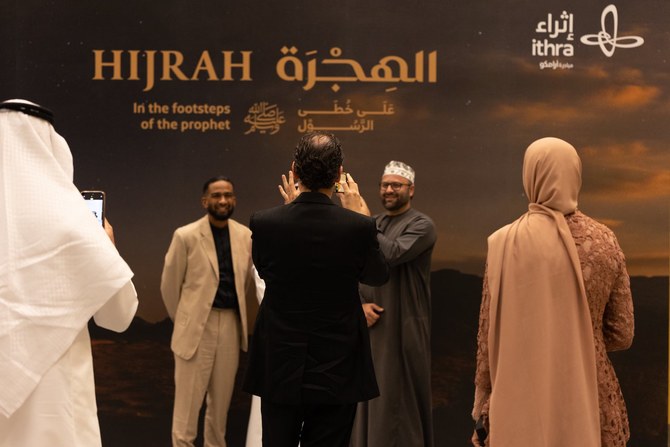


JEDDAH: Visitors gathered on Thursday at the Islamic Arts Biennale for the world premiere of Ithra’s “In the Footsteps of the Prophet” documentary film.
Directed by award-winning filmmaker Ovidio Salazar, the production is the first-ever cinematic account of the Hijrah, Prophet Muhammad’s eight-day journey from Makkah to Madinah in A.D. 622. It captures the moment that marked the start of the spread of Islam.
Dr. Abdullah Alkadi is a man with a mission. For the last 40 years, he has been focused on filling in the blanks to track the route that Prophet Muhammad walked many centuries ago.
Armed with a pair of binoculars, a wristwatch and various smart gadgets to measure coordinates based on a detail mentioned in a line of text, the professor of urban and regional planning at Imam Abdulrahman Bin Faisal University has studied what walking that path entailed.
He consulted several respected experts in the field, and used the new findings to paint an accurate and realistic picture that gives today’s audience a deeper connection to something that occurred many centuries ago.
Alkadi said: “My life has been determined by my quest to study and experience, not only the exact route the prophet and his companions took across the desert, but also the wider story, life, and legacy of this journey.”
The documentary, much like the book, follows the narrative in sections. Each of the Hijrah’s eight days is presented like a chapter.
The story of the great migration that Prophet Muhammad undertook has been one of the region’s most continuous narratives for the past 1,400 years, a tale that has been fondly repeated by Muslims and known by non-Muslims for centuries.
The significance of the Hijrah can be defined as the transition from the practice of Islam as an act of worship to a way of life, and Ithra’s exhibition, the book, and now the film, presents that journey to modern audiences.
On launching the book in 2022, Dr. Idries Trevathan told Arab News: “The Hijrah route is inaccessible by car. You literally have to walk it. It goes through meandering little valleys, and it’s very rocky.
“I think a lot of you when you think of Hijrah abroad, people outside Saudi Arabia think of the sand dunes. It’s not. It’s mountainous and it’s really difficult terrain.”
The exhibition was presented in collaboration with the National Museum of Saudi Arabia in Riyadh, the House of Islamic Arts in Jeddah, the King Abdulaziz Complex for Endowment Libraries in Madinah, and Turquoise Mountain, a prince of Wales charity supporting arts and heritage in the Middle East.
Ithra’s Hijrah started to come to life about four years ago, first with the exhibition, then the book and documentary.
Salazar said: “With Prof. Alkadi acting as guide, we retraced the path taken by the Prophet Muhammad on his monumental journey.
“We intended to visualize details of a cultural memory essential to understanding Islam’s foundation story. In this sense we made it as a deep map of the route — not just a two-dimensional view of what is there, but rather the why and how of it.
“In this way, it attempts to ‘map the unmappable’. I hope that ‘In the Footsteps of the Prophet’ will help form a deeper understanding and start a conversation inviting everyone to reflect on the meaning of migration itself.”
Jassim Al-lawati, who was the Omani-English sound recordist and drone operator for the documentary, told Arab News that the schedule was a tough but rewarding one.
He said: “I think we all knew it was going to be really very tough. I’ve done lots of films and lots of long-form TV shows but this was a little bit different.
“We were all invested in it heavily, and spiritually. There was the local team, the logistics team. I think it must have been 16, maybe 18 people. People stayed for the whole month.
“It was eight days for the prophet to walk; it took us about four weeks with all the equipment and the charging.
“We went in January, so the weather was fine. I think probably most of the people you speak to, I think shooting the cave, it was the hardest day of their life. We had so much equipment, we had to walk all the way up there and film on the way up.”
Al-lawati called it the ultimate project, and it was one that helped him connect with his “Arab side” following years of living in London.
“It felt like it was the peak of your career, and maybe life,” he said.
The documentary is not meant to cater to only Muslims; it is something Ithra hopes transcends space and spirituality.
Christopher Wilton-Steer attended the opening night screening as a longtime friend of Salazar and the film crew.
He told Arab News: “I was reflecting on what this [film] would mean to a Muslim versus a non-Muslim. I guess as a non-Muslim I’m looking at this as a sort of historical journey.
“This is a piece of history; unearthing this route, looking at the milestones along it. How the prophet took this journey, what he encountered on his way, the tribes that he met and the geological features. So for me, I'm looking at it purely as a sort of historical piece of research.
“I didn't know anything about this route before. I kind of had a vague idea about this Makkah and Madinah journey but I had no idea about this route. It surprised me that it was eight days and that the guys took some five weeks, from what I understand, to get to walk that whole path.
“I think the thing that’s probably surprised me the most is that these are stories that we know from books we’ve read that are thousands of years old, but nobody has ever charted this before and actually done the research using the technology to do it.
“I think when you can connect this sort of story with the on-the-ground reality, then there’s something amazing that happens that connects it in a way that makes it more than just something that happened in the past. You can kind of see it, touch it and feel it today.”
Medina Trevathan, an artist who has participated at the biennale by hosting workshops and selling items, said: “I’m really excited to see the film in that visual format and I’ve been very lucky as my brother gifted me the book and I’ve been kind of perusing it throughout the trip and the images are breathtaking.”
“Hijrah: In the Footsteps of the Prophet” exhibition at Ithra’s Great Hall, Dhahran, was curated by the team of in-house experts led by Dr. Trevathan, the curator of Islamic art at Ithra, and Dr. Kumail Almusaly, the curator of international exhibitions.
The collaboration with Alkadi presents a first-of-its-kind holistic and immersive experience of the prophet’s journey.
Nora Alzamil, head of programs at Ithra, said: “The Hijrah project showcases over two decades of research brought forth by a world-renowned team of subject matter experts in various fields.
“A first endeavor of its kind, The Hijrah project by Ithra sheds new light onto one of the most important journeys which has impacted civilization’s culture, heritage, and artistic vision to this day.”
A virtual reality experience of the Hijrah exhibition, using cutting-edge VR technologies, will also be made available at the Islamic Arts Biennale in Jeddah.
The guided tour will transport visitors to the Hijrah exhibition at Ithra and will be available and accessible through Ithra’s website for the duration of the exhibition’s run.
Farah Abushullaih, the head of the museum at Ithra, told Arab News: “Inshallah, the Hijrah film is going to be premiering in Ithra as part of the Hijrah exhibition.
“And after that it’s going to be traveling with the Hijrah exhibition to Riyadh and then hopefully to Madinah in the future. After that, it will go internationally, along with the Hijrah exhibition, touring the world.”


