

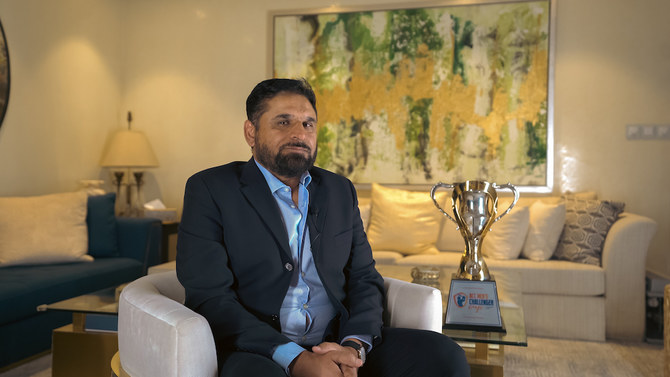

RIYADH: High on confidence after winning the ACC Men’s Challenger Cup 2023 in Bangkok last Sunday, the Saudi Arabian national cricket team’s head coach has said the plan is now to qualify for the World Cup, and not just win regional tournaments.
Saudi Arabia won the inaugural edition of the ACC’s tournament after beating Bahrain by 10 wickets in the final, with the men in green maintaining a perfect record of five wins from five matches along the way.
In an exclusive interview with Arab News, Kabir Khan shared the winning strategy and game plan that helped to win Saudi its first-ever international cricket trophy.
"First of all, I would like to thank our federation, the Saudi Arabian Cricket Federation, the Ministry of Sports and the Saudi Olympic Committee for giving us a chance and providing us with the funds and the facilities that we needed to become the champions,” said the coach.
“It took over one year of hard work by the federation, our top officials and the coaching staff to build a team and get it to a level where they could be champions. The main idea was to collect the top talents from all over the Kingdom. We searched for the players and organized a lot of different talent hunts for juniors and seniors, which gave us a lot of players to pick up in the national squad.”
Significant resources were spent in the talent hunt that helped in the selection of the squad and in building the faith in them to be successful.
“And you can see the results now,” said Khan. “But that’s not the end of the day. It’s just the start of a new journey. We are planning to qualify for the World Cups, not just win tournaments.”
Spelling out the plans, and the targets for the team in terms of competitions and rankings, Khan said that the main thing is to keep on improving.
“At one meeting, our Chairman Prince Saud bin Mishal and I were talking to each other, and we said, ‘What’s next?’ And all of us agree that this happiness was only for one day, and we have to start the new journey and keep it up,” said the Saudi coach.
He added that there is no room for complacency in cricket.
“We have to work hard, and progress. We have to achieve our goals,” said Khan. “This is not the end of it. It’s only the start, and the target is to qualify for 50-Overs World Cup, qualify for the T20 World Cup, and get the ranking to at least below 20. That is our target for the next two years.”
Saudi Arabia is currently ranked 33 in the ICC T20 ranking and is working to get an ODI ranking.
The 2023 ACC Men’s Challenger Cup acts as a pathway to September’s 2023 Asia Cup in Pakistan, which itself is a preparatory tournament for the 2023 ICC Cricket World Cup in India starting in October.
Before that, Saudi Arabia will now enter the ACC Premier Cup, to be played in Nepal next month.
On plans to reach the Asia Cup, the coach said: “We have already started planning for it. We know that it’s not going to be an easy task. The team is doing well. We know that they are capable of winning upcoming matches. There’s no doubt about it. Other teams are more experienced. We haven’t got that experience, but we have got the passion that goes on our side
“Our team is much more passionate, and if they play the way they played in the ACC Men’s Challenger Cup, I am very hopeful that they can win that Premier Cup in Nepal to qualify for the Asia Cup,” he added.
Khan said that the federation’s talent hunt was executed in stages. “First, we needed to select a bunch of players that we thought were talented enough and then obviously process them over time and get them fitter,” he said.
“The main issue in the first few tournaments that we played was our fitness and the mindset of the players,” said Khan. “We worked a lot on that. Saudi Arabia is a huge country and it’s not easy to collect all the players together in one place as they live and work in different cities. We started coaching them online, with them playing cricket three days a week, training and giving us the report. And then at the end, when we were able to bring them all together for the camp, they were more or less ready to play. We lost some senior players who were performers, but they couldn’t maintain their fitness.
“Thus we got the final team, which we thought was fit enough, and the next step was to bring them together with a champion’s mindset because we played a lot of tournaments, but we always just participated. We never went into tournaments to be champions, and for that, the mindset has to be changed in the way they play and behave on the ground,” he said.
“As a coach, I started believing in them and teaching them how to believe in themselves, and to believe in the team and the process,” said Khan, who joined the Saudi national cricket team in 2021.
Khan was chosen to lead the team by the SACF due to the wealth of experience he amassed over a 15-year coaching career, as he previously played an instrumental role in leading the Afghanistan national team to its highest international ranking.
“Now our fitness standards are touching most of the international cricket teams in the world. So that’s the biggest change,” he said.
“The first thing was to make them believe in their abilities, to make them brave cricketers,” said Khan. “After proper coaching, they played with a positive mindset and won the trophy.”
On the remarkable progress in cricket in Saudi Arabia, the coach said: “We have to thank the management, the chairman and the CEO who trusted in me. We had lost all the tournaments we played in previously. But I kept on telling them and they believed in me. Without their help, I could not have done it. We were not top performers when I came in, but we processed it. The timing was right, we got the best out of the players and selected them in the team.
“I had full support from the SACF chairman and the CEO. They gave me full authority to select the team and carry out the camps that helped a lot,” said the coach.
Khan said that targeting local Saudi talent is one of the long-term goals.
“We want to go to the kids,” he said.
The plan, he explained, is to target kids as young as 7 years old and train them “four, five years to start playing the game, so that they become decent enough for international cricket and represent us at junior level in U-16 and U-19 cricket first, and then slowly progress to join the national squad.”


