PENAJAM PASER UTARA, Indonesia: Orange-red ground has been broken in the jungle of East Borneo, where the Indonesian government has begun construction of its new capital city.
Officials promise a “sustainable forest city” that puts the environment at the heart of development and aims to be carbon-neutral by 2045. But the project has been plagued by criticism from environmentalists and Indigenous communities, who say it degrades the environment, further shrinks the habitat of endangered animals such as orangutans and displaces Indigenous people that rely on the land for their livelihoods.
Indonesia began construction of the new capital in mid 2022, after President Joko Widodo announced that Jakarta — the congested, polluted current capital that is prone to earthquakes and rapidly sinking into the Java Sea — would be retired from capital status.
Plans for the new capital — about twice the size of New York City — are grandeur. Officials tout the creation of a futuristic green city centered on forest, parks and food production that utilizes renewable energy resources, “smart” waste management and green buildings.
“We have to think beyond what is happening today and try to tackle (things) that are futuristic,” said Bambang Susantono, chairman of Nusantara National Capital Authority, speaking about the city’s design and ability to answer future challenges.
Digital renderings shared by the government show a city surrounded by forest, with people walking on tree-lined sidewalks and buildings with plant-covered rooftops surrounded by walking paths, ponds, clean creeks and lush forest.
Building architecture is inspired by modern urban towers combined with traditional Indonesian architecture: the presidential palace in the shape of a garuda — a mythical bird and the national symbol of Indonesia — and other buildings that give a stylistic nod to traditional architecture used by Indigenous groups around the archipelago.
In its current state, the new city is far from the tidy finish presented by its planners, but there is progress. Basuki Hadimuljono, Indonesia’s minister for public works and housing, said in February that the city’s infrastructure is 14 percent completed.
Some 7,000 construction workers are clearing, plowing and building the first phases of the site. Worker dormitories, basic roads and a helipad are already being used. Construction of key buildings — such as the presidential palace — is expected to be completed by August 2024.
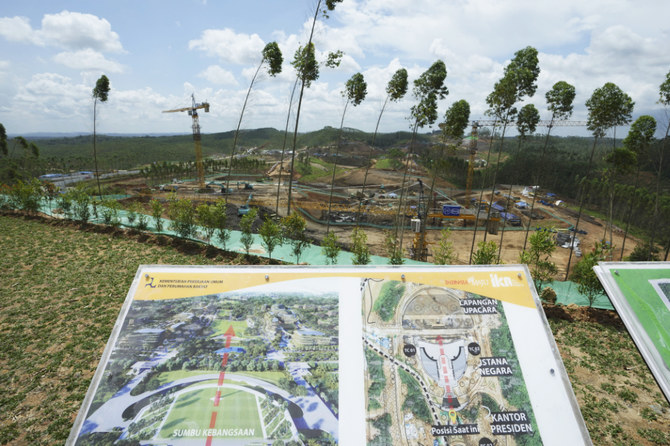
Sites visited by The Associated Press in early March showed mounds of freshly turned earth with excavators and cranes around them. At least one site has a sign with a QR code that visitors can scan to see 3D visuals of what the area will look like when finished; others have printed signboards showing what’s to come.
The government has said it’s working to be considerate of the environment. Signs of a more-conscious approach to construction are visible: patches of trees remain fenced-off to protect them from machinery, a plant nursery has already started for the replanting process officials promise and industrial forest surrounds the site.
But with construction set to ramp up this year, environmentalists warn building a metropolis will speed up deforestation in one of the world’s largest and oldest stretches of tropical rainforest. Forests, called the lungs of the world, suck in planet-warming carbon dioxide from the atmosphere and are home to numerous wildlife species. The island has already been compromised by palm oil plantations and coal mines.
Dwi Sawung, an infrastructure specialist at the Indonesian Forum for Living Environment, an environmental nongovernmental organization that has been monitoring the new capital project, said that the government’s plans lack consideration of the region’s unique wildlife like orangutans and sun bears. The new city cuts through an important animal corridor.
“The animals should be relocated first and then build the construction,” he said. “But since they need to hurry up, they just built the area without relocating the animals first.”
Experts have also expressed concerns about how the new capital will be powered. While the government vows the city will rely on a “smart energy” system, groups worry that some of the region’s coal-fired power plants could be used in the short term.
Indonesia has significant energy potential from solar, hydropower, geothermal, wind and other sources, but only some 12 percent of them are tapped, according to the International Renewable Energy Agency. And while user-friendly public transport might keep cars off the city’s roads, there will likely be extensive air travel between the new capital and Jakarta, about 1,300 kilometers (800 miles) away.
Indigenous groups that reside in the region and already lost parts of their land fear that urban sprawl from the new capital could make things even worse.
Officials have vowed to respect Indigenous rights and compensate those losing their homes. Local officials said they would verify all land claims and accept documents of proof of ownership, but much of the area is passed down through families without paperwork and not all tribal areas are formally recognized.
“We do not want to be relocated. We do not want they move our graves of our ancestors, or make changes or remove our historical site,” said Sibukdin, an Indigenous community leader, who like many in the country only uses one name and lives in Sepaku, a ward very close to the construction area.
Susantono said that Indigenous residents have “a couple of options for them to be included in the process” including compensation, relocation or share ownership of stores that will open.
“We are going to always persuade them and tell them about the future of the city,” he said. “Hopefully they will understand that this is for the sake of everybody.”
But as Indonesia continues to court investors, construction is moving forward, with the government planning to inaugurate the city on Aug. 17 next year to coincide with Indonesia’s Independence Day.
“Nusantara is the city for tomorrow,” said Susantono. “It will become a vibrant city, not just a government city.”

Indonesia unveils construction site of new capital city
Short Url
https://arab.news/z2kb6
Indonesia unveils construction site of new capital city
Cuba pays tribute to soldiers killed in Maduro capture
- President Miguel Diaz-Canel and Castro, the 94-year-old retired former Cuban leader, were present in full military uniform to receive the soldiers’ remains
- Twenty-three Venezuelan soldiers were also killed in the US strike that saw Maduro and his wife whisked away to stand trial in New York
HAVANA: Cuba paid tribute on Thursday to 32 soldiers killed in the US military strike that ousted Venezuelan leader Nicolas Maduro, in a ceremony attended by revolutionary leader Raul Castro.
Havana, under pressure from US President Donald Trump, had decreed two days of tribute for the men, some of whom had been assigned to Maduro’s protection team.
Twenty-one of the soldiers were from the Cuban interior ministry, which oversees the intelligence services, officials have said. The others were from the military.
President Miguel Diaz-Canel and Castro, the 94-year-old retired former Cuban leader, were present in full military uniform to receive the soldiers’ remains early Thursday.
Their urns, draped in Cuban flags, were unloaded from a plane at Havana’s Jose Marti International Airport, according to footage broadcast on state TV.
At the event, Interior Minister General Lazaro Alberto Alvarez expressed the country’s respect and gratitude for the soldiers he said had “fought to the last bullet” during US bombings and a raid by US special forces who seized Maduro and his wife from their Caracas residence on January 3.
“We do not receive them with resignation; we do so with profound pride,” the minister added, and said the United States “will never be able to buy the dignity of the Cuban people.”
The soldiers’ bodies were then transported in Jeeps to the Ministry of the Revolutionary Armed Forces, with Cubans lining the streets and applauding the procession.
Residents of the capital can pay their respects throughout the day, which will close with a gathering outside the US embassy in Havana.
‘Manipulation’
The homage serves as an opportunity for Cuba to make a display of national unity at a time it is batting away pressure from US President Donald Trump.
Trump on Sunday urged Cuba to “make a deal,” the nature of which he did not divulge, or face the consequences.
The Republican president, who says Washington is now effectively running Venezuela, has vowed to cut off all oil and money that Caracas had been providing to ailing Cuba.
Cuba, which is struggling through its worst economic crisis in decades, has reacted defiantly to the US threats even as it reels from the loss of a key source of economic support.
Havana has dismissed as “political manipulation” a US announcement of humanitarian aid for victims of Hurricane Melissa, which hit last October and killed nearly 60 people across the Caribbean.
“The US government is exploiting what might seem like a humanitarian gesture for opportunistic purposes and political manipulation,” Cuba’s foreign ministry said in a statement in response.
It added Washington had not been in touch about the delivery, which it would welcome “without conditions.”
Jeremy Lewin, the senior US official for foreign assistance, on Thursday cautioned Havana not to “politicize” the help.
“We look at this as the first, the beginning of what we hope will be a much broader ability to deliver assistance directly to the Cuban people,” he said.
US-Cuba relations have been tense for decades but hit a new low after the US capture of Maduro and his wife.
Twenty-three Venezuelan soldiers were also killed in the US strike that saw Maduro and his wife whisked away to stand trial in New York on drug-trafficking charges.
Havana, under pressure from US President Donald Trump, had decreed two days of tribute for the men, some of whom had been assigned to Maduro’s protection team.
Twenty-one of the soldiers were from the Cuban interior ministry, which oversees the intelligence services, officials have said. The others were from the military.
President Miguel Diaz-Canel and Castro, the 94-year-old retired former Cuban leader, were present in full military uniform to receive the soldiers’ remains early Thursday.
Their urns, draped in Cuban flags, were unloaded from a plane at Havana’s Jose Marti International Airport, according to footage broadcast on state TV.
At the event, Interior Minister General Lazaro Alberto Alvarez expressed the country’s respect and gratitude for the soldiers he said had “fought to the last bullet” during US bombings and a raid by US special forces who seized Maduro and his wife from their Caracas residence on January 3.
“We do not receive them with resignation; we do so with profound pride,” the minister added, and said the United States “will never be able to buy the dignity of the Cuban people.”
The soldiers’ bodies were then transported in Jeeps to the Ministry of the Revolutionary Armed Forces, with Cubans lining the streets and applauding the procession.
Residents of the capital can pay their respects throughout the day, which will close with a gathering outside the US embassy in Havana.
‘Manipulation’
The homage serves as an opportunity for Cuba to make a display of national unity at a time it is batting away pressure from US President Donald Trump.
Trump on Sunday urged Cuba to “make a deal,” the nature of which he did not divulge, or face the consequences.
The Republican president, who says Washington is now effectively running Venezuela, has vowed to cut off all oil and money that Caracas had been providing to ailing Cuba.
Cuba, which is struggling through its worst economic crisis in decades, has reacted defiantly to the US threats even as it reels from the loss of a key source of economic support.
Havana has dismissed as “political manipulation” a US announcement of humanitarian aid for victims of Hurricane Melissa, which hit last October and killed nearly 60 people across the Caribbean.
“The US government is exploiting what might seem like a humanitarian gesture for opportunistic purposes and political manipulation,” Cuba’s foreign ministry said in a statement in response.
It added Washington had not been in touch about the delivery, which it would welcome “without conditions.”
Jeremy Lewin, the senior US official for foreign assistance, on Thursday cautioned Havana not to “politicize” the help.
“We look at this as the first, the beginning of what we hope will be a much broader ability to deliver assistance directly to the Cuban people,” he said.
US-Cuba relations have been tense for decades but hit a new low after the US capture of Maduro and his wife.
Twenty-three Venezuelan soldiers were also killed in the US strike that saw Maduro and his wife whisked away to stand trial in New York on drug-trafficking charges.
© 2026 SAUDI RESEARCH & PUBLISHING COMPANY, All Rights Reserved And subject to Terms of Use Agreement.


