

Facing uproar, Tunisian president denies he’s stoking racism

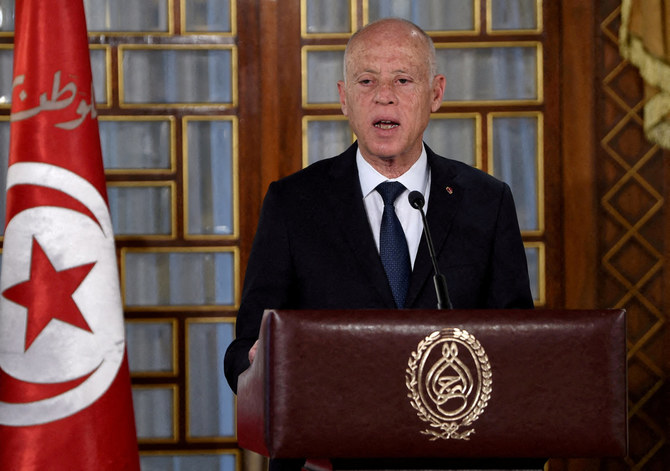
Tunisian President Kais Saied says his crackdown on sub-Saharan African migrants and comments against a perceived plot to erase Tunisia’s identity were not racist. (Reuters)
Short Url
Updated 09 March 2023
Follow

Facing uproar, Tunisian president denies he’s stoking racism

  • President Kais Saied drew international criticism over his crackdown on sub-Saharan African migrants and his comments about a perceived plot to erase Tunisia’s identity

TUNIS: Tunisia’s president has rejected accusations that he is stoking anti-Black racism, saying that he has sub-Saharan African friends and that his comments last month targeting migrants were misinterpreted by his enemies.
President Kais Saied drew international criticism and concern with those comments, in which he ordered a crackdown on sub-Saharan African migrants and lashed out at a perceived plot to erase Tunisia’s identity. The comments fanned racist abuse targeting Black people in Tunisia, and prompted some African countries to evacuate their citizens.
On Wednesday evening, at a meeting with the president of Guinea-Bissau, Saied denounced what he called a “malicious interpretation’’ of his comments, and issued a “blatant denial’’ that he is racist.
“I am African, and proud to be so,” he said in televised comments. He said some of his family members are married to sub-Saharan Africans and that he had friends in law school who were Africans. He also described Africans as “brothers.’’
He stuck by his call for a crackdown on illegal migration, however, and did not say anything to curb racist sentiment that has surged online and in the country’s streets.
And as Tunisian authorities have stepped up arrests of migrants without residency documents in recent weeks, Saied insisted that they are just upholding the law.
Saied has consolidated power and dismantled democratic gains in Tunisia since 2021, and in recent weeks several opposition figures have been arrested.
Both the European Union and the United States have voiced their concern about Saied’s position toward migrants and said they were closely watching developments.
The World Bank earlier this week advised its staff that it was temporarily pausing its Country Partnership Framework with Tunisia — one aspect of its work with the North African country, citing its “core values of inclusion, respect and anti-racism in all shapes and forms.”
More than 100 migrants are camped outside the International Organization for Migration office in Tunisia. The UN agency said Wednesday it is working non-stop to help them.
It welcomed a hotline for migrants and other promises announced by the Tunisian government earlier this week, and encouraged Tunisia to turn commitments into concrete action.


Morocco pushes to reform social security system amid inflation and economic pressure, PM says

Updated 54 min 35 sec ago
Follow

Morocco pushes to reform social security system amid inflation and economic pressure, PM says

  • Speaking at the World Economic Forum in Davos, Aziz Akhannouch said his government had expanded healthcare to more than 80 percent of its population

DUBAI: Morocco’s prime minister said on Tuesday that the country was pursuing radical social and economic reforms in the wake of inflationary and economic pressures.

Speaking at the World Economic Forum in Davos, Aziz Akhannouch said his government had expanded healthcare to more than 80 percent of its population, up from just 42 percent when he took office three years ago.

He said this also coincided with consistently strong economic growth and headline inflation reducing to below 1 percent. 

“In a world that doubts itself, Morocco has decided to protect its population, reform and look forward,” he told attendees in Davos.

In late 2025, Morocco was rocked by its largest demonstrations in over a decade as youth‑led groups mobilized nationwide against deteriorating public services, deepening social inequality, and chronic unemployment.

Akhannouch said the country was aware of the difficulties facing Moroccans and was determined to ensure the country would remain on a positive trajectory.

Part of this included the provision of financial aid to more than 12 million citizens, and the formation of trusts for orphans to be paid out when they turn 18.

“Health means dignity, if you want to have a decent life you have to have good health,” he said.

Nevertheless, Akhannouch noted that the government had not forgone its budgetary principles — and had in fact balanced the country’s debt payments and achieved successful fiscal reforms. He noted S&P’s decision in 2025 to raise Morocco’s sovereign rating to BBB‑/A‑3 and restore its investment‑grade status.

Speaking on the World Cup, set to be co-hosted with neighbors Spain and Portugal in 2030, he said the project was seen as a nation-building exercise that would help spur Morocco to develop its underlying infrastructure and provide employment opportunities for young Moroccans.

“It will be a growth accelerator,” he said.

“When we build new rail networks and upgrade cities it will have a long-term impact on people.”