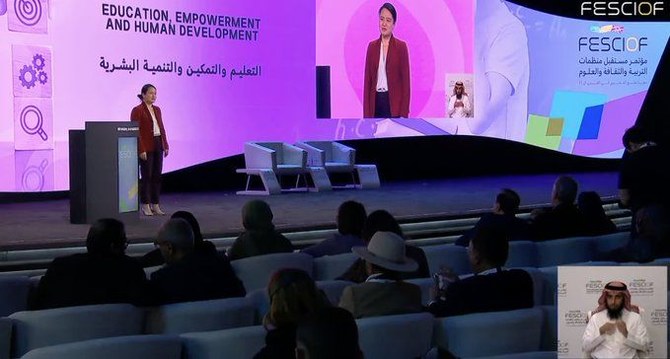
RIYADH: Education is the best investment, and governments must plow more resources in to get more out, a UN expert who has run the numbers has said during a Riyadh forum.
Yanchun Zhang, the UN Development Program’s chief statistician, said that her work on the Human Development Index has convinced her that rising GDP is just one indicator of a successful country.
Her research on the index, she said, showed that countries that have invested in education grow more sustainably and robustly.
“People and their capabilities should be the ultimate criteria for assessing the development of a country, not economic growth alone,” she said during an interview at the Future of Education, Science and Culture forum.
“Public funding is very important,” she said, adding that improving education systems, even if expensive, opened doors to culture, science and technology.
“Funding from the state is crucial and still the main source that provides access to education,” she states. “Of course, the private sector can be important but I think the importance of public education cannot be emphasized more.
“If you look at countries that have very high educational achievements they all invested heavily in education.”
“It is about choices and setting priorities. If there is no public funding, then where have the government revenues gone to? If you look at the budget allocation, then you can ask the question and citizens should ask the question.”
Zhang said access to education in the Middle East has been uneven, especially in countries burdened with economic challenges and conflict such as Syria, Yemen, Iraq, Egypt and Libya.
“There is definitely uneven progress within the Middle East region — even a lack of progress or a regression,” she said.
“In countries like Syria and Lebanon — their HDI (score) has been declining. It is very unfortunate to see how some countries in the region are regressing while others are catching up and furthering their access to education for all.”
Political fragility was anathema to aspiration, she added.
“When you look at these countries, the reality is that people are suffering and their standard of living and human development status has been declining. Most of these countries are conflict countries; that is just the reality.”
Zhang said the UNDP has seen the importance of peace, stability, and financial investment in developing a strong educational sector that contributes to the nation’s progress.
“If you have peace, stability and steady growth over time you will see progress in education,” she said.


![]()

Education and prosperity go hand in hand, says UN expert
Short Url
https://arab.news/mnac5
Education and prosperity go hand in hand, says UN expert
- Chief statistician Yanchun Zhang says research shows public investment in schooling creates better, sustainable societies
- “Public funding is very important,” she said, adding that improving education systems, even if expensive, opened doors to culture, science and technology


Latest updates


© 2026 SAUDI RESEARCH & PUBLISHING COMPANY, All Rights Reserved And subject to Terms of Use Agreement.