

Saudi Yemen reconstruction delegation highlights sustainable development at UN conference in Qatar

1 / 2
SDRPY representatives highlighted the Kingdom’s efforts in Yemen to achieve sustainable development. (SPA)
2 / 2
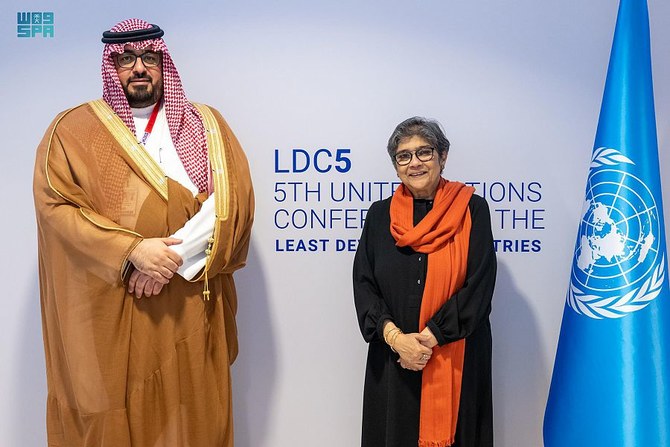
Saudi Minister of Economy and Planning Faisal Al-Ibrahim held meetings with senior officials on the sidelines of the UN conference. (SPA)
Short Url
Updated 09 March 2023
Follow

Saudi Yemen reconstruction delegation highlights sustainable development at UN conference in Qatar

  • The conference aims to accelerate sustainable development in countries that require assistance
  • Saudi Minister of Economy and Planning Faisal Al-Ibrahim held meetings with senior officials on the sidelines

RIYADH: Officials from the Saudi Development and Reconstruction Program for Yemen are taking part in the 5th UN Conference on the Least Developed Countries being held in the Qatari capital Doha, the Saudi Press Agency reported on Wednesday.

The program’s General Supervisor Mohammed Al-Jaber was representing the organization as part of the Kingdom’s delegation led by Minister of Economy and Planning Faisal Al-Ibrahim.

The conference, running until March 9, aims to accelerate sustainable development in countries that require assistance through an action plan for the next decade.

During the conference, the SDRPY’s Assistant General Supervisor Hassan Al-Attas participated in two sessions organized by the UN Economic and Social Commission for Western Asia, in partnership with SDRPY.

Both sessions looked at ways to support the least-developed countries, including Yemen, and how to establish initiatives and partnerships for stakeholders to achieve the Doha Work Program, and review the Kingdom’s experience through the SDRPY as a development model that effectively contributed to improving the infrastructure of the basic Yemeni sectors.

The SDRPY representatives also took part in high-level thematic round tables and a session where they highlighted the Kingdom’s efforts in Yemen to achieve sustainable development.

The roundtable also tackled supporting structural transformation as an engine for achieving prosperity, enhancing the participation of the least-developed countries in international trade and regional integration, and addressing environmental issues, including climate change.

Side sessions concentrated on topics including sustainable energy, rural and agricultural development, digital communication, and sustainable tourism.

Meanwhile, Al-Ibrahim held a number of meetings with senior officials on the sidelines of the UN conference, where he discussed the sustainable development goals achievement and issues of common concern.

He met with the secretary-general of the Organization of African, Caribbean, and Pacific States, Georges Rebelo Pinto Chikoti, to discuss was of enhancing cooperation between the Kingdom and the organization in a number of fields.

Al-Ibrahim also met with ESCWA Executive Secretary Dr. Rola Dashti, and president of the Economic and Social Council and Bulgaria’s permanent representative to the UN in New York, Lachezara Stoeva.

The meetings also included talks with the undersecretary-general and high representative for the least-developed countries, landlocked developing countries and small island developing states, Rabab Fatima.


Experimental farm in Al-Lith looks into future of Saudi Arabian agriculture

Updated 02 February 2026
Follow

Experimental farm in Al-Lith looks into future of Saudi Arabian agriculture

  • Research initiative reflects strategic transformation

JEDDAH: An experimental farm in Saudi Arabia’s Al-Lith Governorate is one of the research initiatives reflecting the strategic transformation taking place in the Kingdom’s agricultural sector.

The farm uses highly efficient, sustainable production models that combine scientific research with commercial application, contributing to strengthening the country’s food security system and the sustainability of water resources.

Located in the Ghumaiqa Center on an area of about 10 hectares, the cutting-edge farm is a testing platform for modern agricultural technologies that tackle the challenge of water scarcity.

The farm includes developed open fields and modern greenhouses, supported by smart irrigation encompassing drip and sprinkler irrigation alongside surface and subsurface technologies.

All the systems operate via smart controls that enable the monitoring of water consumption and ensure improved efficiency, thereby achieving a balance between agricultural production and water conservation.

The farm also uses treated and diluted low-salinity seawater.

It aims to diversify agricultural water sources, reduce reliance on freshwater, and open new horizons for agriculture in coastal and semi-arid environments.

A view of the experimental farm in Al-Lith. (SPA)

The project represents a promising investment opportunity in the field of smart agriculture, enabling the development of commercially scalable production models, particularly for high-value vegetables and fruits, while reducing operational costs associated with water and energy, enhancing the economic feasibility of future agricultural projects.

In addition, the project contributes to transferring and localizing agricultural expertise, supporting local food supply chains, and creating an attractive environment for agricultural investment.

This aligns with Sustainable Development Goals and enhances the efficiency of the private sector in adopting innovative agricultural solutions.

Yahya bin Abdulrahman Al-Mahabi, the director of the Ministry of Environment, Water and Agriculture office in Al-Lith Governorate, told the Saudi Press Agency that the project represented the future of agriculture in the Kingdom.

He explained that the vision was based on investing in technology, enhancing the return on water per unit, and integrating scientific research with investment opportunities.

Al-Mahabi spoke of the experimental farm as a modern, scalable and replicable model applicable in several regions of the Kingdom, particularly in coastal environments.

Al-Mahabi highlighted the Ministry of Environment, Water and Agriculture’s commitment to supporting distinctive projects that contributed to achieving food security while developing rural areas and enhancing agricultural production efficiency, in line with the objectives of the Kingdom’s Vision 2030.