

Case filed against top Punjab officials after ex-PM Khan supporter killed during rally

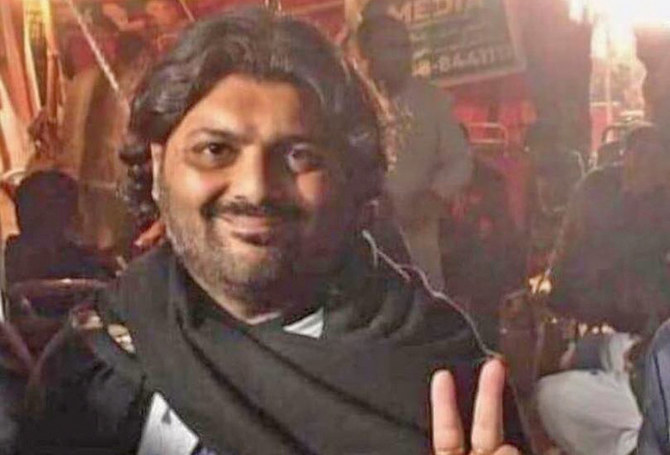
The undated picture shows Ali Bilal, a political activist associated with former prime minister Imran Khan’s Pakistan Tehreek-e-Insaf (PTI) party, who died while the police were arresting dozens of PTI supporters for defying the government’s ban on holding rallies in Pakistan's Lahore city. (Social media)
Short Url
Updated 09 March 2023
Follow

Case filed against top Punjab officials after ex-PM Khan supporter killed during rally

  • Pakistan Tehreek-e-Insaf says Ali Bilal lost his life while in police custody, though provincial authorities deny the claim
  • Lawyer representing the bereaved family promises to go to the court if a police complaint was not registered in the case

ISLAMABAD: Father of a political activist associated with former prime minister Imran Khan’s Pakistan Tehreek-e-Insaf (PTI) party on Wednesday nominated the Punjab chief minister and other officials after his son lost his life in clashes with the police while the PTI was trying to take out a rally in the eastern Lahore city.

According to Khan’s political faction, Ali Bilal was killed while the police were arresting dozens of PTI supporters for defying the government’s ban on holding rallies in the city.

The incident took place after the former premier announced his plan to kick off his party’s election campaign in Pakistan’s most populous Punjab province along with northwestern Khyber Pakhtunkhwa (KP) by addressing the Lahore rally.

The police formed an inquiry commission to investigate Bilal’s killing after the PTI said he lost his life in official custody.

In a written complaint filed in the Race Course Police Station, his father named Punjab Chief Minister Mohsin Naqvi, Inspector General Police Dr. Usman Anwar and Capital City Police Officer Bilal Siddique Kamyana for targeting PTI activists at Khan’s residence in the city ahead of the public rally. He added that his son was tortured before he was taken away by the police in a van.

“We were looking for him when we got information from the social media that the police had killed my son Ali Bilal and sent his body to the Services Hospital,” the document seen Arab News said. “The reason was that my son was a PTI member and was participating in Imran Khan’s rally.”

The complaint urged the police to register a case against all suspects before bringing them to justice.

Ex-PM Khan’s nephew, Hassaan Niazi, who is providing legal representation to the bereaved family, said he would take the issue to court if the police did not register the case on the basis of the application filed by Bilal’s father.

Pakistan’s The News International reported the Punjab chief minister denied that the PTI activist had died in the police custody. The newspaper also said that a CCTV footage from the hospital showed two unknown individuals bringing Bilal’s body in a black vehicle.

The authorities in Punjab have already started probing how the PTI supporter lost his life.

They have also registered another police case against the former premier following the clash, saying some of his party supporters were armed and targeted police personnel.


Pakistan launches privatization process for five power distributors under IMF reforms

Updated 10 sec ago
Follow

Pakistan launches privatization process for five power distributors under IMF reforms

  • Power-sector losses have pushed circular debt above $9 billion, official documents show
  • Move is tied to IMF and World Bank conditions aimed at cutting subsidies and fiscal risk

KARACHI: Pakistan has appointed financial advisers and launched sell-side due diligence for the privatization of five electricity distribution companies, marking a long-awaited step in power-sector reforms tied to International Monetary Fund (IMF) and World Bank programs, according to official documents shared with media on Monday.

The five companies, namely Islamabad Electric Supply Company (IESCO), Faisalabad Electric Supply Company (FESCO), Gujranwala Electric Power Company (GEPCO), Hyderabad Electric Supply Company (HESCO) and Sukkur Electric Power Company (SEPCO), supply electricity to tens of millions of customers and have long been a major source of financial losses for the state.

Pakistan’s power sector has accumulated more than Rs2.6 trillion (about $9.3 billion) in circular debt as of mid-2025, driven largely by distribution losses, electricity theft and weak bill recovery, according to official government data cited in the documents. The shortfall has repeatedly forced the government to provide subsidies, adding pressure to public finances in an economy under IMF supervision.

“The objective is to reduce losses, improve efficiency and limit the government’s fiscal exposure by transferring electricity distribution operations to the private sector,” the documents said, adding that sell-side due diligence for five distribution companies is under way as a prerequisite for investor engagement.

Two utilities, the Quetta Electric Supply Company and Tribal Areas Electric Supply Company, are excluded from the current privatization phase due to security and structural constraints, the documents said.

Power-sector reform is a central pillar of Pakistan’s IMF bailout program, under which Islamabad has committed to restructuring state-owned enterprises, improving governance and reducing budgetary support. The World Bank has also linked future energy-sector financing to progress on structural reforms.

Electricity distribution companies in Pakistan routinely report losses exceeding 20 percent of supplied power, far above international benchmarks, according to official figures. These inefficiencies have been a persistent obstacle to economic growth, investment and reliable power supply.

Previous attempts to privatize power distributors have stalled amid political resistance, labor union opposition and concerns over tariff increases. While officials have not announced a timeline for completing transactions, the launch of due diligence marks the most concrete step taken in years. International lenders and investors will now be closely watching whether Pakistan can translate this phase into completed sales, a key test of its ability to deliver on IMF-backed reforms.

In a related development in Pakistan’s privatization agenda, the government last month concluded the long-delayed sale of a 75 percent stake in national flag carrier Pakistan International Airlines (PIA) in a publicly televised auction. A consortium led by the Arif Habib Group emerged as the highest bidder with a Rs135 billion ($482 million) offer for the controlling stake, in a transaction officials have said will end decades of state-funded bailouts and inject fresh capital into the loss-making airline.