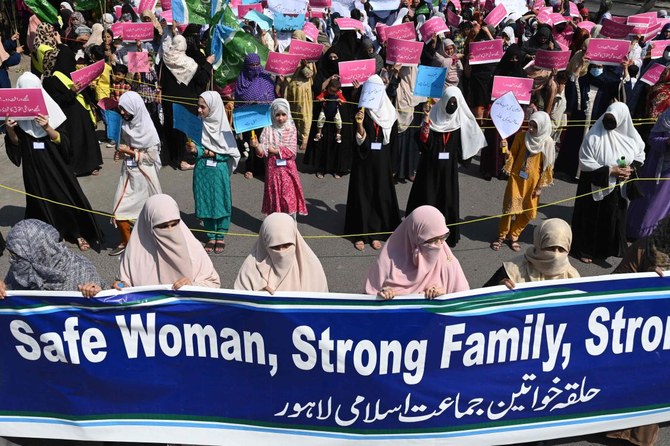
LAHORE, Pakistan: Thousands of women took part in rallies across Pakistan on Wednesday despite efforts by authorities in several cities to block the divisive marches.
Known as the Aurat (women) March, the rallies have courted controversy because of banners and placards waved by participants that raise subjects such as divorce, sexual harassment and menstruation.
Each year, some of the most provocative banners ignite weeks of outrage and a slew of violent threats.
“The whole point of the Aurat March is to demand the security and safety that women are not afforded in this country and society,” said Rabail Akhtar, a schoolteacher who joined a crowd of around 2,000 in Lahore to mark International Women’s Day.
“We are not going to sit silently anymore. It’s our day, it’s our time.”
Videos posted on social media showed several police officers baton charging participants as they tried to join the demonstration.
In a tweet, Interior Minister Rana Sanaullah said the capital’s police chief had been summoned and the officers involved suspended.
City authorities had at the weekend refused to provide security, despite allowing a “modesty” countermarch to go ahead, before a court ordered them to back down.
“It’s ridiculous how we have to go through the same drama every year... Why are they so afraid of women demanding their rights?” asked Soheila Afzal, a graphic designer.
In Karachi, judges dismissed a legal challenge by an individual to ban a related rally scheduled for the weekend so that working women could attend.
In the capital Islamabad, organizers refused to comply with orders to confine the gathering to a city park where a woman was gang raped in February.
Hundreds of women gathered instead outside the city’s press club, where police eventually removed a barricade and allowed the march to begin.
“Women used to be quiet, but now we have women on roads talking about their rights and justice and I think that is the change they were looking for,” said 24-year-old NGO worker Aisha Masood.
The Aurat March is seen by critics as supporting elitist and Western cultural values in the Muslim country, with organizers accused of disrespecting religious and cultural sensitivities.
Countermarches are also held in most cities, where women from right-wing religious groups call for modesty and “family values” to be upheld.
“I will not defend men because we live in a patriarchal and male-dominated society. But we have to ensure an end to violence while confining ourselves within the parameters of Islamic Shariah,” said 45-year-old Asia Yaqoob, a housewife veiled in a hijab at a rally of more than 1,000 women in the capital.
“The beauty of a woman lies in covering her body in a way that our religion teaches.”
In 2020, groups of hard-line Islamist men turned up in vans and hurled stones at women participating in the Aurat March in Islamabad.
Much of Pakistani society operates under a strict code of “honor,” systemising the oppression of women in matters such as the right to choose who to marry, reproductive rights and even the right to an education.
Hundreds of women are killed by men in Pakistan every year for allegedly breaching this code.


![]()

Thousands of women rally in Pakistan despite legal hurdles
Short Url
https://arab.news/bybdg
Thousands of women rally in Pakistan despite legal hurdles
- Known as the Aurat (women) March, the rallies have courted controversy because of banners and placards waved by participants
- Videos posted on social media showed several police officers baton charging participants as they tried to join the demonstration


Latest updates


© 2026 SAUDI RESEARCH & PUBLISHING COMPANY, All Rights Reserved And subject to Terms of Use Agreement.