

Pakistan to play T20 series against Afghanistan in Sharjah this month

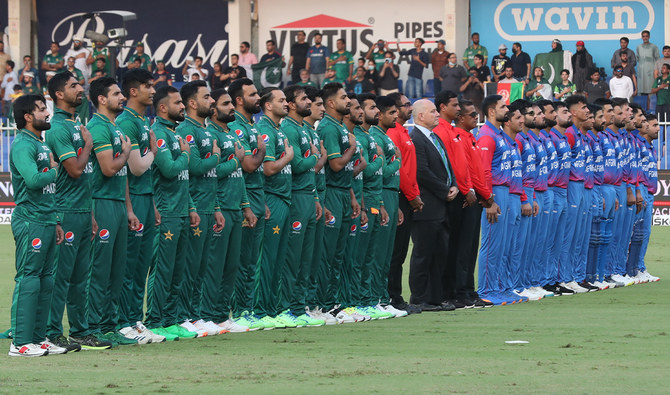
Afganistan's and Pakistan's (L) players line up for their national anthems before the start of the Asia Cup Twenty20 international cricket Super Four match between Afghanistan and Pakistan at the Sharjah Cricket Stadium in Sharjah on September 7, 2022. (AFP/File)
Short Url
Updated 31 July 2023
Follow

Pakistan to play T20 series against Afghanistan in Sharjah this month

  • Series will kick off Afghanistan’s international home season for 2023-24, Pakistan also scheduled to play ODI series against Afghanistan in August
  • PCB Management Committee chair says “delighted” series happening in city that has large ex-pat community and has always supported cricket

ISLAMABAD: Afghanistan will play a T20I series against Pakistan from March 25-29 in Sharjah, the Pakistan Cricket Board announced on Tuesday, kicking off Afghanistan’s international home season for 2023-24. 

Afghanistan has played Pakistan several times in ACC and ICC events in recent years, but this will be the first time the two countries meet in a three-match T20I series. Pakistan are also scheduled to play another three-match ODI series against Afghanistan in August 2023.

“We appreciate Pakistan Cricket Board’s willingness to play Afghanistan in March,” Afghanistan Cricket Board Chairman Mirwais Ashraf, was quoted as saying in a PCB statement. 

“This is a significant accomplishment for two neighboring countries.”

Ashraf said Afghanistan looked forward to extending its ties and partnership with the PCB.

“Overall, we are excited to host and play Pakistan in what will be a thrilling series of cricket games between the two countries,” he added.

Chair of the PCB Management Committee, Najam Sethi, said he was “delighted” that inaugural Pakistan versus Afghanistan T20I series would be played later this month “in a city that has a large ex-pat community and which has always supported cricketers from both countries.”

“The PCB and ACB enjoy a strong and cordial relationship that goes back to the 1990s. Even today, Afghanistan players are hugely popular in the HBL PSL,” Sethi said. 

“I am sure when cricketers from both sides will wear national jerseys for the upcoming international series, they will demonstrate the highest levels of performances and entertain the passionate and cricket-loving crowds.”

Last year, Australia’s men’s team pulled out of a three-match, one-day international series with Afghanistan to have been held in March in the United Arab Emirates, following further curbs on women’s and girls’ rights imposed by the hard-line Taliban administration.

Despite decades of violence and upheaval, Afghanistan has an enthusiastic and widespread cricket following.

Australia were scheduled to play a test match against Afghanistan in November 2021 but the fixture was postponed after the Taliban took power in August that year.

The ACB has criticized Australia’s decision, saying it had put political interests over sportsmanship and that cricket had contributed to education and social development in the country.

Following Australia’s pullout, the PCB said “cricket and politics should be kept separate.”


Pakistan says defense pact with Saudi Arabia elevated brotherly ties to ‘new heights’

Updated 25 February 2026
Follow

Pakistan says defense pact with Saudi Arabia elevated brotherly ties to ‘new heights’

  • Pakistan, Saudi Arabia signed strategic defense pact last year pledging aggression against one will be treated as attack on both
  • Deputy PM Ishaq Dar says enduring bonds with Islamic and Arab nations form vital pillar of Pakistan’s foreign policy 

ISLAMABAD: Deputy Prime Minister Ishaq Dar said on Wednesday that Pakistan’s defense pact with Saudi Arabia elevated its brotherly ties with the Kingdom to “new heights,” stressing that close ties with Arab and Islamic nations form a key pillar of Islamabad’s foreign policy. 

Pakistan and Saudi Arabia signed a Strategic Mutual Defense Agreement on Sept. 17 last year, pledging that aggression against one country would be treated as an attack on both, enhancing joint deterrence and formalizing decades of military and security cooperation.

Both nations agreed in October 2025 to launch an economic cooperation framework to strengthen trade and investment ties. 

“In the Middle East, our landmark Strategic Mutual Defense Agreement with Saudi Arabia has elevated our brotherly ties to new heights,” Dar said while speaking at the Pakistan Governance Forum 2026 event in Islamabad. 

The Pakistani deputy prime minister was speaking on the topic “Navigating International Relations Amidst Changing Geo-Politics.”

Dar noted that Pakistan has reinforced partnerships with other Middle Eastern nations such as the UAE, Qatar, Jordan, Oman, Egypt and Bahrain. He said these partnerships have yielded “concrete agreements” in investment, agriculture, infrastructure, and energy sectors. 

“Our enduring bonds with Islamic and Arab nations form a vital pillar of our foreign policy, and we will continue to expand our partnerships across Asia, Latin America, and Africa,” he said. 

Dar pointed out that the presidents of Kazakhstan, Uzbekistan and Kyrgyzstan have undertaken visits to Pakistan in recent months, reflecting Central Asian nations’ desire to boost cooperation with Islamabad.

On South Asia, the Pakistani deputy PM said Pakistan has successfully transformed its fraternal ties with Bangladesh into “a substantive partnership.”

“Similarly, the trilateral mechanism involving China, Pakistan, and Bangladesh has been launched with a view to expanding and deepening regional cooperation and synergy,” the Pakistani minister said. 

He said Islamabad has strengthened its “all-weather” partnership with China via the second phase of the multi-billion-dollar China-Pakistan Economic Corridor agreement and “unwavering support” from both sides for each other’s core interests. 

Dar said Pakistan had also reinvigorated its partnership with the US, advancing cooperation in trade, technology, investment, and regional stability. 

“This calibrated approach has enhanced our ability to navigate complexity with skill and confidence, ensuring that our national interests are served without compromising our core foreign policy principles,” he said.