Afghanistan cricket slams Australia for canceling ODIs

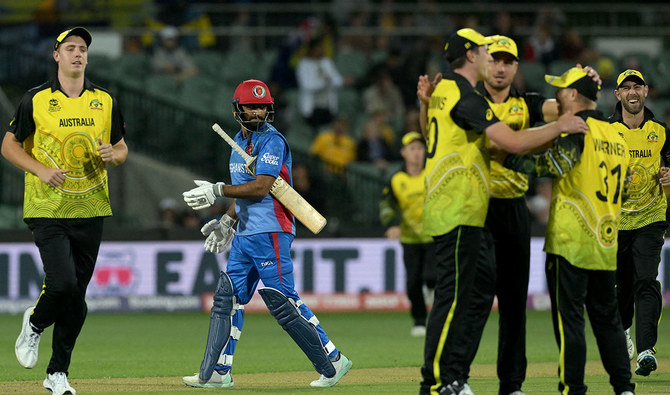
Afghanistan's Usman Ghani (C) departs as Australian players celebrate his dismissal during the ICC men's Twenty20 World Cup 2022 cricket match between England and New Zealand at The Gabba on November 1, 2022 in Brisbane. (AFP)
Short Url
Updated 12 January 2023
Follow

Afghanistan cricket slams Australia for canceling ODIs

  • Australia announces withdrawing from series against Afghanistan citing restrictions on women’s and girls’ education
  • Afghanistan Cricket Board says it is “extremely disappointed, saddened by pathetic statement” from Cricket Australia

MELBOURNE: Afghanistan cricket officials blasted Australia's decision on Thursday to cancel their men's one-day international cricket series.
Cricket Australia cited recent heavier restrictions on women's rights in Afghanistan by the Taliban government for axing the three ODIs in March in the United Arab Emirates.
The Afghanistan Cricket Board said it was “extremely disappointed and saddened by the pathetic statement” from Cricket Australia and it would complain to the International Cricket Council.
It accused CA of prioritizing political interests over fair play and sportsmanship, undermining the integrity of the game, and damaging the relationship between the two countries.
“Cricket has played a significant role in promoting unity and national pride in Afghanistan,” the board said. “After years of war and conflict, cricket has helped to bring people together and provide a sense of normalcy to the country. It has also been an important source of hope and inspiration for all Afghans, particularly young people.”
It said it would rethink the participation of Afghan players in the Big Bash League if the decision was not reversed.
Afghan fast bowler Naveen ul Haq Murid called scrapping the series “childish” and accused Australia of taking away Afghans’ only reason for happiness instead of being supportive.
When Kabul fell to the Taliban in 2021, women were banned from playing sports on the grounds that doing so would contravene Islamic laws requiring their hair and skin to be covered.
Recent Taliban restrictions on women’s and girls’ education, employment opportunities, and their ability to access parks and gyms were cited by Cricket Australia for dropping the men's ODIs following consultation with the Australian government and other groups.
“CA is committed to supporting growing the game for women and men around the world, including in Afghanistan, and will continue to engage with the Afghanistan Cricket Board in anticipation of improved conditions for women and girls in the country,” CA said.
Australia gave similar reasons for axing a one-off test match against Afghanistan in Hobart, Australia, in November 2021.
In December, the Taliban banned women from completing higher education, having prohibited attendance at gyms and parks a month earlier.
Women are also banned from attending school beyond the sixth grade and working most jobs outside of their homes.
In November 2021, the ICC formed a working group aiming to support and review women’s and men’s cricket in Afghanistan but more than a year later, the country remains the only full member of the ICC without a fully operational women’s team. Afghanistan is also the only full member not represented at the Under-19 Women's T20 World Cup in South Africa starting this week.


T20 cricket set to dominate game’s landscape in 2026

Updated 58 min 31 sec ago
Follow

T20 cricket set to dominate game’s landscape in 2026

  • Inexorable rise of one of sport’s controlling forces

Following the end of the Ashes series in Australia, it has not taken long for cricket’s longest format — Test cricket — to be overwhelmed by the T20 format.

Apart from the 50-over Under-19s World Cup taking place in Namibia, it seems that, wherever one turns, there are only T20 tournaments.

Two explanations for this situation are the looming ICC Men’s and Women’s World Cups. The men’s event, to be jointly hosted by India and Sri Lanka, starts on Feb. 7, while the women’s tournament starts on June 12 in England.

The women’s event will comprise 12 teams, the largest number ever, of which eight have qualified already. The other four will emerge from 10 teams competing in a qualifying tournament in Nepal. This began on Jan. 18 and will end on Feb. 1. The teams have been divided into two groups of five and will play each other once. Group A comprises Bangladesh, Ireland, Namibia, Papua New Guinea and the US, with the Netherlands, Nepal, Scotland, Thailand and Zimbabwe in Group B. The top three teams will qualify for the Super Six stage in which the three teams from Group A will play the three teams from Group B. Points earned against the other two qualifying teams from each group are carried forward. The top four teams at the end of the Super Six will qualify for the World Cup in June.

The four highest-ranked teams in the competition are Ireland, Bangladesh, Scotland and Thailand. They are expected to progress to the Super Sixes but it remains to be seen if each of them will reach the main event in June. Thailand will probably face tough challenges against Ireland and Bangladesh in the Super Six stage. The Thai team are in good form, having triumphed in the ICC Women’s Emerging Nations Trophy and won double gold medals in the women’s cricket competitions in the SE Asia Games at the end of 2025. This form has continued into the tournament with victories over Nepal and Zimbabwe, but sterner tests lie ahead.

Players who are squad members of teams who have qualified for the World Cup are warming up in different ways. A number are currently involved in India’s Women’s Premier League, which is halfway into its schedule and will conclude on Feb. 5. In New Zealand, the Women’s Super Smash concludes on Jan. 31, while in South Africa the CSA Women’s Pro20 will resume on Feb. 8. There are upcoming bilateral tours by India to Australia in late February, Pakistan to South Africa in February, Zimbabwe to New Zealand in March, followed by South Africa. No doubt other matches will be arranged once the identity of the final four qualifying teams is known. Immediately prior to the World Cup, formal warm-up matches will take place at three venues in England and Wales.

The need for preparation is even more pressing for those involved in the men’s T20 World Cup, which comprises 20 teams. The Big Bash League in Australia allows four overseas players in each 18-man squad. In 2025/26, English players represent the bulk of non-Australian players, followed by players from Pakistan and New Zealand. The South African World Cup players are fully engaged in SA20, in which 19-man squads are allowed to contain seven overseas players, four of whom can be selected for a playing 11. English players are well represented. The Bangladesh Premier League will conclude on Jan. 23. Indian players with central contracts are not allowed to participate in franchise leagues outside India. Their World Cup players will feature in a T20 series against New Zealand that started on Jan. 21 in Nagpur. It followed an ODI series which was won by New Zealand. England start a three-match T20 series against Sri Lanka on Jan. 30, following three ODIs.

Outside of the leading countries, it can be difficult for players and teams to gain enough game-time preparation. Some of the UAE players participated in the DP World ILT20. Their next international action is a two-match series on Jan. 29 and 31 against Ireland in Dubai, where Afghanistan currently have a three-match T20 series against the West Indies, who then play a series against South Africa. Ireland will remain in Dubai where they will play three T20 matches against Italy, who are making their first appearance in a World Cup.

Australia will visit Pakistan and play three T20 matches. Teams such as the US, Canada, Oman, Nepal, Namibia and the Netherlands appear to have limited match preparation opportunities.

At least they do not face the uncertainties of Bangladesh. In early January, in a further example of the use of cricket as a political weapon, the Indian authorities excluded the Bangladeshi cricketer Mustafizur Rahman from the 2026 Indian Premier League, amid rising tensions between the two countries. Rahman had been bought at auction by the Kolkata Knight Riders franchise, which is owned by Shah Rukh Khan, the Indian actor and film producer, who was born into a Muslim family. Following this decision, the Bangladesh Cricket Board requested that the International Cricket Council move matches involving Bangladesh in the T20 World Cup out of India, citing the “safety and well-being of the players.”

Discussions ensued between the parties. Independent security assessments were commissioned by the ICC, along with comprehensive venue-level security plans and formal assurances from the host authorities. These were shared with the BCB. All assessments consistently concluded that “there is no credible or verifiable threat to the safety or security of the Bangladesh team in India.” On Jan. 17, the BCB suggested a swap of their matches with those of Ireland, whose group matches are to be played in Sri Lanka. The suggestion was rejected. At an emergency meeting of the ICC’s board on Jan. 21, 14 out of the 16 members voted against Bangladesh’s request. It is assumed that, apart from Bangladesh, the other vote in favour was from Pakistan.

It appears that the BCB’s attempt at a hardline stance has backfired. It must now either accept to play in India or withdraw from the competition, with significant loss of face either way. If it withdraws, a replacement team need to be introduced. The next-best-ranked T20I team are Scotland, who will have even less time to prepare than the other 19 teams.

Once again, a major international tournament has been disrupted by geopolitics. It is also the case that, once again, almost everyone has fallen in behind the combined power of the ICC and the Indian board. This stranglehold and the inexorable rise of T20 cricket are now undoubtedly the controlling forces shaping cricket’s future landscape.