

Pakistani women pilots and engineers defy the odds to fix gender imbalance in aviation

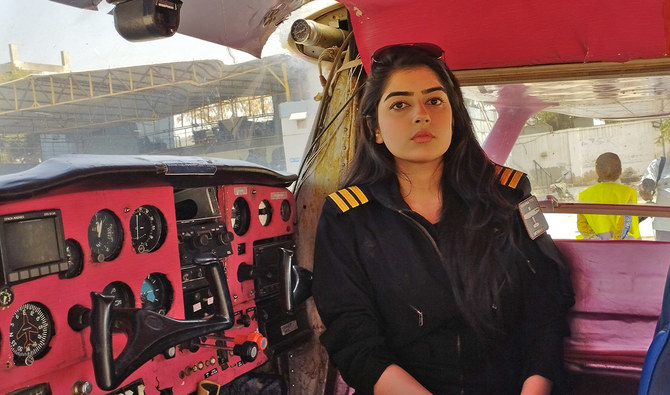
Azka Malik, a pilot, is sitting in a cockpit of Cessna aircraft in Karachi, Pakistan, on March 7, 2023. (AN photo)
Short Url
Updated 08 March 2023
Follow

Pakistani women pilots and engineers defy the odds to fix gender imbalance in aviation

  • Several Pakistani women pilots, engineers and technicians successfully working in airlines in Pakistan and abroad
  • Pakistani women aviators and technicians say the concept of aviation only being men’s territory now ‘obsolete’

KARACHI: For Azka Malik, 23, becoming a commercial pilot was a dream, but many people told her that it was not a woman’s job. Malik spent four years pursuing her dream at Karachi’s Sky Wing aviation academy and is now a woman commercial pilot, who aims to narrow the gender gap in Pakistan’s aviation industry. 

The global aviation industry is predominated by men and women make up around 7 percent of the overall commercial pilots, according to Women in Aviation International, an American organization that provides networking, education, mentoring in the aviation and aerospace industries. But Pakistani aviation professionals say the number, though not exactly known, is lower in the South Asian country. 

Malik, who recently graduated from the aviation academy, was glad at more women joining the industry and said she was ready to face the “big challenge” as aviation, like most sectors in Pakistan, was considered only men’s territory 

“There are a lot more women who are joining this field now, so things are progressing, things are getting better and obviously our seniors have paved the way for us,” Malik told Arab News, sitting inside the cockpit of Cessna aircraft at her academy in Karachi on Tuesday. 

“The freedom you feel when you’re in the aircraft, when you fly in the sky, it’s amazing. It’s like no other experience in this world.” 

Apart from flying aircraft, Pakistani women are also at the forefront of technical and mechanical support for maintenance of aircraft. 

Subhana Anwer, a 25-year-old aircraft maintenance technician, said the field requires a lot of study and hard work. 

“If I speak from my heart about aviation, it takes a lot of work. It’s not easy. There’s a lot of studying to be done. There is a lot of late-night work. There is hardship... and, you know, honestly, it takes a lot of grit and how much you’re willing to put in,” Anwer said. 

“Being a female, being a male either, it’s not really that much for the difference of dynamics. Being an aviation maintenance as a career, it takes a lot of studying, it takes a lot of hard work.” 

Komal Khalid, another aircraft maintenance technician, said women had proven it wrong that aircraft maintenance was only men’s job as women professionals were increasingly seen in the field. 

“It is said here that maintenance is only males’ job... it is not like this I think there is no work in the world that only man can do and woman can’t... this thinking is getting obsolete,” Khalid, 25, said. 

“Definitely it is a tough field but it is not that women can’t do. We are present and are doing at front of you.” 


Aircraft technicians are inspecting a Cessna flight training aircraft in Karachi, Pakistan, on March 7, 2023. (AN Photo)

A few years ago, there used to be around 15 aviation academies in Pakistan, but only nine of them are operational today. 

Since its inception in 2019, the Sky Wing aviation academy has trained 25 pilots and 42 aircraft engineers and technicians. Of them, there are seven women pilots and 22 engineers and technicians. 

Imran Aslam Khan, CEO of the Sky Wings academy, said the workforce trained by them was successfully contributing to the national and international aviation industries. 

“We have trained several women pilots, engineers and technicians in aviation industry and now they are successfully working in different airlines within Pakistan and abroad,” Khan told Arab News. 

“We believe that till the time we bring in women in all the industries, no country can progress because, it is half of the population of the world. So it goes in the same way for Pakistan that we have to involve the women so that they can contribute in the economy of the country.” 

Pakistani aviation stakeholders say the industry is open to women and they are progressing at all fronts and can thrive with policy support. 


Pakistan’s finance chief says country shifting from aid to trade, investment with Gulf nations

Updated 5 sec ago
Follow

Pakistan’s finance chief says country shifting from aid to trade, investment with Gulf nations

  • Aurangzeb says remittances from the GCC topped $38 billion last fiscal year, projected at $42 billion this time
  • He tells an international media outlet discussions on a free trade agreement with the GCC are at an advanced stage

ISLAMABAD: Pakistan is no longer seeking aid-based support and is instead pivoting toward trade- and investment-led partnerships, Finance Minister Muhammad Aurangzeb said in an interview with an international media outlet circulated by the finance division on Monday, acknowledging longstanding economic backing from Gulf countries.

Aurangzeb spoke to CNN Business Arabia at a time when Pakistan seeks to consolidate macroeconomic stability after a prolonged crisis marked by soaring inflation, currency pressure and external financing gaps.

Aurangzeb said the government’s economic direction, articulated by Prime Minister Shehbaz Sharif, aims to replace reliance on external assistance with sustainable growth driven by investment and exports, particularly from partners in the Gulf Cooperation Council (GCC), which includes Saudi Arabia, the United Arab Emirates, Qatar, Kuwait, Oman and Bahrain.

“We are not looking for aid flows anymore,” he said. “For us, we are very clear ... that going forward is really trade and investment, which is going to bring sustainability and be win-win for our longstanding bilateral partners in GCC and for Pakistan.”

“This FDI [foreign direct investment] is going to help us in terms of GDP growth [and] more employment opportunities as we go forward,” he continued. “So, you know, all hands are on deck at this point in time to make this materialize.”

Aurangzeb said Pakistan’s shift was underpinned by improving macroeconomic indicators following an 18-month stabilization program.

He noted that inflation, which peaked at 38 percent in 2023, has fallen to single-digit levels, while the country has posted primary fiscal surpluses and kept the current account deficit within targeted limits, adding that foreign exchange reserves now cover about 2.5 months of imports.

The finance chief described recent international assessments as external validation of the government’s reform path.

“All three international credit rating agencies are now aligned in terms of their upgrades and outlook for Pakistan this year,” he said, adding that the successful completion of the second review under the International Monetary Fund’s loan program, approved by the lending agency’s executive board, reinforced confidence in Pakistan’s economic management.

The finance minister said reforms across taxation, energy, state-owned enterprises, public finance and privatization were central to consolidating stability and supporting growth.

He pointed out Pakistan’s tax-to-GDP ratio had risen to about 10.3 percent from 8.8 percent at the start of the reform program and is on track to reach 11 percent, driven by efforts to widen the tax base to include under-taxed sectors such as real estate, agriculture and wholesale and retail trade, while tightening compliance through technology-based monitoring.

Aurangzeb also highlighted the role of the GCC in supporting Pakistan’s external position, particularly through remittances.

He said inflows reached about $38 billion last fiscal year and are projected to rise to nearly $42 billion this time, with more than half originating from GCC states, reflecting the contribution of Pakistani nationals working in the region.

The finance chief said Pakistan was actively engaging Gulf partners to attract investment in sectors including energy, oil and gas, mining, artificial intelligence, digital infrastructure, pharmaceuticals and agriculture, while discussions on a free trade agreement with the GCC were at an advanced stage.