

61% Pakistanis have ‘good opinion’ of ex-PM Imran Khan, new Gallup survey says

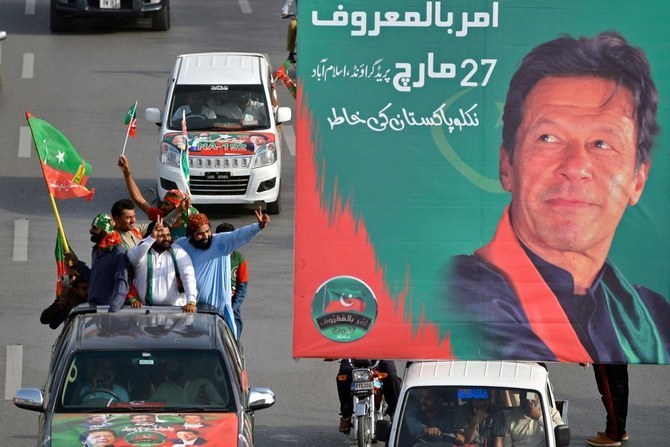
In this file photo, taken on March 27, 2022, supporters of the ruling Pakistan Tehreek-e-Insaf party arrive to attend a rally next to a billboard with a picture of Prime Minister Imran Khan in Islamabad. (Photo courtesy: AFP/File)
Short Url
Updated 07 March 2023
Follow

61% Pakistanis have ‘good opinion’ of ex-PM Imran Khan, new Gallup survey says

  • Coalition of Khan’s political opponents, the PDM, getting blamed for ongoing inflation and economic instability, survey says
  • 62 percent of Pakistanis say PDM rather than Khan’s PTI party to be blamed for current meltdown, Public Pulse report says

ISLAMABAD: Sixty-one percent of Pakistanis who were part of a recent countrywide survey said they have a “good opinion” of former prime minister Imran Khan, with the report further adding that a majority of Pakistanis blame his political opponents for Pakistan’s current economic crisis.

Khan, who was ousted from power last year following a no-trust move, has been campaigning for snap elections which are otherwise slated to take place later this year. The former premier, who claims he enjoys massive popularity across the country, has won a string of by-elections over the past couple of months against the ruling coalition government and its ally, the Pakistan Peoples Party (PPP).

As Khan ramps up his criticism of Pakistan’s powerful military and the coalition government, his speeches are banned from being broadcast in the country while he faces a slew of cases in various courts across the country.

Despite all this, respondents of the Gallup survey say Khan continues to be the most popular leader in the country.

“Imran Khan was positively rated with 61 percent of Pakistanis having a good opinion [of] him,” Gallup’s Public Pulse report said last week.

“At the second position [are] Nawaz Sharif and Bilawal Bhutto with 36 percent of Pakistanis having a good opinion about both of them.”

The survey report further revealed that the majority of the respondents blamed the ruling coalition government — the Pakistan Democratic Movement (PDM) — for Pakistan’s current economic crisis.

“62 percent of Pakistanis say they (PDM) rather than PTI (Khan’s Pakistan Tehreek-e-Insaf) is to be blamed for the current meltdown,” the report added.

The standoff between Khan and Sharif’s government has roiled Pakistan as it struggles to cope with rapidly declining reserves and a currency that has plummeted to historic lows against the US dollar. Islamabad is desperately trying to revive a stalled loan program with the International Monetary Fund (IMF) to save Pakistan from default.

Fifty-three percent of survey respondents from across Pakistan also said that if a new party, comprising “honest political members and technocrats” would be formed, they would stop supporting the party they currently support and vote for the new one instead.


Pakistan PM orders safeguards for legitimate travelers amid airport off-loading complaints

Updated 9 sec ago
Follow

Pakistan PM orders safeguards for legitimate travelers amid airport off-loading complaints

  • Over 66,000 passengers were off-loaded this year by Pakistani authorities as part of a crackdown on illegal migration
  • Instruction comes a day after Greece rescued about 540 illegal migrants at sea, including several Pakistani nationals

ISLAMABAD: Prime Minister Shehbaz Sharif on Saturday acknowledged complaints over passenger off-loading at airports and ordered safeguards for legitimate travelers, as he chaired a meeting on human smuggling a day after Greece rescued hundreds of migrants, including Pakistanis, at sea.

Earlier this week, the Federal Investigation Agency (FIA) said in a briefing to a parliamentary committee that more than 66,000 passengers had been off-loaded from Pakistani airports this year over suspected irregular travel, while tens of thousands were deported from Gulf states and other countries amid a broader crackdown on illegal migration.

The meeting chaired by Sharif reviewed enforcement measures aimed at curbing human smuggling and illegal immigration, with officials highlighting a 47 percent decline in illegal migration to Europe from the country following intensified screening at departure points.

“In taking action against those traveling illegally or holding suspicious travel documents, special care must be taken to ensure that passengers with valid documents are not affected,” the prime minister said, according to a statement issued by his office.

Sharif also ordered improvements in coordination between the FIA, the Protectorate of Emigrants and other agencies to facilitate Pakistanis traveling abroad legally for employment, while calling for stricter action against corrupt officials.

The meeting was also briefed about a growing reliance on technology by the immigration authorities to address weaknesses in the existing system. Authorities said work was under way to expand the use of electronic gates at airports, allowing automated identity verification to reduce discretionary checks.

Officials also said Pakistan was developing a mobile application to access passenger data and integrating advance passenger information and passenger name record (API-PNR) systems, enabling authorities to flag potentially fraudulent travel documents before departure.

Artificial intelligence tools are being introduced to support risk assessment and targeted screening, the statement added.

Pakistan intensified action against illegal migration in 2023 after hundreds of people, including its own nationals, died while attempting to cross the Mediterranean in an overcrowded fishing vessel that sank off the Greek coast, prompting widespread outrage and scrutiny of smuggling networks.

The meeting followed a Greek coast guard statement on Friday saying it rescued about 540 migrants from a fishing boat south of the island of Gavdos, transferring them to temporary facilities on Crete. Greek authorities said the group included nationals of Pakistan, Bangladesh and Egypt.

The latest rescue highlights how, despite tighter controls and airport screening at home, migrants continue to seek dangerous routes to Europe, largely driven by economic hardship and the promise of work in richer countries.