

Japan’s new rocket fails after engine issue, in blow to space ambitions

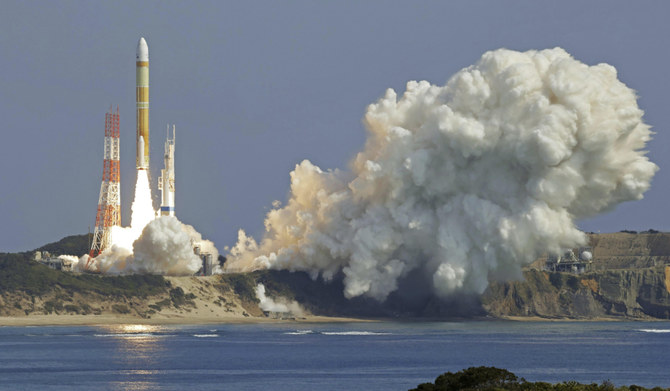
The 57-meter-tall H3 rocket lifted off without a hitch but upon reaching space, the rocket’s second-stage engine failed to ignite, forcing mission officials to manually destroy the vehicle. (AP)
Short Url
Updated 07 March 2023
Follow

Japan’s new rocket fails after engine issue, in blow to space ambitions

  • Blow to Japan’s efforts to cut the cost of accessing space and compete against Elon Musk’s SpaceX
  • Japan’s first new rocket in three decades was carrying the ALOS-3, a disaster management land observation satellite

TOKYO: Japan’s new medium-lift rocket failed on its debut flight in space on Tuesday after the launcher’s second-stage engine did not ignite as planned, in a blow to its efforts to cut the cost of accessing space and compete against Elon Musk’s SpaceX.

The 57-meter-tall H3 rocket lifted off without a hitch from the Tanegashima space port, a live-streamed broadcast by the Japan Aerospace Exploration Agency (JAXA) showed.

But upon reaching space, the rocket’s second-stage engine failed to ignite, forcing mission officials to manually destroy the vehicle.

“It was decided the rocket could not complete its mission, so the destruct command was sent,” a launch broadcast commentator from JAXA said. “So what happened? It’s something we will have to investigate looking at all the data.”

The failed attempt followed an aborted launch last month.

“Unlike the previous cancelation and postponement, this time it was a complete failure,” said Hirotaka Watanabe, a professor at Osaka University with expertise in space policy.

“This will have a serious impact on Japan’s future space policy, space business and technological competitiveness,” he added.

Japan’s first new rocket in three decades was carrying the ALOS-3, a disaster management land observation satellite, which was also equipped with an experimental infrared sensor designed to detect North Korean ballistic missile launches.

H3 builder Mitsubishi Heavy Industries Ltd. (MHI) said it was confirming the situation surrounding the rocket with JAXA and did not have an immediate comment.

MHI has estimated that the H3’s cost per launch will be half that of its predecessor, the H-II, helping it win business in a global launch market increasingly dominated by SpaceX’s reusable Falcon 9 rocket.

A company spokesperson said earlier that it was also relying on the reliability of Japan’s previous rockets to gain business.

In a report published in September, the Center for Strategic and International Studies put the cost of a Falcon 9 launch to low Earth orbit at $2,600 per kilogram. The equivalent price tag for the H-II is $10,500.

A successful launch on Tuesday would have put the Japanese rocket into space ahead of the planned launch later this year of the European Space Agency’s new lower-cost Ariane 6 vehicle.

Powered by a new simpler, lower-cost engine that includes 3D-printed parts, the H3 is designed to lift government and commercial satellites into Earth orbit and will ferry supplies to the International Space Station.

As part of Japan’s deepening cooperation with the United States in space, it will also eventually carry cargo to the Gateway lunar space station that US space agency NASA plans to build as part of its program to return people to the moon, including Japanese astronauts.


Winter storm packing snow and strong winds to descend on Great Lakes, Northeast

Updated 30 December 2025
Follow

Winter storm packing snow and strong winds to descend on Great Lakes, Northeast

  • The fierce winds on Lake Erie sent water surging toward the basin’s eastern end near Buffalo, New York, while lowering water on the western side in Michigan to expose normally submerged lakebed — even the wreck of a car and a snowmobile

NEW YORK: A wild winter storm was expected to bring strong winds, heavy snow and frigid temperatures to the Great Lakes and Northeast on Tuesday, a day after a bomb cyclone barreled across the northern US and left tens of thousands of customers without power.
The storm that hit parts of the Plains and Great Lakes on Monday brought sharply colder air, strong winds and a mix of snow, ice and rain, leading to treacherous travel. Forecasters said it intensified quickly enough to meet the criteria of a bomb cyclone, a system that strengthens rapidly as pressure drops.
Nationwide, more than 127,000 customers were without power Tuesday morning, more than a third of them in Michigan, according to Poweroutage.us.

BACKGROUND

The storm that hit parts of the Plains and Great Lakes on Monday brought sharply colder air, strong winds and a mix of snow, ice and rain, leading to treacherous travel.

As the storm moved into Canada, the National Weather Service predicted more inclement weather conditions for the Eastern US, including quick bursts of heavy snow and gusty winds known as snow squalls. Blustery winds were expected to add to the arctic chill, with low temperatures dipping below freezing as far south as the Florida panhandle, the agency said.
New York Gov. Kathy Hochul warned that whiteout conditions were expected Tuesday in parts of the state, including the Syracuse metro area.
“If you’re in an impacted area, please avoid all unnecessary travel,” she said in a post on the social platform X.
Snow piled up quickly in Michigan’s Upper Peninsula on Monday, where as much as 2 feet (60 centimeters) fell in some areas, according to the National Weather Service. Meteorologist Ryan Metzger said additional snow was expected in the coming days, although totals would be far lighter.
Waves on Lake Superior that were expected to reach 20 feet (6 meters) on Monday sent all but one cargo ship into harbors for shelter, according to MarineTraffic.com.
The fierce winds on Lake Erie sent water surging toward the basin’s eastern end near Buffalo, New York, while lowering water on the western side in Michigan to expose normally submerged lakebed — even the wreck of a car and a snowmobile.
Kevin Aldrich, 33, a maintenance worker from Monroe, Michigan, said he has never seen the lake recede so much and was surprised on Monday to spot remnants of piers dating back to the 1830s. He posted photos on social media of wooden pilings sticking up several feet from the muck.
“Where those are at would typically be probably 12 feet deep,” he said. “We can usually drive our boat over them.”
Dangerous wind chills plunged as low as minus 30 F (minus 34 C) across parts of North Dakota and Minnesota on Monday. And in northeast West Virginia, rare, nearly hurricane-force winds were recorded on a mountain near Dolly Sods, according to the National Weather Service.
In Iowa, after blizzard conditions eased by Monday morning, high winds continued blowing snow across roadways, keeping more than 200 miles (320 kilometers) of Interstate 35 closed. State troopers reported dozens of crashes during the storm, including one that killed a person.
On the West Coast, the National Weather Service warned that moderate to strong Santa Ana winds were expected in parts of Southern California through Tuesday, raising concerns about downed trees in areas where recent storms had saturated the soil. Two more storms were forecast later this week, with rain on New Year’s Day potentially soaking the Rose Parade in Pasadena for the first time in about two decades.