Experts shed light on applications of artificial intelligence in justice

1 / 3
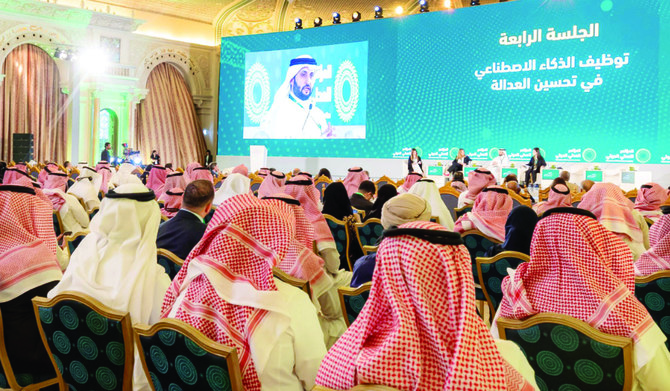
Saudi Deputy Minister for Planning and Development Yasser Al-Sudais speaks at the first session, titled ‘Using AI to enhance justice,’ with international experts Francesca Mazzi and Deng Suning. (Supplied)
2 / 3
Photo/Abdulrahman AlMofarreh
3 / 3
Photo/Abdulrahman AlMofarreh
Short Url
Updated 06 March 2023
Follow

Experts shed light on applications of artificial intelligence in justice

  • Effective use of technology can help reduce burden on courts, Riyadh forum told

RIYADH: Speaking on Monday at the International Conference on Justice in Riyadh, Saudi Arabia’s deputy minister for planning and development highlighted the role of artificial intelligence in the world of justice.

Yasser Al-Sudais’ remarks came during the conference’s first session, titled “Using AI to enhance justice,” with international experts Francesca Mazzi and Deng Suning.

Al-Sudais discussed the experience of the Ministry of Justice in employing AI to improve justice.
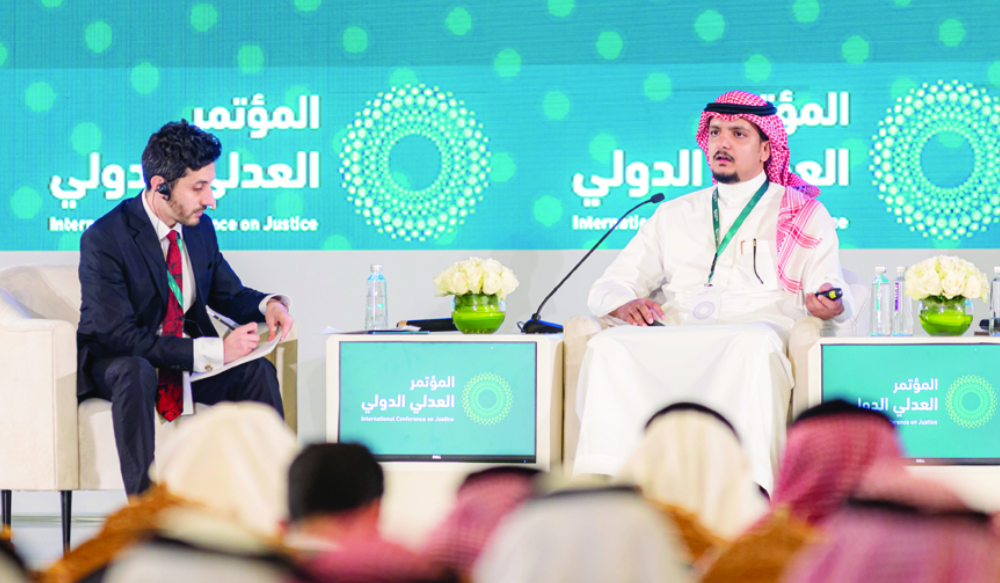


Yusuf Al-Ghamdi, director of Taradhi at the Ministry of Justice, spoke about the experience of the ministry in remote reconciliation in Saudi Arabia. (Photo/Abdulrahman AlMofarreh)

“We have a huge amount of cases that are carrying a heavy load for the courts. So, we want to solve this using AI. There are many ways you can design a system to use AI, by engaging a committee of human experts to take into consideration protecting your public ideologies, ideas and your social norms,” he said.  

Mazzi, a researcher specializing in intersections between technology and the arts at the University of Oxford, spoke about AI ethics and protection from algorithmic bias.

HIGHLIGHT

Deng Suning, a researcher at the East China University of Political Science and Law, talked about China’s experience with the applications of AI in justice.

“In every field, including the justice field, AI can be used, but (it) also can create negative consequences. So, the more we have a main event relation that allows us to have control and to direct information that is human-centric, the more we have certainties,” said Mazzi.

Deng, a researcher at the East China University of Political Science and Law, talked about China’s experience with the applications of AI in justice.


Roy Radding made a presentation titled “Artificial Intelligence and Bias in the Field of Justice Causes and Possible Cures.” (Photo/Abdulrahman AlMofarreh)

The second session, titled “Data analytics for justice enhancement,” featured discussions with Rory J. Radding, Prof. Wang Zhu and other experts in the field.

Radding, a partner in Mobile Cowboy Buds Law Firm, spoke on the different forms of AI, including “generative AI, deep and machine learning, neural networks, prediction, and probabilistic reasoning.”

Radding also gave the presentation: “Artificial intelligence and bias in the field of justice: causes and possible cures.”
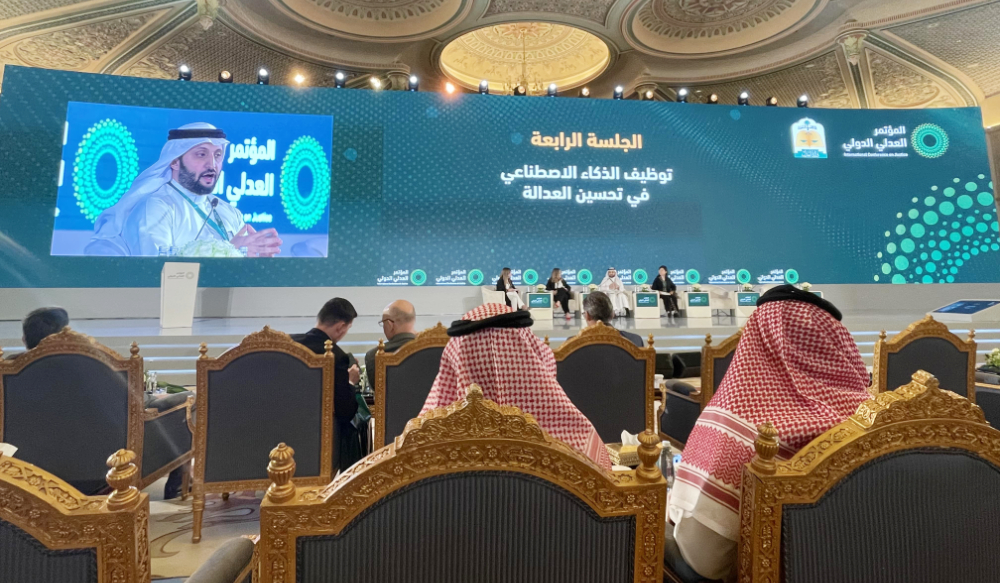


Al-Sudais said that, “We have a huge amounts of cases that are carrying a heavy load for the courts. So we want to solve this using the AI." (Photo/Abdulrahman AlMofarreh)

He provided an overview of the history of robotics, credited to the father of robotics Ismail Al-Jazari, and possible sectors where AI bias may be introduced.

“Bias means the reliability of the system, such as hardware bias, software bias, and data bias. AI may intensify human bias,” said Radding. “A judge’s decision is biased, and that’s the norm everywhere in the world. AI can’t assist the judge in this case.”

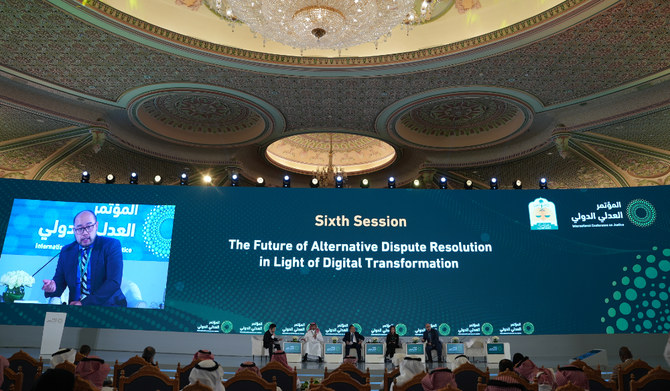
The third session at the conference, titled “The future of alternative dispute resolution in light of digital transformation,” featured Chuan Wee Meng, Gloria Lim, Dr. Zhang Yuntong and Yusuf Al-Ghamdi.


Researcher Francesca Mazzi spoke about AI ethics and protection from algorithmic bias. (Supplied)

Al-Ghamdi, director of the reconciliation initiative known as Taradhi at the Saudi Ministry of Justice, spoke about the experience of the ministry in remote reconciliation in Saudi Arabia.

“Taradhi is a platform that brings together disputants and mediators digitally, as the platform has been developed to be smooth, easy and flexible, with fast procedures and models,” he said.

Taradhi has contributed to reducing the costs incurred by both parties in a conflict, ensuring the swift resolution of disputes through easy and confidential processes while promoting a culture of amicable settlements.

“Today, more than 1 million disputes are resolved through Taradhi,” he added.

Lim, CEO of the Singapore International Arbitration Centre, spoke on how the center has benefited from digital transformation.

“What parties in conflict are looking for is a trusted system that provides them with certainty, predictability, and effective mechanisms to resolve disputes,” she said.


India and Saudi Arabia share robust defense partnership anchored in mutual trust, ambassador says

Updated 6 sec ago
Follow

India and Saudi Arabia share robust defense partnership anchored in mutual trust, ambassador says

RIYADH: India and Saudi Arabia share a robust and steadily expanding defence partnership anchored in mutual trust, Indian Ambassador Suhel Ajaz Khan said.

Speaking to Arab News ahead of the World Defense Show in Riyadh, which will feature a major Indian presence, the ambassador said: “Saudi Arabia is one of India’s most trusted and valued strategic partners. Our ties are rooted in a rich tapestry of civilizational, cultural, and commercial connections that date back centuries. In recent years, the relationship has grown exponentially, evolving into a robust strategic partnership.

“The landmark state visit of Prime Minister Narendra Modi to the Kingdom in April 2025 was a true reflection of this deepening bond. He and Crown Prince Mohammed bin Salman had highly productive engagements in Jeddah, resulting in key outcomes — including the agreement on establishment of two India-Saudi joint venture refineries in India, and MoUs in space cooperation, health, sports, and postal cooperation, the envoy said. 

“The second leaders’ meeting of the India-Saudi Arabia Strategic Partnership Council was also co-chaired by the two leaders during this visit. The council reviewed the work of the various committees, subcommittees and working groups under the SPC,” he added.

“On the defense side, India and Saudi Arabia share a robust and steadily expanding partnership, anchored in mutual trust and based on the Defense Cooperation Agreement signed in 2014 during the India visit of the then crown prince and defense minister King Salman,” Khan said.

“Over the past few years, this cooperation has deepened through regular high-level engagements, and enhanced interactions between the armed forces of both countries,” he said.

The most significant development has been the addition of a Ministerial Pillar of Defence Cooperation to the Strategic Partnership Council, chaired by the defense ministers, announced during the Jeddah visit of the Indian prime minister.

Seven rounds of discussions under the Joint Committee on Defense Cooperation have been held so far. The continued exchange of senior defence delegations reflects the priority accorded to defence cooperation under the framework of the Strategic Partnership Council. 

“Over the last few years, we have seen two editions of naval exercises, Al Mohed Al Hindi and the first land forces exercises, Sada Tanseeq. There have also been regular port calls by Indian naval and coast guard vessels,” Khan said.

After a gap of nearly 12 years, the first ministerial delegation on the defence side visited Riyadh for WDS 2024, the delegation was headed by Minister of State for Defense Ajay Bhatt. 

During that visit, an agreement was signed by Munitions India Ltd. for defence exports from India to Saudi Arabia worth $225 million, Khan said.

India will feature prominently at WDS 2026 being held from Feb. 8-12.

“We congratulate the Kingdom for its organization of WDS in recent years, which has grown significantly since its inception. While preparations are underway, we expect a high-level delegation for this event. The senior leadership of Indian Armed Forces will also be part of the delegation. There will be an India Pavilion set up by our Ministry of Defense in the show.

“While earlier, a number of Indian companies have participated in the WDS, this will be the first time an India Pavilion will be set up and will showcase India’s growing defence manufacturing capabilities,” the envoy said.

The past year has been particularly productive for India–Saudi defence relations. 

“We witnessed, for the first time, service-to-service level staff talks, along with high-level visits from both sides, including the first visit of the Chief of General Staff of the Saudi Armed Forces Gen. Fayyad bin Ruwaili, to India in December 2025,” Khan said.

He noted that there are several areas between the two sides that reflect the depth of the partnership, one of the primary fields being military-to-military cooperation, including joint exercises, training exchanges, and service-to-service engagements.

“Amongst them maritime and naval cooperation is key, reflecting our shared interest in the security of the Indian Ocean region, the Red Sea, and critical sea lines of trade and communication. The two rounds of the naval exercises Al Mohed Al Hindi have provided an excellent base for continued collaboration in this area,” Khan said.

“Another rapidly expanding area of engagement is defence industry and industrial collaboration. India’s growing defense manufacturing ecosystem driven by the motto of ‘Make in India, Make for the World’ aligns closely with Saudi Arabia’s Vision 2030,” he added. 

India’s defence industrial capabilities have grown exponentially in recent years, crossing $15 billion, with exports upwards of $2.7 billion. 

“We have a large number of products which we can offer to the Saudi side,” the ambassador said.

Saudi Arabia has been sending cadets to India for training with the Indian Navy and the National Defense Academy, marking a significant boost in bilateral defense cooperation.

Khan said: “Training and capacity-building cooperation has emerged as an important pillar of the defence partnership between India and Saudi Arabia. The participation of Saudi cadets in professional military training institutions in India reflects the high level of trust and confidence between our armed forces.”

As part of a landmark initiative, six instructors and 55 cadets from the King Fahd Naval Academy of the Royal Saudi Naval Forces participated in Afloat Summer Training with the Indian Navy at Kochi in 2023, he said. 

This was followed by an expanded engagement in 2024, when five instructors and 76 cadets from the same academy undertook similar training. 

“We anticipate that this program will continue to grow and expand in the years ahead,” the ambassador said.

In 2023 and 2025, senior delegations from the National Defence College, New Delhi visited Saudi Arabia on study tours. 

Officers from the Saudi armed forces have also attended NDC courses in the past.

“These training exchanges not only contribute to professional skill development and interoperability but also foster enduring institutional linkages between our armed forces. We see this cooperation as a valuable investment in the long-term strength of the India–Saudi Arabia defence partnership," the ambassador said.