Three arrested over killing of Philippine governor

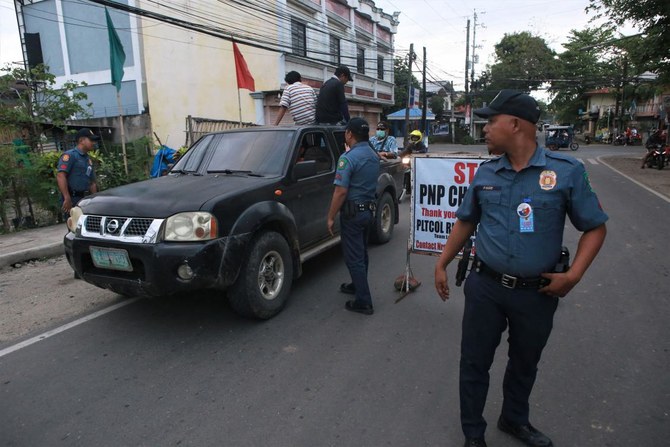
Policemen man a checkpoint between the border of Tanjay City and Pamplona town in the Philippine Province of Negros Oriental on March 4, 2023, hours after the provincial governor Roel Degamo and five others were killed by unknown gunmen. (AFP)
Short Url
Updated 05 March 2023
Follow

Three arrested over killing of Philippine governor

PAMPLONA: Three people have been arrested over the murder of a Philippine provincial governor and eight others, authorities said Sunday, adding another suspect was killed in a shoot-out.
Seventeen people were also wounded in the audacious attack on Saturday in the sugarcane-growing heartland of the Philippines.
At least six gunmen armed with rifles and wearing military-style uniforms opened fire in the governor’s home in Pamplona municipality in the central province of Negros Oriental.
Governor Roel Degamo became the latest victim of a recent rash of assaults on local Philippine politicians.
Two of the three suspects arrested were former soldiers who were dishonorably discharged several years ago, the Philippine Army said in a statement.
A fourth suspect was killed in a shootout in a plantation on Saturday night, police spokesman Lt. Col. Gerard Pelare told journalists.
Pelare said about 10 suspects were involved in the attack. Authorities believed they were still on the island after ports were closed to prevent their escape, he said.
The previous death toll had been put at six but was raised to nine late Saturday, police said. Thirteen people were hospitalized for their wounds, while four others were treated for minor injuries.
Negros Oriental is one of two provinces on Negros island, which is the center of the nation’s sugar industry and home to some of the country’s wealthiest landowners as well as some of its poorest farm workers.
Degamo, 56, was at least the third politician to be shot in the Philippines since last year’s general election.
The Supreme Court declared him last month the rightful winner of the contest for the Negros Oriental governorship following a recount that unseated his rival, who had previously been proclaimed victor.
Degamo had campaigned for President Ferdinand Marcos during Marcos’ run for the top job.
Marcos has condemned the “dastardly and heinous” assassination of his political ally and has sent his top officials, including police and military chiefs, to investigate.
Authorities presented evidence at a news conference on Sunday gathered from the suspects, including high-powered firearms and camouflage uniforms, and vowed to solve the case.
“We will capture the mastermind, I assure you that,” Interior Secretary Benjamin Abalos said.


Pakistan is latest Asian country to step up checks for deadly Nipah virus

Updated 2 sec ago
Follow

Pakistan is latest Asian country to step up checks for deadly Nipah virus

  • Vietnam, Thailand, Singapore, Hong Kong, Malaysia and Indonesia have also tightened screening
  • Nipah has high mortality rate but not easily transmitted; there is also no vaccine for it
LAHORE/HANOI: Authorities in Pakistan have ordered enhanced screening of people entering the country for signs of infections of the deadly Nipah virus after India confirmed two cases, adding to the number of Asian countries stepping up controls.
Thailand, Singapore, Hong Kong, Malaysia, Indonesia and Vietnam have also tightened screening at airports.
The Nipah virus can cause fever and brain inflammation and has a high mortality rate. There is also no vaccine. But transmission from person to person is not easy and typically requires prolonged contact with an infected individual.
“It has become imperative to strengthen preventative and surveillance measures at Pakistan’s borders,” the Border Health Services department said in a statement.
“All travelers shall undergo ⁠thermal screening and clinical assessment at the Point of Entry,” which includes seaports, land borders and airports, the department added.
The agency said travelers would need to provide transit history for the preceding 21-day period to check whether they had been through “Nipah-affected or high-risk regions.”
There are no direct flights between Pakistan and India and travel between the two countries is extremely limited, particularly since their worst fighting in decades in May last year.
In Hanoi, the Vietnamese capital’s health department on Wednesday ⁠also ordered the screening of incoming passengers at Noi Bai airport, particularly those arriving from India and the eastern state of West Bengal, where the two health workers were confirmed to have the virus in late December.
Passengers will be checked with body temperature scanners to detect suspected cases. “This allows for timely isolation, epidemiological investigation,” the department said in a statement.
That follows measures by authorities in Ho Chi Minh City, Vietnam’s largest city, who said they had tightened health controls at international border crossings.
India’s health ministry said this week that authorities have identified and traced 196 contacts linked to the two cases with none showing symptoms and all testing negative for the virus.
Nipah is a rare viral infection that spreads largely from infected ⁠animals, mainly fruit bats, to humans. It can be asymptomatic but it is often very dangerous, with a case fatality rate of 40 percent to 75 percent, depending on the local health care system’s capacity for detection and management, according to the World Health Organization.
The virus was first identified just over 25 years ago during an outbreak among pig farmers in Malaysia and Singapore, although scientists believe it has circulated in flying foxes, or fruit bats, for thousands of years.
The WHO classifies Nipah as a priority pathogen. India regularly reports sporadic infections, particularly in the southern state of Kerala, regarded as one of the world’s highest-risk regions for Nipah.
As of December 2025, there have been 750 confirmed Nipah infections globally, with 415 deaths, according to the Coalition for Epidemic Preparedness Innovations, which is funding a vaccine trial to help stop Nipah.