China plans 7.2% defense spending rise this year, faster than GDP target

1 / 3
Military vehicles take part in a military parade at Tiananmen Square in Beijing on October 1, 2019, to mark the 70th anniversary of the founding of the People’s Republic of China. (AFP)
2 / 3
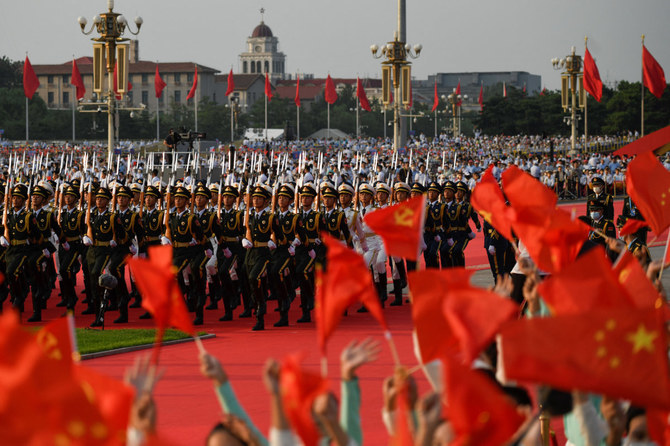
Chinese honor guards prepare for celebrations in Beijing on July 1, 2021, to mark the 100th anniversary of the founding of the Communist Party of China. (AFP)
3 / 3
China fired ballistic missiles and deployed fighter jets August 4, 2022 as it held its largest-ever military exercises around Taiwan in reaction to US House Speaker Nancy Pelosi's visit to the island. (AFP)
Short Url
Updated 06 March 2023
Follow

China plans 7.2% defense spending rise this year, faster than GDP target

  • Budget is closely watched as a barometer of how aggressively China will beef up its military
  • Premier Li says armed forces should boost combat preparedness

BEIJING: China will boost defense spending 7.2 percent this year, slightly outpacing last year’s increase and faster than the government’s modest economic growth forecast, as Premier Li Keqiang called for the armed forces to boost combat preparedness.
The 1.55 trillion yuan ($224 billion) in military spending in the national budget released on Sunday is closely watched by China’s neighbors and in Washington as a barometer of how aggressively the country will beef up its military.
This year’s hike marks the eighth consecutive single-digit increase. As in previous years, no breakdown of the spending was given, only the overall amount and the rate of increase.
The spending increase outpaces targeted economic growth of around 5 percent, which is slightly below last year’s target as the world’s second-largest economy faces domestic headwinds.
Beijing is nervous about challenges on fronts ranging from Chinese-claimed Taiwan to US naval and air missions in the disputed South China Sea near Chinese-occupied islands.
China staged war games near Taiwan last August to express anger at the visit to Taipei of then-US House Speaker Nancy Pelosi.
In his work report to the annual session of parliament, Li said military operations, capacity building and combat preparedness should be “well-coordinated in fulfilling major tasks.”
“Our armed forces, with a focus on the goals for the centenary of the People’s Liberation Army in 2027, should work to carry out military operations, boost combat preparedness and enhance military capabilities,” he said in the state-of-the-nation address to the largely rubber-stamp legislature.
China, with the world’s largest military in terms of personnel, is busy adding a slew of new hardware, including aircraft carriers and stealth fighters.
Its development and Beijing’s strategic intentions have sparked concern regionally and in Washington, especially as tensions have spiked in recent years over Taiwan.
Beijing says its military spending for defensive purposes is a comparatively low percentage of its GDP and that critics want to demonize it as a threat to world peace.
“The armed forces should intensify military training and preparedness across the board, develop new military strategic guidance, devote greater energy to training under combat conditions and make well-coordinated efforts to strengthen military work in all directions and domains,” Li said.


Hundreds in London protest against Beijing ‘mega embassy’

Updated 3 sec ago
Follow

Hundreds in London protest against Beijing ‘mega embassy’

  • Protesters, their faces mostly covered with scarves or masks, chanted “No to Chinese embassy“
  • The latest protest came ahead of an expected decision this week

LONDON: Hundreds of people on Saturday rallied in London against Beijing’s controversial new “mega” embassy, days ahead of a decision on the plan.
Protesters, their faces mostly covered with scarves or masks, chanted “No to Chinese embassy” and waved flags reading “Free Hong Kong. Revolution now.”
Others held up placards with slogans such as “MI5 warned. Labour kneeled,” referring to the UK’s domestic intelligence agency and Prime Minister Keir Starmer’s ruling party.
Others read: “CCP (Chinese Communist Party) is watching you. Stop the mega embassy.”
China has for several years been trying to relocate its embassy, currently in the British capital’s upmarket Marylebone district, to the sprawling historic site in the shadow of the Tower of London.
The move has sparked fierce opposition from nearby residents, rights groups and critics of China’s ruling Communist Party.
The latest protest came ahead of an expected decision this week.
Benedict Rogers, head of the human rights group Hong Kong Watch said if it got the go-ahead it was “highly likely” that the site “will be used for espionage,” citing the sensitive underground communications cables close to the site.
He said China had already been “carrying out a campaign of transnational repression against different diaspora communities” and other critics and predicted that that would “increase and intensify.”

Beijing ‘operations base’ -

A protester who gave his name only as Brandon, for fear of reprisals, said the plans raised a “lot of concerns.”
The 23-year-old bank employee, originally from Hong Kong but now living near Manchester in northwestern England, said many Hong Kongers had moved to the UK “to avoid authoritarian rule in China.”
But they now found there could be an embassy in London serving as an “operations base” for Beijing.
“I don’t think it’s good for anyone except the Chinese government,” he said.
Another demonstrator, who did not to give her name, called on Starmer to “step back and stop it (the plan) because there is a high risk to the national security of the UK, not only Hong Kongers.”
The 60-year-old warehouse worker, also originally from Hong Kong and now living in Manchester, said the embassy would be a “spy center not only to watch the UK but the whole of Europe.”
Speakers at the rally throwing their weight behind the campaign to stop the embassy included Kemi Badenoch, leader of the main opposition Conservative Party.
British MPs voiced major security concerns earlier this week after a leading daily reported the site would house 208 secret rooms, including a “hidden chamber.”
The Daily Telegraph said it had obtained unredacted plans for the vast new building which would stand on the historical site of the former Royal Mint.
It showed that Beijing reportedly plans to construct a single “concealed chamber” among “secret rooms” underneath the embassy which would be placed alongside the underground communications cables.