

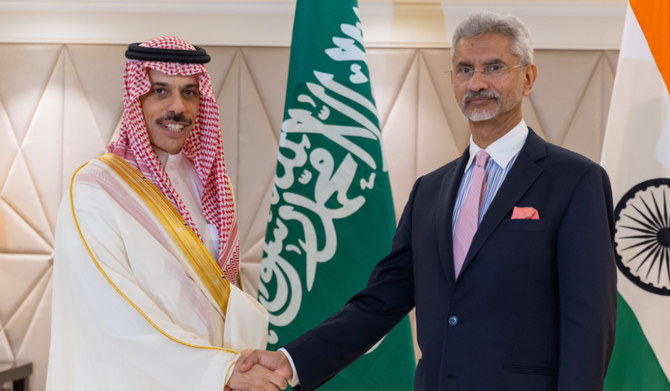

NEW DELHI: Saudi Arabia’s foreign minister and his Indian counterpart discussed global developments on Friday, after the top diplomats of the world’s 20 biggest economies met in New Delhi.
The foreign ministers of the Group of 20, which includes the US, Saudi Arabia, Japan, Russia, China and the EU, arrived in the Indian capital for the second high-level ministerial meeting under India’s G20 presidency this year.
The talks on Thursday were dominated by tensions over Russia’s invasion of Ukraine, which prevented them from finding enough common ground to deliver a joint statement at the end of the summit.
The G20 meeting was followed by Indian Foreign Minister Subrahmanyam Jaishankar’s individual discussions with some of the participants.
In a morning meeting with his Saudi counterpart Prince Faisal bin Farhan, he said he had discussed “global developments.”
“A good conversation this morning with FM Faisal bin Farhan of Saudi Arabia,” Jaishankar said on Twitter. “Appreciate Saudi Arabia’s support in the G20. Also discussed global developments.”
During the G20 meeting’s session on promoting multilateralism, development cooperation, food and energy security, Prince Faisal “reiterated the importance of resolving conflicts and political tensions hindering effective action on facing global challenges and exacerbating economic fragmentation,” the Saudi Press Agency reported.
He also “praised the efforts of the Indian government during its presidency of the G20,” as New Delhi has been trying to enhance multilateral action in light of the current global political and economic challenges.
Experts see the Saudi foreign minister’s engagements in India as bringing the two countries closer together on global political issues.
“The main point about Saudi foreign policy is that it is following an independent foreign policy based on strategic autonomy. This makes the Kingdom very close to India in its approach,” Talmiz Ahmad, former Indian ambassador to Saudi Arabia, told Arab News.
“The most important aspect in the message that is coming to me from G20 at the moment is the need for countries of the South to cooperate with each other. I do not believe there is any prospect in the near future of Western countries participating in any serious dialogue relating to global issues.”
Talmiz said that it was now time for countries like Saudi Arabia and India to cooperate even closer.
Muddassir Quamar, Middle East expert and fellow at the Institute of Defence Studies and Analyses in New Delhi, said that now was the right moment for New Delhi and Riyadh to broaden cooperation.
“There is immense political and diplomatic momentum in favor of strengthening the ties,” he told Arab News.
“The two sides have many mutual and shared interests when it comes to issues of the Global South, including climate change, net zero and so on, and they have been cooperating on these issues at the G20 as well as other forums.”
Mohammed Soliman, director of the Strategic Technologies and Cyber Security Program at the Middle East Institute in Washington, said Saudi Arabia and India were natural economic and strategic partners, both aspiring to strategic autonomy and asserting themselves as major G20 nations.
“Delhi and Riyadh aim to present a middle ground between Washington and Brussels on the one hand, and Beijing and Moscow on the other, as the G20 is evolving into the de facto global governance mechanism,” he said.
“The meetings between the Saudi foreign minister (and) Indian leaders in Delhi reflect the two nations’ common objective of building more direct channels that are crucial to coordinate their positions on regional issues as well as the G20.”


