THESSALONIKI, Greece: Emergency crews cut through the mangled remains of a passenger train on Thursday, progressing “centimeter by centimeter” in their search for the dead from a head-on collision in northern Greece that killed at least 46 people.
Rail workers went on strike to protest years of underfunding they say has left the country’s train system in a dangerous state.
The passenger train and a freight train slammed into each other late Tuesday, crumpling carriages into twisted steel knots and forcing people to smash windows to escape. It was the country’s deadliest crash ever, and more than 50 people remained hospitalized, most in the central Greek city of Larissa. Six of them were in intensive care.
Fire Service spokesman Yiannis Artopios said the grim recovery effort was proceeding “centimeter by centimeter.”
“We can see that there are more (bodies) people there. Unfortunately they are in a very bad condition because of the collision,” Artopios told state television.
STATION MANAGER CHARGED
The cause of the crash is still not clear. A station manager arrested after the collision was charged Wednesday with multiple counts of manslaughter and causing serious physical harm through negligence, as a judicial inquiry tries to establish why the two trains were traveling in opposite directions on the same track.
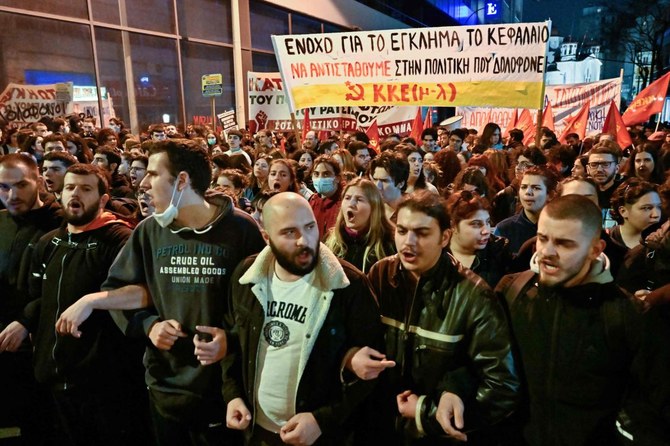
Railway workers’ associations, meanwhile, called strikes, halting national rail services and the subway in Athens. They are protesting working conditions and what they described as a dangerous failure to modernize the Greek rail system due to a lack of public investment during the deep financial crisis that spanned most of the previous decade and brought Greece to the brink of bankruptcy.
Transport Minister Kostas Karamanlis resigned following the crash, his replacement tasked with setting up an independent inquiry looking into the causes of the accident.
“Responsibility will be assigned,” Prime Minister Kyriakos Mitsotakis said in a televised address late Wednesday after visiting the scene of the collision.
“We will work so that the words ‘never again’ ... will not remain an empty pledge. That I promise you.”
Supporters of the strike plan to protest in central Athens later Thursday.
CRASH SURVIVOR DESCRIBES FIERY ESCAPE
More than 300 people were on board the passenger train, many of them were students returning from a holiday weekend and annual Carnival celebrations around Greece.
Andreas Alikaniotis, a 20-year-old survivor of the crash, described how he and fellow students, escaped from a jack-knifed train car as fire approached, smashing windows and throwing luggage onto the ground outside to use as a makeshift landing pad.
“It was a steep drop, into a ditch,” Alikaniotis, who suffered a knee injury, told reporters from his hospital bed in Larissa.
“The lights went out. And light had came from the approaching fire and the sparks that were flying. The smoke was suffocating inside the rail car but also outside,” Alikaniotis said.
“I managed to remain calm and I was one of the few around who had not been seriously injured,” he said. “Me and my friends helped people get out.”
GREEKS OFFER HELP
Residents in Larissa lined up to give blood, many waiting in heavy rain for more than an hour, while the city’s hotel association provided free accommodation to relatives of the crash victims and to those who traveled to the city to provide DNA samples to help police forensics experts identify bodies. Nine bodies have been identified through genetic matches so far, authorities said.
Pope Francis and European leaders sent messages of sympathy in the wake of the crash. Among them were the Turkish Foreign Minister Mevlut Cavusoglu, whose country is recovering from devastating earthquakes last month. Ukrainian President Volodymyr Zelensky sent a message in Greek, writing “The people of Ukraine share the pain of the families of the victims. We wish a speedy recovery to all the injured.”


Greece: Grim train search moves ‘centimeter by centimeter’
https://arab.news/vxmh2
Greece: Grim train search moves ‘centimeter by centimeter’

- Rail workers went on strike to protest years of underfunding they say has left the country’s train system in a dangerous state
- It was the country's deadliest crash ever, and more than 50 people remained hospitalized


Pakistanis fleeing Iran describe strikes shaking ground under their feet
- Nearly 1,000 students, businessmen and pilgrims have fled Iran since the war started out of a total 35,000 Pakistanis in the country
QUETTA: Pakistanis fleeing Iran described explosions and missile strikes across Tehran shaking the ground under their feet and engulfing buildings in fire and smoke in a city emptied of many of its residents. The conflict has widened sharply, with a US submarine sinking an Iranian warship off Sri Lanka on Wednesday and NATO air defenses destroying an Iranian missile fired toward Turkiye.
Governments have been scrambling to evacuate stranded citizens, with most of the region’s airspace closed due to the risk of missiles hitting passenger planes.
“I was in the classroom when a powerful explosion rocked our university building,” Hareem Zahra, 23, a student at the Tehran University of Engineering, told Reuters after crossing Pakistan’s land border with Iran.
“We saw thick smoke coming from many buildings on fire,” she said, adding Tehran was under attack until the moment she left.
TEHRAN LOOKED DESERTED
Nearly 1,000 students, businessmen and pilgrims have fled Iran since the war started out of a total 35,000 Pakistanis in the country, Mudassir Tipu, Pakistan’s ambassador to Tehran, said.
“There are now serious challenges. As you know there is no Internet in most parts of Iran,” he said. Iran has retaliated with a barrage of ballistic missiles targeting Israel and Washington’s allies in the Gulf, including Qatar, Kuwait, the UAE, and Saudi Arabia, following US and Israeli air strikes that killed Supreme Leader Ayatollah Ali Khamenei on Saturday.
Tehran has looked deserted since the conflict began, said Nadir Abbas, 25, a student of Persian literature at a university in the Iranian capital.
“I saw a drone hit a basketball court where six girl players lost their lives.”
Reuters could not verify his account.
DESTRUCTION EVERYWHERE
Islamabad is walking a diplomatic tightrope as it attempts to maintain warming ties with Washington while expressing solidarity with Iran.
Pakistan is home to the second-largest Shiite population in the world after Iran and being drawn into the conflict could lead to instability at home as well as complications evacuating its citizens.
“The first attack happened right next to my hospital,” said Sakhi Aun Mohammad, a student at Tehran University of Medical Sciences. After he reached the border, an Iranian friend called to check if he was safe, saying: “’Thank God, you have gone to Pakistan, all of you are safe, but your hostel has been attacked’.” A Pakistani diplomat who is still in Tehran said attacks took place every four or five hours, adding one missile struck a building next to his office. “At times you will feel as if something exploded right at your feet,” he said. “The last time I got out was at night. Buildings had collapsed, some others were on fire. There is destruction everywhere.”
He added: “It is almost like a ghost town.”


