THESSALONIKI, Greece: Emergency crews cut through the mangled remains of a passenger train on Thursday, progressing “centimeter by centimeter” in their search for the dead from a head-on collision in northern Greece that killed at least 46 people.
Rail workers went on strike to protest years of underfunding they say has left the country’s train system in a dangerous state.
The passenger train and a freight train slammed into each other late Tuesday, crumpling carriages into twisted steel knots and forcing people to smash windows to escape. It was the country’s deadliest crash ever, and more than 50 people remained hospitalized, most in the central Greek city of Larissa. Six of them were in intensive care.
Fire Service spokesman Yiannis Artopios said the grim recovery effort was proceeding “centimeter by centimeter.”
“We can see that there are more (bodies) people there. Unfortunately they are in a very bad condition because of the collision,” Artopios told state television.
STATION MANAGER CHARGED
The cause of the crash is still not clear. A station manager arrested after the collision was charged Wednesday with multiple counts of manslaughter and causing serious physical harm through negligence, as a judicial inquiry tries to establish why the two trains were traveling in opposite directions on the same track.
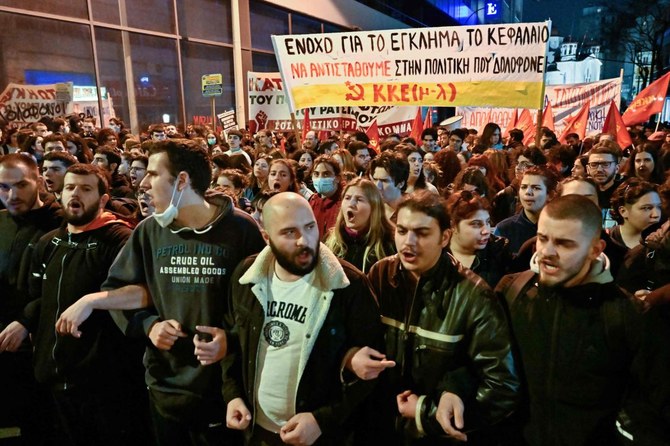
Railway workers’ associations, meanwhile, called strikes, halting national rail services and the subway in Athens. They are protesting working conditions and what they described as a dangerous failure to modernize the Greek rail system due to a lack of public investment during the deep financial crisis that spanned most of the previous decade and brought Greece to the brink of bankruptcy.
Transport Minister Kostas Karamanlis resigned following the crash, his replacement tasked with setting up an independent inquiry looking into the causes of the accident.
“Responsibility will be assigned,” Prime Minister Kyriakos Mitsotakis said in a televised address late Wednesday after visiting the scene of the collision.
“We will work so that the words ‘never again’ ... will not remain an empty pledge. That I promise you.”
Supporters of the strike plan to protest in central Athens later Thursday.
CRASH SURVIVOR DESCRIBES FIERY ESCAPE
More than 300 people were on board the passenger train, many of them were students returning from a holiday weekend and annual Carnival celebrations around Greece.
Andreas Alikaniotis, a 20-year-old survivor of the crash, described how he and fellow students, escaped from a jack-knifed train car as fire approached, smashing windows and throwing luggage onto the ground outside to use as a makeshift landing pad.
“It was a steep drop, into a ditch,” Alikaniotis, who suffered a knee injury, told reporters from his hospital bed in Larissa.
“The lights went out. And light had came from the approaching fire and the sparks that were flying. The smoke was suffocating inside the rail car but also outside,” Alikaniotis said.
“I managed to remain calm and I was one of the few around who had not been seriously injured,” he said. “Me and my friends helped people get out.”
GREEKS OFFER HELP
Residents in Larissa lined up to give blood, many waiting in heavy rain for more than an hour, while the city’s hotel association provided free accommodation to relatives of the crash victims and to those who traveled to the city to provide DNA samples to help police forensics experts identify bodies. Nine bodies have been identified through genetic matches so far, authorities said.
Pope Francis and European leaders sent messages of sympathy in the wake of the crash. Among them were the Turkish Foreign Minister Mevlut Cavusoglu, whose country is recovering from devastating earthquakes last month. Ukrainian President Volodymyr Zelensky sent a message in Greek, writing “The people of Ukraine share the pain of the families of the victims. We wish a speedy recovery to all the injured.”


Greece: Grim train search moves ‘centimeter by centimeter’
https://arab.news/vxmh2
Greece: Grim train search moves ‘centimeter by centimeter’

- Rail workers went on strike to protest years of underfunding they say has left the country’s train system in a dangerous state
- It was the country's deadliest crash ever, and more than 50 people remained hospitalized


Shooting in Austin leaves 3 dead, including suspect, 14 injured
- EMS Chief Robert Luckritz said three people were found dead at the scene, and 14 people were injured and transported to hospitals
AUSTIN: Three people were killed, including the alleged gunman, and 14 others were wounded in a shooting at a popular bar in the Texas capital of Austin, authorities said on Sunday.
Austin Police Chief Lisa Davis said at a news conference that police received a call for reports of a “male shooting” at Buford’s, a beer garden in the city’s entertainment district.
When police arrived at the scene, they confronted a man with a gun and then “returned fire, killing the suspect,” Davis said.
EMS Chief Robert Luckritz said three people were found dead at the scene, and 14 people were injured and transported to hospitals. Of those injured, three were in critical condition. The shooter was among the dead.
“We received a call at 1:39 a.m. and within 57 seconds, the first paramedics and officers were on scene actively treating the patients,” Luckritz said.
It may have been an “act of terrorism,” the FBI said. “It’s still way too early in the process to determine an exact motivation, but there were indicators on the subject and in his vehicle that indicate a potential nexus to terrorism,” FBI special agent Alex Doran said.
“In terms of specifically what type of terrorism, we’re just at this point prepared to say that it was potentially an act of terrorism,” Doran said.


