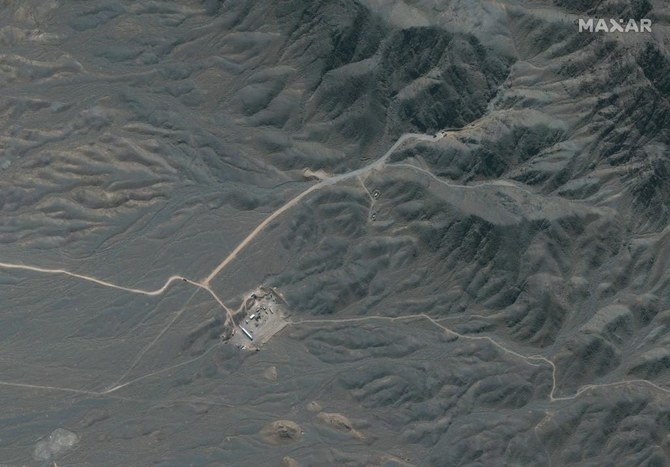
PARIS: France on Thursday called developments in Iran’s nuclear program “very concerning” after the UN nuclear watchdog reported finding uranium particles enriched just under the 90 percent needed for an atomic bomb.
“This report states that the direction Iran is taking is very concerning,” foreign ministry spokeswoman Anne-Claire Legendre told reporters, adding this development was “unprecedented and extremely serious.”
The International Atomic Energy Agency (IAEA) confirmed Tuesday that it had detected particles of uranium enriched to up to 83.7 percent, only just short of the 90 percent needed to produce a nuclear device.
Last week, Iran claimed it had not made any attempt to enrich uranium beyond 60 percent.
The head of the IAEA is to meet with Iran’s President Ebrahim Raisi in Tehran on Saturday to try to “relaunch the dialogue” on the country’s atomic work, a diplomatic source said Wednesday.
Iran has been enriching uranium well over the limits laid down in a landmark 2015 deal with world powers, which started to unravel when the United States withdrew from it in 2018.


France says Iran uranium enrichment ‘very concerning’
https://arab.news/cygrn
France says Iran uranium enrichment ‘very concerning’

- The IAEA confirmed Tuesday that it had detected particles of uranium enriched to up to 83.7%
- Last week, Iran claimed it had not made any attempt to enrich uranium beyond 60 percent



Syria launches debris removal campaign in Idlib
- Officials will prioritize reopening roads to enhance basic services, help residents’ return
LONDON: Syrian authorities launched a campaign to remove at least 600,000 cubic meters of debris in Idlib province, which was created by the civil war.
The Syrian Ministry of Emergency and Disaster Management said on Thursday that the project targets the towns of Khan Sheikhoun, Maaret Al-Numan and Jisr Al-Shughour, areas that sustained significant damage during years of war.
Officials will prioritize removing debris and reopening main and secondary roads to enhance basic services, and facilitate residents’ return, according to the Syrian Arab News Agency.
Last year, about 450,000 cubic meters of rubble were cleared as part of a national recovery plan in Idlib. Officials said that removing debris is essential for restoring infrastructure and enabling displaced residents to return.
The northwestern province of Idlib experienced heavy rainfall in February, leading to the flooding of several displacement camps and the evacuation of hundreds of families. The civil war in Syria, which lasted from 2011 to 2024, left the country’s infrastructure in dire condition and in urgent need of repair.


