DP World appoints Pakistani vice chairman to spearhead 'multibillion-dollar investment strategy'

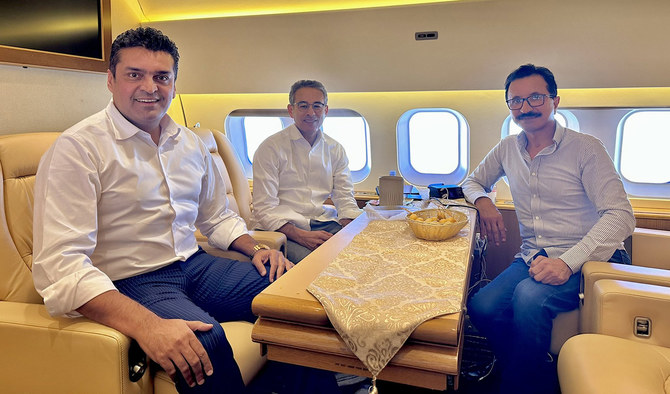
Pakistani celebrity, Fakhar-e-Alam, left, with Emaar founder Mohamed Ali Alabbar, center, and CEO DP World Sultan Ahmed Bin Sulayem. (Photo courtesy: @falamb3/Twitter)
Short Url
Updated 02 March 2023
Follow

DP World appoints Pakistani vice chairman to spearhead 'multibillion-dollar investment strategy'

  • Well-known celebrity Fakhar-e-Alam has been working with UAE firm since last year’s devastating floods
  • Says looking forward to building stronger economic bridges between the "UAE and Pakistan and beyond"

ISLAMABAD: A United Arab Emirates-based multinational logistics company has decided to appoint a Pakistani celebrity, Fakhar-e-Alam, as vice chairman to spearhead a “multibillion-dollar investment strategy” in the South Asian state, said a statement circulated by the organization earlier this week.
It added that Alam, a longtime UAE resident, had been working closely with DP World since last year’s devastating floods in Pakistan, adding the company made a donation of $2.5 million to help the survivors of the natural calamity due to his efforts.
“I am deeply honored and most grateful to His Highness Sheikh Mohammad [bin Rashid Al Maktoum] the ruler of Dubai, His Excellency Sultan Ahmed Bin Sulayem and the leadership of DP World to give me this opportunity,” the statement quoted the Pakistani celebrity as saying.
“I look forward to building newer [and] stronger economic bridges between the UAE and Pakistan and beyond,” he continued. “The challenges that Pakistan is faced with require out of the box thinking and a much more progressive approach towards investors like DP World.”
Alam maintained it was possible to create great value and wealth that would ultimately benefit Pakistanis and help grow trade in the entire region.
DP World is said to be “the crown jewel enterprise of Dubai” which is currently valued at about $90 billion. The company’s core business has also facilitated global trade flow.
The statement said DP World’s “global dominance” was growing at a rapid pace as it had been winning bids, creating new partnerships, and adding greater value to its industry.


Pakistan minister orders measures to ease port congestion, speed up sugar and cement handling

Updated 08 November 2025
Follow

Pakistan minister orders measures to ease port congestion, speed up sugar and cement handling

  • Meeting in Islamabad reviewed congestion at Port Qasim and its impact on export shipments
  • Ports directed to enforce first-come, first-served berthing and penalize unnecessary delays

KARACHI: Pakistan’s Maritime Affairs Minister Junaid Anwar Chaudhry on Saturday directed authorities to streamline sugar and cement operations at Port Qasim after reports of severe congestion caused by the slow unloading of sugar consignments disrupted export activities.

The government has been working to ease port bottlenecks that have delayed shipments and raised logistics costs for exporters, particularly in the cement and clinker sectors. The initiative is part of a broader effort to improve operational efficiency and align port management with national trade and logistics priorities.

“Improving operational efficiency is vital to prevent port congestion, which can cause delays, raise costs, and disrupt the supply chain,” Chaudhry told a high-level meeting attended by senior officials from the maritime and commerce ministries, port authorities and the Trading Corporation of Pakistan.

The meeting was informed that sugar was being unloaded at a rate below Port Qasim’s potential capacity. The minister instructed the Port Qasim Authority to optimize discharge operations in line with its daily capacity of about 4,000 to 4,500 tons.

Participants also reviewed directives from the Prime Minister’s Office calling for up to 60 percent of sugar imports to be redirected to Gwadar Port to ease the load on Karachi terminals.

Officials said all vessels at Port Qasim and Karachi Port would now be berthed on a first-come, first-served basis, with penalties to be applied for unnecessary delays.

The TCP was told to improve operational planning and coordinate vessel arrivals more closely with port authorities.

Chaudhry commended the engagement of all participants and said consistent adherence to performance standards was essential to sustaining port efficiency and preventing a recurrence of logistical disruptions.