

SpaceX launches UAE, US, Russian astronauts on voyage to space station

A SpaceX Falcon 9 rocket with the Crew Dragon spacecraft lifts off from launch pad 39A at the Kennedy Space Center. (AFP)
Short Url
Updated 02 March 2023
Follow

SpaceX launches UAE, US, Russian astronauts on voyage to space station

  • Four astronauts launched to the International Space Station for NASA on Thursday
  • Launch included first person from the Arab world going up for an extended monthslong stay

CAPE CANAVERAL: SpaceX launched four astronauts to the International Space Station for NASA on Thursday, including the first person from the Arab world going up for an extended monthslong stay.
The Falcon rocket bolted from Kennedy Space Center shortly after midnight, illuminating the night sky as it headed up the East Coast..
Nearly 80 spectators from the United Arab Emirates watched from the launch site as astronaut Sultan Al-Neyadi — only the second Emirati to fly to space — blasted off on his six-month mission.

Half a world away in Dubai and elsewhere across the UAE, schools and offices planned to broadcast the launch live.
Also riding the Dragon capsule that’s due at the space station on Friday: NASA’s Stephen Bowen, a retired Navy submariner who logged three space shuttle flights, and Warren “Woody” Hoburg, a former research scientist at Massachusetts Institute of Technology and space newbie, and Andrei Fedyaev, a space rookie who’s retired from the Russian Air Force.
The first attempt to launch them was called off Monday at the last minute because of a clogged filter in the engine ignition system.
They will replace a US-Russian-Japanese crew that has been up there since October. The other station residents are two Russians and an American whose six-month stay was doubled, until September, after their Soyuz capsule sprang a leak. A replacement Soyuz arrived last weekend.
Al-Neyadi, a communications engineer, served as backup for the first Emirati astronaut, Hazzaa Al-Mansoori, who rode a Russian rocket to the space station in 2019 for a weeklong visit. The oil-rich federation paid for Al-Neyadi’s seat on the SpaceX flight.
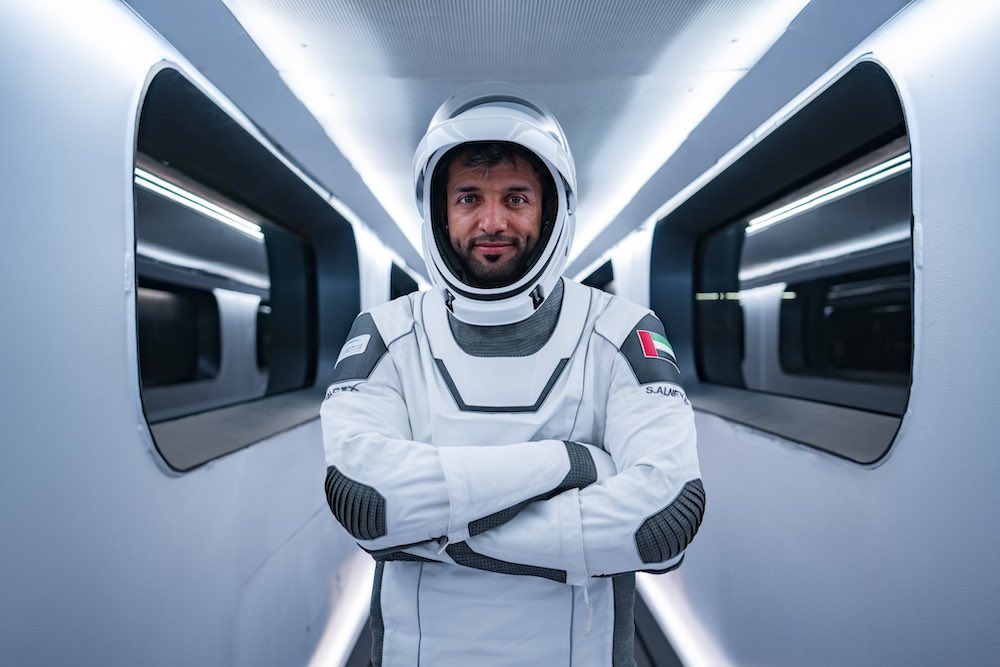


The UAE’s minister for public education and advanced technology, Sarah Al-Amiri, said the long mission “provides us a new venue for science and scientific discovery for the country.”
“We don’t want to just go to space and then not have much to do there or not have impact,” said the director general of the UAE’s space center in Dubai, Salem Al-Marri.
The Emirates already have a spacecraft orbiting Mars, and a mini rover is hitching a ride to the moon on a Japanese lander. Two new UAE astronauts are training with NASA’s latest astronaut picks in Houston.
Saudi Prince Sultan bin Salman was the first Arab in space, launching aboard shuttle Discovery in 1985. He was followed two years later by Syrian astronaut Muhammed Faris, launched by Russia. Both were in space for about a week.


Al-Neyadi will be joined this spring by two Saudi astronauts going to the space station on a short private SpaceX flight paid by their government.
“It’s going to be really exciting, really interesting” to have three Arabs in space at once, he said last week. “Our region is also thirsty to learn more.”


He’s taking up lots of dates to share with his crewmates, especially during Ramadan, the Muslim holy month which begins this month. As for observing Ramadan in orbit, he said fasting isn’t compulsory since it could make him weak and jeopardize his mission.
Bowen, the crew’s leader, said the four have jelled well as a team despite differences between their countries. Even with the tension over the war in Ukraine, the US and Russia have continued to work together on the space station and trade seats on rides there.
“It’s just tremendous to have the opportunity to fly with these guys,” Bowen said.


Isolated Kremlin critics lament lost future at Nemtsov memorial

Updated 4 sec ago
Follow

Isolated Kremlin critics lament lost future at Nemtsov memorial

  • Hundreds used to flock to the makeshift memorial on the anniversary of his death
  • Since Russia ordered troops into Ukraine it has intensified a crackdown on dissent, with almost no opposition to the Kremlin visible on the street

MOSCOW: On a bridge next to the Kremlin on a drizzly Friday morning, a lone Russian police officer stood looking at the half-dozen bunches of flowers laying in memory of slain opposition figure Boris Nemtsov.
The symbolism was almost too much.
Four years into Moscow’s full-scale offensive on Ukraine, which has seen President Vladimir Putin eradicate all forms of dissent and usher in strict military censorship laws that have silenced his critics, few Russians dared, or wanted, to pay tribute.
Nemtsov, a longtime Putin opponent, was shot and killed on February 27 2015, meters from the Kremlin’s red walls. He was 55.
Hundreds used to flock to the makeshift memorial on the anniversary of his death, which came on Friday.
This year, there was barely a trickle. Those who turned up were visibly nervous.
“So few people, they’ve all forgotten,” lamented one elderly man, who refused to give his name.
“Everybody is afraid,” a woman standing nearby added.
Since Russia ordered troops into Ukraine it has intensified a crackdown on dissent, with almost no opposition to the Kremlin visible on the street.
AFP reporters on Friday morning saw only around a dozen mourners alongside Western ambassadors laying red carnations.
“Keep moving, don’t gather in a crowd, don’t block the way for other citizens,” a police officer said through a megaphone.
Three days after Russia launched its offensive on Ukraine in 2022, protesters had staged an impromptu rally against the war at the memorial on the anniversary of Nemtsov’s death.
Nemtsov’s supporters have always accused Chechen leader and key Putin ally Ramzan Kadyrov of ordering his killing.
Kadyrov has rejected the claims.
Five Chechens were convicted of a contract killing but investigators never said who it was ordered by.

- ‘Everything is persecuted’ -

For his followers, Nemtsov is a totemic figure in Russian political life — seen as a once-future leader who might have taken the country on a different path.
“I come here every year,” said 79-year-old scientist Sergei at the bridge on Friday.
“Russia should have had — though unfortunately it didn’t work out — a leader exactly like Nemtsov,” he told AFP, declining to give his surname.
“Right now everything here is suppressed, everything is persecuted, people are sitting in prisons.”
A physicist by education, Nemtsov rose to fame in the 1990s as a young, liberal provincial governor, and was widely tipped to take over from Boris Yeltsin.
He gave his hesitant backing to Putin when the ex-KGB spy was tapped to enter the Kremlin instead, but became an early — and fierce — opponent of what he cast as the Russian leader’s creeping authoritarianism.
He had largely lost popularity and was only a marginal figure in Russian politics when he was killed in 2015. Still, his murder shocked the country and the world.
“The hopes of the whole country were pinned on him — of all the people who wanted it to be free here,” said Olga Vinogradova, a 66-year-old volunteer who tends to the pop-up memorial to Nemtsov on the bridge.
“When this man was killed, naturally, all of us were, we were all just executed at that moment. Because our hopes were destroyed,” she said.
“With this memorial, we remind people that there was a different path for Russia. And that there was a real person who could have led us down this path.”

- ‘Forced out’ -

Nemtsov had strongly opposed Putin’s 2014 annexation of Crimea from Ukraine and Moscow’s military backing for pro-Russian separatists in eastern Ukraine.
He was also a close and early ally of Alexei Navalny, who died in 2024 in an Arctic prison in what his supports say was a poisoning.
Open opposition to the Kremlin is unheard of inside Russia since the first days of the Ukraine offensive — when riot police cracked down hard on the thousands that took to the streets to protest.
All major critics of the Kremlin are in exile, prison or dead.
Those that remain have been silenced.
“Many have been forced out of the country, some have been killed,” said Gleb, a 23-year-old photographer.
A movement or person like Nemtsov was “impossible” to imagine right now, he said.
Still, he held on to a slither of hope.
“But everything can change at any moment.”