Iran may fine Pakistan $18 billion for delaying joint pipeline project — official

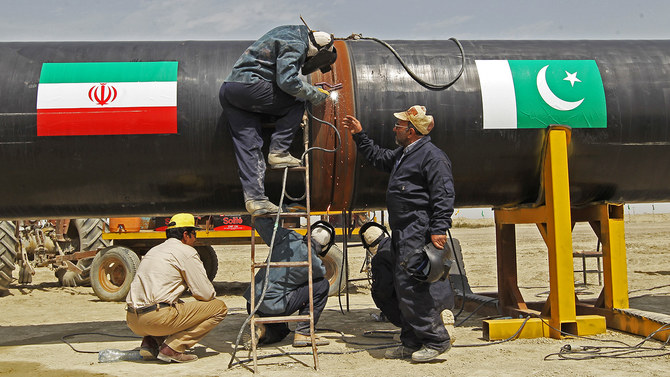
Iranians work on a section of a pipeline after the project was launched during a ceremony with presidents of Iran and Pakistan on March 11, 2013 in the Iranian border city of Chah Bahar. (AFP/File)
Short Url
Updated 02 March 2023
Follow

Iran may fine Pakistan $18 billion for delaying joint pipeline project — official

  • The two countries signed a preliminary agreement to carry out the project in 1995 to help Pakistan import gas from Iran
  • The government has taken up the issue with US authorities, who have imposed sanctions on Tehran, while seeking relief

ISLAMABAD: Pakistan could face a financial penalty of $18 billion, said a senior government functionary while briefing the Public Accounts Committee (PAC) of the National Assembly on Wednesday, if it failed to implement a pipeline project involving Iran on time.
The two countries reached a preliminary agreement to build a pipeline in 1995 to help Pakistan import natural gas from Iran.
The project originally planned to involve India as well, though the administration in New Delhi pulled out in 2009 due to pricing and security issues.
Briefing the committee over the issue, petroleum division secretary Muhammad Mahmood said the government had discussed the issue with the United States, which has imposed sanctions on Iran, while seeking relief.
“The members of the committee asked how much penalty could be imposed on Pakistan for not completing the Iran gas pipeline on time,” reported the Express Tribune newspaper. “The secretary petroleum responded that as per the agreement, the penalty could be $18 billion. He also remarked that they have asked the US ambassador to either give them permission to go ahead with the project or give them money to pay the fine.”
The committee instructed the foreign ministry to discuss the situation with the US envoy to the country.
Pakistan has been trying to explore different options to import energy products at discounted rates from the international markets to reduce its import bill amid mounting financial challenges.
According to official figures, the country has already imported energy products worth $10.6 billion during the first seven months of the current fiscal year.
Last year, its petroleum import bill stood at $23.3 billion, which was 105 percent higher than the year before that.


Pakistan says $50 million meat export deal with Tajikistan nearing finalization

Updated 5 sec ago
Follow

Pakistan says $50 million meat export deal with Tajikistan nearing finalization

  • Islamabad expects to finalize agreement soon after Dushanbe signals demand for 100,000 tons
  • Pakistan is seeking to expand agricultural trade beyond rice, citrus and mango exports

ISLAMABAD: Tajikistan has expressed interest in importing 100,000 tons of Pakistani meat worth more than $50 million, with both governments expected to finalize a supply agreement soon, Pakistan’s food security ministry said on Tuesday.

Pakistan is trying to grow agriculture-based exports as it seeks regional markets for livestock and food commodities, while Tajikistan, a landlocked Central Asian state, has been expanding food imports to support domestic demand. Pakistan currently exports rice, citrus and mangoes to Dushanbe, though volumes remain small compared to national production, according to official figures.

The development came during a meeting in Islamabad between Pakistan’s Federal Minister for National Food Security and Research Rana Tanveer Hussain and Ambassador of Tajikistan Yusuf Sharifzoda, where agricultural trade, livestock supply and food-security cooperation were discussed.

“Tajikistan intends to purchase 100,000 tons of meat from Pakistan, an import valued at over USD 50 million,” the ambassador said, according to the ministry’s statement, assuring full facilitation and that Islamabad was prepared to meet the demand.

The statement said the two sides agreed to expand cooperation in meat and livestock, fresh fruit, vegetables, staple crops, agricultural research, pest management and standards compliance. Pakistan also proposed strengthening coordination on phytosanitary rules and establishing pest-free production zones to support long-term exports.

Pakistan and Tajikistan have long maintained political ties but bilateral food trade remains below potential: Pakistan produces 1.8 million tons of mangoes annually but exported just 0.7 metric tons to Tajikistan in 2024, while rice exports amounted to only 240 metric tons in 2022 out of national output of 9.3 million tons. Pakistan imports mainly ginned cotton from Tajikistan.