

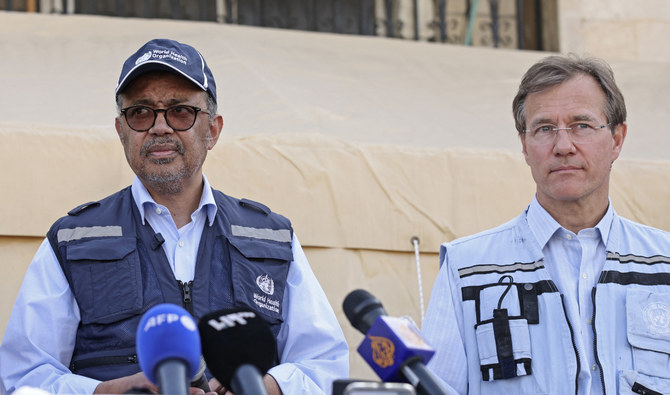

BAB AL-HAWA, Syria: World Health Organization chief Tedros Adhanom Ghebreyesus on Wednesday visited areas of rebel-held northwestern Syria that were devastated by last month’s earthquake, an AFP correspondent reported.
Tedros, the highest-ranking United Nations official to visit Syria’s rebel-held zones since the February 6 quake, had traveled to government-controlled areas of Aleppo and Damascus the week of the disaster.
He entered Syria on Wednesday from neighboring Turkiye via the Bab Al-Hawa crossing and visited several hospitals and a shelter for those displaced, the correspondent said.
In the aftermath of the quake, activists and emergency teams in the rebel-held northwest decried the UN’s slow response, contrasting it with the planeloads of humanitarian aid that have been delivered to government-controlled airports.
A total of 258 planes laden with aid have reached regime-controlled areas, 129 of them from the United Arab Emirates.
UN relief chief Martin Griffiths admitted on February 12 that the body had “so far failed the people in northwest Syria.”
Since then, the UN launched a $397 million appeal to help quake victims in Syria.
The United Nations says a total of 420 trucks loaded with UN aid have crossed into the rebel-held pocket since the tragedy.
More than 4 million people live in areas outside government control in Syria’s north and northwest, 90 percent of whom depend on aid to survive.
The first UN aid convoy crossed into the area on February 9 — three days after the quake struck — and carried tents and other relief for 5,000 that had been expected before the earthquake.
The UN largely delivers relief to Syria’s northwest via neighboring Turkiye through the Bab Al-Hawa crossing — the only way for aid to enter without Damascus’s permission.
The crossing is located in the Idlib region, which UN officials rarely visit and is controlled by the jihadist group Hayat Tahrir Al-Sham.
The WHO chief said on February 12 that Assad had expressed openness to more border crossings for aid to be brought to quake victims in the rebel-held northwest.
On February 13, the United Nations said Damascus had allowed it to also use two other crossings in areas outside its control — Bab Al-Salama and Al-Rai — for three months.
An AFP correspondent said a new aid convoy entered via Bab Al-Salama on Wednesday.
The first UN delegation to visit rebel-held northwestern Syria after the earthquake crossed over from Turkiye on February 14.
It comprised deputy regional humanitarian coordinator David Carden and Sanjana Quazi, who heads the UN Office for the Coordination of Humanitarian Affairs in Turkiye and was largely an assessment mission.
The 7.8-magnitude quake that struck war-torn Syria and Turkiye killed more than 50,000 people across the two countries.
The Syrian government has said 1,414 people were killed in areas under its control, while Turkish-backed officials in Syria have put the death toll in rebel-held areas at 4,537.


