Rampaging Israeli settlers set fire to homes and cars in West Bank

1 / 4
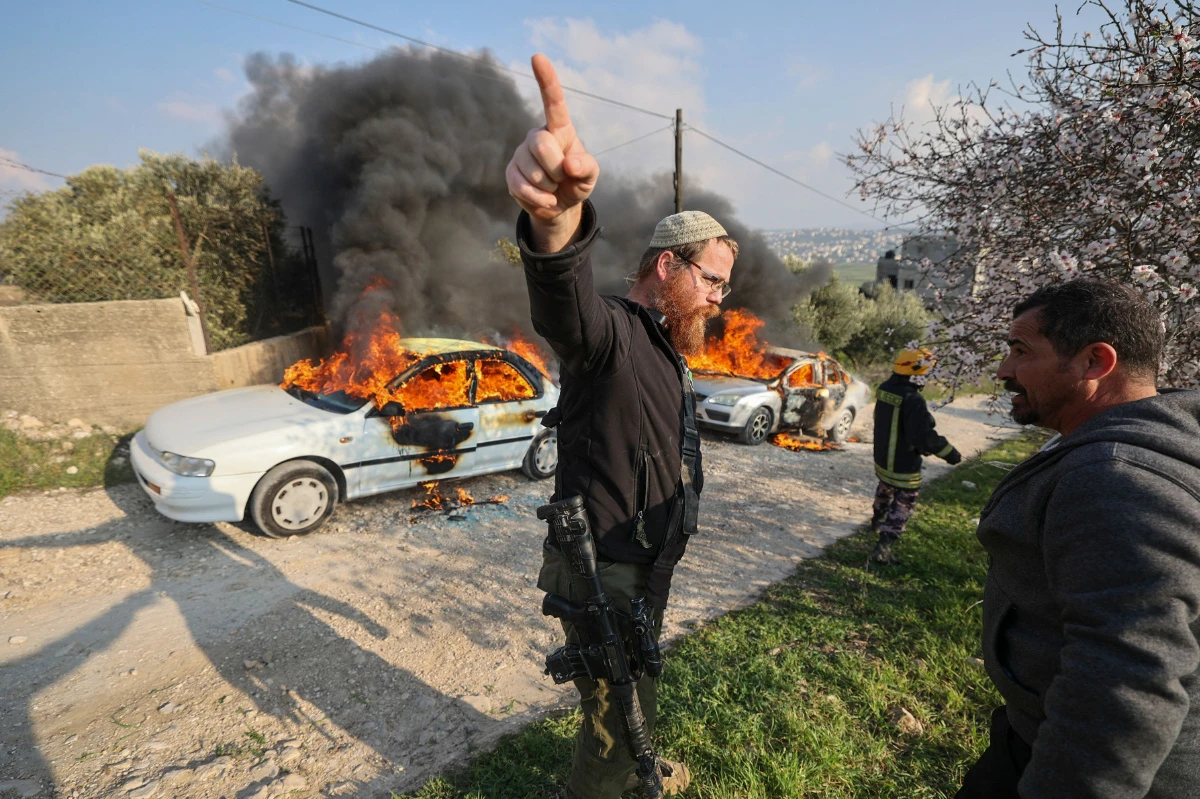
An armed Israeli gestures amid clashes between settlers and Palestinians in Burin village, after settlers reportedly set cars on fire in the village on Feb. 25, 2023. (AFP)
2 / 4
Palestinians carry a youth injured during clashes with Israeli settlers from the nearby Bracha settlement, who reportedly set fire to cars in Burin village in the occupied West Bank on Feb. 25, 2023. (AFP)
3 / 4
Palestinian youths from Burin village hurl rocks at settlers (background) from the nearby Israeli Bracha settlement who reportedly set fire to cars in the village on Feb. 25, 2023. (AFP)
4 / 4
A member of Israeli security forces and one from settlement security walk past a burning car reportedly set on fire by settlers in the Palestinian Burin village on Feb. 25, 2023. (Jaafar Ashtiyeh / AFP)
Short Url
Updated 27 February 2023
Follow

Rampaging Israeli settlers set fire to homes and cars in West Bank

  • Officials said the rampage was sparked by the killing of two Israeli brothers by a suspected Palestinian gunman
  • Netanyahu appeals for calm, while Abbas "holds the Israeli government fully responsible” for the violence

JERUSALEM: Scores of Israeli settlers went on a violent rampage in the northern West Bank late Sunday, setting dozens of cars and homes on fire after two settlers were killed by a Palestinian gunman.

Palestinian medics said one man was killed and four others were badly wounded in what appeared to be the worst outburst of settler violence in decades.

Israelis from the Har Bracha settlement went berserk after a Palestinian gunman killed two Israeli brothers as they were driving in the occupied West Bank on Sunday, according to officials.

Israel’s military said the gunman came to a junction “and opened fire toward an Israeli vehicle.” One of the slain victims was a soldier in a program for Jewish seminary students.

There was no immediate claim of responsibility for the Palestinian attack, which came as Israeli and Palestinian officials met in Jordan to discuss ways of lowering tensions.

After the shooting, Palestinians reported that Israelis from Har Bracha settlement attacked Palestinian houses in nearby Burin village.

Ghassan Daghlas, an official in charge of anti-settlement activities, said several Palestinian houses and 15 cars had been set on fire, while Palestinian media said some 30 homes and cars were torched.

Photos and video on social media showed large fires burning throughout the town of Hawara — scene of the deadly shooting earlier in the day — and lighting up the sky.

In one video, crowds of Jewish settlers could be heard reciting the Jewish prayer for the dead as they stared at a building in flames. And earlier, a prominent Israeli Cabinet minister and settler leader had called for Israel to strike “without mercy.”

Late Sunday, the Palestinian Health Ministry said a 37-year-old man was shot and killed by an Israeli settler. The Palestinian Red Crescent medical service said two other people were shot and wounded, a third person was stabbed and a fourth was beaten with an iron bar. Some 95 others were being treated for tear gas inhalation.

The Israeli military, which was operating in the area, did not have any immediate comment.

Palestinian President Mahmoud Abbas condemned what he called “the terrorist acts carried out by settlers under the protection of the occupation forces tonight.”
“We hold the Israeli government fully responsible,” he added.
As videos of the violence appeared on evening news shows, Prime Minister Benjamin Netanyahu appealed for calm and urged against vigilante violence. “I ask that when blood is boiling and the spirit is hot, don’t take the law into your hands,” Netanyahu said in a video statement.
The Israeli military said its chief of staff, Lt. Gen. Herzl Halevi, was rushing to the scene and that forces were trying to restore order.
The rampage occurred shortly after the Jordanian government, which hosted Sunday’s talks at the Red Sea resort of Aqaba, said the sides had agreed to take steps to de-escalate tensions and would meet again next month ahead of the Muslim holy month of Ramadan.
“They reaffirmed the necessity of committing to de-escalation on the ground and to prevent further violence,” the Jordanian Foreign Ministry announced.

After nearly a year of fighting that has killed over 200 Palestinians and more than 40 Israelis in the West Bank and east Jerusalem, the Jordanian announcement marked a small sign of progress. But the situation on the ground immediately cast those commitments into doubt.


The Palestinians claim the West Bank, east Jerusalem and Gaza Strip – areas captured by Israel in the 1967 Mideast war – for a future state. Some 700,000 Israeli settlers live in the West Bank and east Jerusalem. The international community overwhelmingly considers the settlements as illegal and obstacles to peace.
The West Bank is home to a number of hard-line settlements whose residents frequently vandalize Palestinians land and property. But rarely is the violence so widespread.
Prominent members of Israel’s far-right government called for tough action against the Palestinians.
Israeli Finance Minister Bezalel Smotrich, a settler leader who lives in the area and has been put in charge of much of Israel’s West Bank policy, called for “striking the cities of terror and its instigators without mercy, with tanks and helicopters.”
Using a phrase that calls for a more heavy-handed response, he said Israel should act “in a way that conveys that the master of the house has gone crazy.”

Opinion

This section contains relevant reference points, placed in (Opinion field)

An Israeli ministerial committee gave initial approval to a bill that would impose the death penalty on Palestinians convicted in deadly attacks. The measure was sent to lawmakers for further debate.
There were also differing interpretations of what exactly was agreed to in Aqaba between the Palestinians and Israelis.
Jordan’s Foreign Ministry said the representatives agreed to work toward a “just and lasting peace” and had committed to preserving the status quo at Jerusalem’s contested holy site.
Tensions at the site revered by Jews as the Temple Mount and Muslims as the Haram Al-Sharif have often spilled over into violence, and two years ago sparked an 11-day war between Israel and the Hamas militant group during Ramadan.
Officials with Israel’s government, the most right-wing in Israeli history, played down Sunday’s meeting.
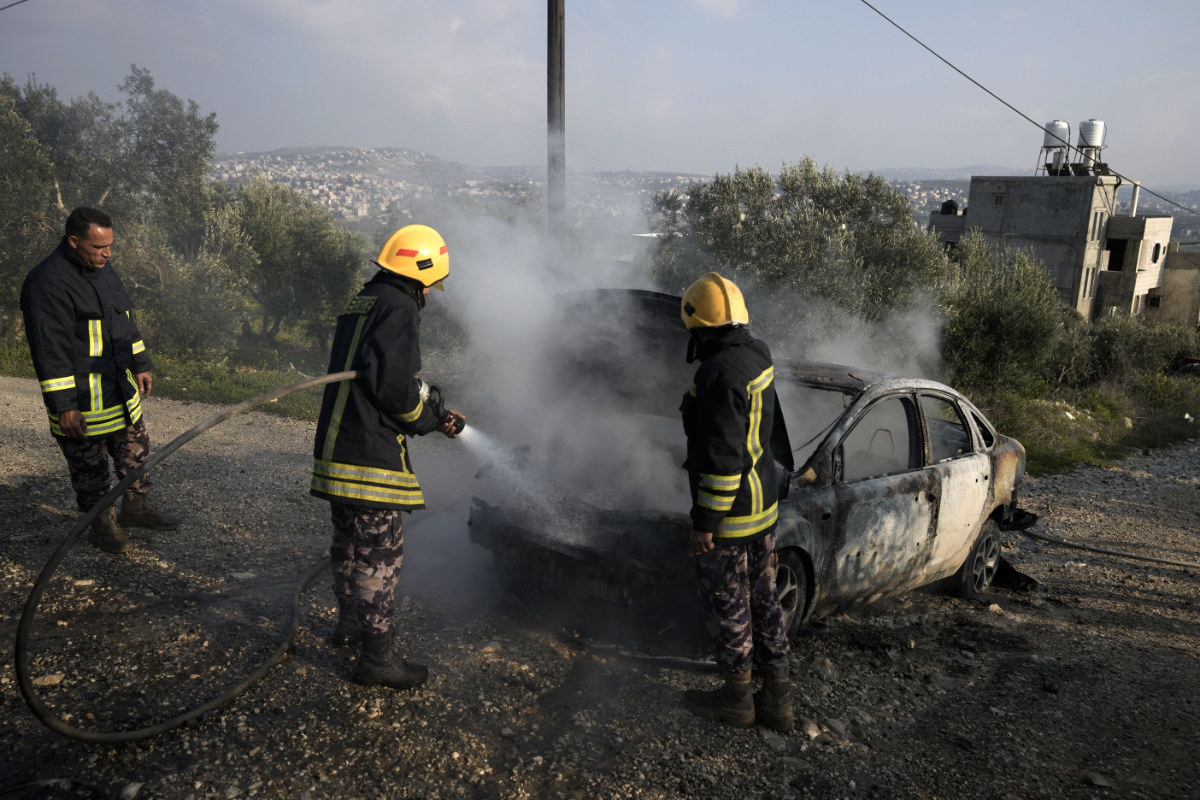


Palestinian firefighters extinguish a burning car, which residents say was set on fire by Israeli settlers, in Burin village near the West Bank city of Nablus on Feb. 25, 2023. (AP Photo/Majdi Mohammed) 

A senior official, speaking on condition of anonymity under government guidelines, said only that the sides in Jordan agreed to set up a committee to work at renewing security ties with the Palestinians. The Palestinians cut off ties last month after a deadly Israeli military raid in the West Bank.
Netanyahu’s national security adviser, Tzachi Hanegbi, who led the Israeli delegation said there were “no changes” in Israeli policies and that plans to build thousands of new settlement homes approved last week would not be affected.
He said “there is no settlement freeze” and “there is no restriction on army activity.”
The Jordanian announcement had said Israel pledged not to legalize any more outposts for six months or to approve any new construction in existing settlements for four months.
The Palestinians, meanwhile, said they had presented a long list of grievances, including an end to Israeli settlement construction on occupied lands and a halt to Israeli military raids on Palestinian towns.
Sunday’s shooting in Hawara came days after an Israeli military raid killed 10 Palestinians in the nearby city of Nablus. The shooting occurred on a major highway that serves both Palestinians and Israeli settlers. The two men who were killed were identified as brothers, ages 21 and 19, from the Jewish settlement of Har Bracha.
Hanegbi was joined by the head of Israel’s Shin Bet domestic security agency who attended the talks in neighboring Jordan. The head of the Palestinian intelligence services as well as advisers to President Mahmoud Abbas also joined.
Jordan’s King Abdullah II, who has close ties with the Palestinians, led the discussions, while Egypt, another mediator, and the United States also participated.
In Washington, the US national security adviser, Jake Sullivan, welcomed the meeting. “We recognize that this meeting was a starting point,” he said, adding that iImplementation will be critical.”
It was a rare high-level meeting between the sides, illustrating the severity of the crisis and the concerns of increased violence as Ramadan approaches in late March.
In Gaza, Hamas, an Islamic militant group that seeks Israel’s destruction, criticized Sunday’s meeting and called the shooting a “natural reaction” to Israeli incursions in the West Bank.
Israel withdrew from Gaza in 2005. The Hamas militant group subsequently took control of the territory, and Israel and Egypt maintain a blockade over the territory.


What do the leaked Assad videos tell us about the deposed Syrian regime?

Updated 5 sec ago
Follow

What do the leaked Assad videos tell us about the deposed Syrian regime?

  • Videos obtained by Al-Arabiya and Al-Hadath channels expose former president Bashar Assad’s inner circle, revealing toxic culture
  • Regional media coverage regard leaks as confirmation of critiques of Assad’s contempt for Syrians, cynicism toward allies

LONDON: The recent leak by Al-Arabiya of a series of videos allegedly showing Bashar Assad in candid, closed-door conversations has reopened longstanding questions about how his former regime functioned — and perhaps why Syria descended into such a devastating conflict.

Assad is shown in the Al-Arabiya leaks, prior to his Dec. 8, 2024, ouster, making contemptuous remarks about Syrians, Syria itself, Eastern Ghouta and even Russian President Vladimir Putin, while speaking privately with his late adviser Luna Al-Shibl.

While the new Syrian government of Ahmad Al-Sharaa has not verified the footage, analysts say the material is consistent with the behavior patterns of Assad’s inner circle: personalized decision-making, narrative obsession and a deep-rooted siege mentality.

“These videos don’t actually tell Syrians anything new — they merely reveal, with complete clarity, what people have known and lived through for decades,” Ibrahim Hamidi, editor-in-chief of Al-Majalla, who is himself from Syria, told Arab News.

“What stands out to me is the indifference and contempt he shows toward everything: his people, his cities, his allies, and the sense that power is an inheritance, not a responsibility.”

In one clip, when Al-Shibl asks him what he feels about the state of Syria, Assad says he does not only feel ashamed but “disgusted,” adding that this is “our country,” conveying revulsion rather than responsibility.

In another segment he says that when Syrians look him in the face he “loves them” yet is also “disgusted by them,” exposing a deeply cynical view of his own population.

He is also shown mocking ordinary Syrians for their spending priorities, saying they spend money on mosques even though they “cannot afford food.”

Several clips are from a tour of Eastern Ghouta and its surroundings, during or after the area’s reconquest in 2018. Assad is heard cursing Ghouta, directed at an area that had endured years of siege and bombardment.

“It showed that Assad is a weak dictator,” said Ghassan Ibrahim, a Syria expert and founder of the Global Arab Network. “He tried to present himself as a strong personality, but all these videos showed how easy it was to be manipulated by his assistant, his media officer.”

In another clip, Assad appears to mock the Russian president’s appearance, despite Moscow having been his main war-time ally.

When Al-Shibl draws his attention to how “puffy” Putin looks, Assad responds that it is “all procedures” or “all surgeries,” suggesting extensive cosmetic work.

The tone in these exchanges is casual and derisive, portraying Assad as privately belittling Putin’s looks while publicly thanking him.

“Such remarks reflect Assad’s deep-rooted duplicity,” said Egyptian writer and political expert Hani Nasira. “The same man who publicly deferred to Putin — whose military intervention preserved Assad’s rule and offered him refuge — privately mocked him.

“These comments will likely erode whatever sympathy Putin may still have for the former Syrian leader and underscore Assad’s penchant for betrayal, even toward those who offered him sanctuary.”

Hamidi concurs: “The question now is: How will Putin respond? Especially since Bashar lives in Moscow — and Putin does not easily forgive any insult.”

The videos also capture Assad and Al-Shibl speaking dismissively about Hezbollah and pro-regime commanders.

Regional media coverage framed the Assad leaks as confirmation of long-held critiques of his contempt for Syrians and cynicism toward allies, with tone varying by outlet but broadly harsh.

Pan-Arab platforms like The New Arab and Asharq Al-Awsat foregrounded Assad’s insults toward Ghouta, Syrians and the army, highlighting his disgust at Syria, and mockery of soldiers as emblematic of an entrenched disdain for his own population.

Gulf-based media stressed his ridicule of loyalist figures and allies, using the leaks to underline his perceived disloyalty to those who fought for him and to question his past narratives of steadfastness and resistance.

Syrian opposition-aligned and exile media amplified the footage as further evidence of his moral and political bankruptcy rather than a revelation, stressing that the content matched years of lived experience under his rule.

A recurring feature in the leaked clips is Assad’s habit of issuing direct orders to intelligence chiefs, senior officers and advisers, bypassing ministries and formal structures.

The informal tone — part off-the-record briefing, part reprimand — underscores the extent to which the Syrian state under Assad revolved around personal allegiance.

Assad postured publicly as a defender of the Syrian state but has since been unmasked as someone who harbors deep disdain for all around him.

In private, he mocks his loyal fighters, sneers at those who kiss his hand, and speaks of them with derision — as if unable to feel genuine empathy for their sacrifices.

“This is a man who views Syria through the lens of masters and servants, rulers and ruled,” said Nasira.

“To Assad, those who fought for him — in Syria and abroad — are nothing more than an annoyance. Speaking casually and comfortably to Al-Shibl, he reveals a condescending view of the nation, his people, and even his inner circle.”

The leaked videos stripped away the official image and exposed the toxic culture of a ruling circle that never viewed Syrians as citizens with rights but “as subjects expected to endure anything,” Hamidi said.

“For years, they endured hardships believing Assad was steady, serious, and above chaos. What hurts them now is seeing a completely different personality: careless, mocking, and seemingly dismissive of people’s suffering.

“This shakes the narrative they built in their minds to justify their loyalty. And when that narrative cracks, everything else becomes harder to defend.”

The footage also shows Assad fixating on media coverage, urging officials to safeguard the regime’s messaging and chastising those who, in his view, allowed “contradictory signals” to emerge.

His language mirrors longstanding regime strategy: project strength, deny missteps and attribute all instability to external interference.

Another pattern evident throughout the clips is Assad’s repeated framing of Syria’s crises as part of a coordinated foreign plot. Whether discussing political dissent, economic collapse or battlefield challenges, the theme of encirclement dominates.

The leaked comments reveal that “for Bashar Assad, there was never a true cause or message — just a regime to preserve, and a throne to protect,” Nasira said.

Despite the performative confidence, the videos reveal moments of frustration, especially when Assad chastises advisers for mismanaging situations or warns of rivalries within the security services.

The timing of the leaks is notable. Regional governments have reopened channels with Damascus, diplomatic rehabilitation is creeping forward, and the question of Syria’s postwar reconstruction looms large.

“Released on the anniversary of what pro-regime media called “Liberation Day” — marking the collapse of Assad’s rule — the timing could not have been more symbolic,” said Nasira.

For Syrians, the footage is less revelation than validation — an affirmation of what many lived through: a state defined not by institutions but by coercion, suspicion and the whims of an inner circle.

“Most Syrians no longer care about Bashar himself; they care about Syria’s future. They want to look forward, not backward,” said Hamidi.

For international observers, the videos offer one of the clearest windows yet into the operating logic of a regime that has survived sanctions, war, isolation and internal collapse.