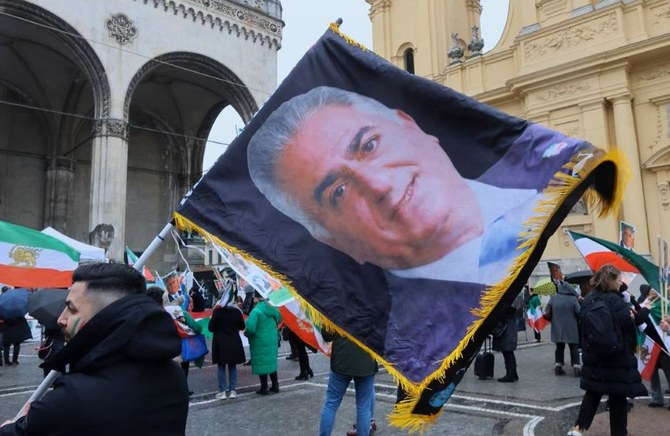

LONDON: The eldest son of the last shah of Iran has urged Western governments to support popular efforts to topple the regime in Tehran.
Reza Pahlavi, who is in Europe to drum up support for young activists in his country, told the Guardian that the West should proscribe the Islamic Revolutionary Guards Corps as a terrorist organization and help Iranians circumvent the regime’s restrictions on the internet.
“The reason the revolution is continuing is because everybody understands this is do-or-die. Iranians are calling for ‘death to the dictator’. They are getting shot in the eyes and, if not, imprisoned or tortured or executed, and they are still standing there,” Pahlavi said. “The world needs to respond and be on their side.”
Pahlavi, often referred to as Iran’s crown prince, said reform-minded politicians and elements of the IRGC would abandon the regime if enough external and internal pressure was brought to bear on Tehran.
“The discourse of the reformists is increasingly: ‘Forget about reform. It is not going to work, and we need to think past this regime.’ There is a convergence with what we are saying,” he said.
So far, Western governments have been reluctant to move beyond sanctioning the IRGC itself over fears that doing so could derail any possibility of reviving the Joint Comprehensive Plan of Action, or Iran Nuclear Deal.
The IRGC, Pahlavi said, “is an armed paramilitary mafia that controls every aspect of the country, but only the top echelons of the IRGC benefit from this.
“The lower ranks have to decide if they want to be used as an instrument of repression, or to consider this regime is on its last legs and they should take the exit strategy being offered to them, through truth and reconciliation, and return to the bosom of the nation.
“In my vision of regime change, the lower paramilitary ranks peel away from the regime, but that requires maximum pressure by the West.”
He added: “Political expediency often has a problem with freedom-loving movements. The fact some governments are suggesting the protests are tapering off is perhaps because they want to justify some re-engagement and negotiations. It’s a bit like South Africa at the end of apartheid. Governments tried to ignore the issue until it was impossible to do so.
“It is curious to me that the Biden administration is so hell-bent on rejuvenating a JCPOA, when first time round the West did not benefit economically. As long as this regime is in power there will be a complete block on cooperating with the West. That is the mindset.”
Pahlavi, who has been in exile from Iran since he was 17, said he was drawing up a charter with activists based on democratic principles for a future Iranian political system.
“It originates from inside Iran, and that is why it has legitimacy,” he said. “This is not something we concocted to export to Iran. Quite the opposite. We are the voice of those inside Iran that cannot openly advocate for obvious reasons. It is a diverse group: left, right, center, republicans and monarchists.”
He added: “I am not here to be president or the next monarch. I am here to use my political capital and the trust that people have in me to be instrumental in helping the transition process.
“My only mission in life is to see the day the Iranians go to the polls and decide their own fate,” he said. “If afterwards I can contribute by helping to institutionalize checks on concentration of power, or corruption, or abuse of power or a new political culture … that is where I think I can be most effective.”
He distanced himself from association with his father’s rule, which came to an end with the Iranian Revolution in 1979. “People do not look at me as going back to the past. They look at me and see someone moving towards a future,” he said.
“Had it not been for this revolution, we should at least have been South Korea. Instead, we are North Korea.”