

Social media reacts to removal of artwork by Palestinian children from London hospital  

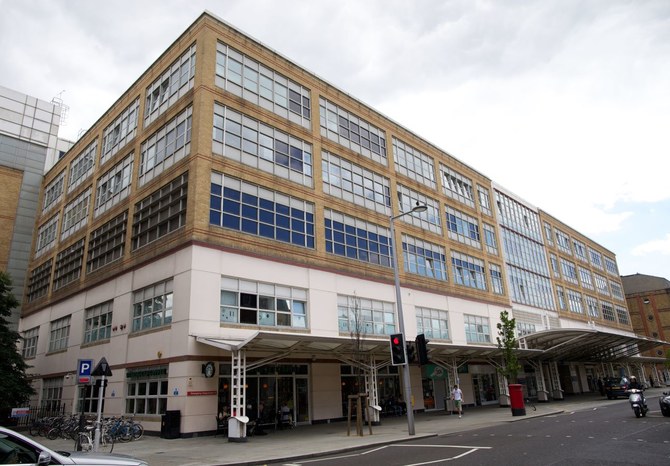
Social media users are protesting in droves after it was announced that the Chelsea and Westminster Hospital in London has removed Palestinian children’s art from a display, following complaints by a UK-based pro-Israel lawyer group. (AFP)
Short Url
Updated 27 February 2023
Follow

Social media reacts to removal of artwork by Palestinian children from London hospital  

DUBAI: Social media users are protesting in droves after it was announced that a hospital in London has removed Palestinian children’s art from a display, following complaints by a UK-based pro-Israel lawyer group.  

The displayed artwork at the Chelsea and Westminster Hospital was drawn by Palestinian children from Gaza and featured a number of designs, including that of an olive branch and images of Temple Mount with a Palestinian flag.  

The artwork, titled “Crossing Borders - A Festival of Plates,” was designed by schoolchildren from two United Nations Relief Work Agency (UNRWA) schools in Gaza — Beit Lahia Girls’ School and the Jabalia Prep Boys’ A School — and was displayed at the children’s outpatients department.  

The artwork was removed following a complaint by the UK Lawyers for Israel group (UKLFI). 

“Jewish patients have approached UKLFI for help, saying that they feel vulnerable, harassed and victimised by this display. UKLFI has written to Lesley Watts, the Chief Executive of the Chelsea and Westminster Hospital NHS Foundation Trust asking for the display to be removed,” UKLFI wrote on its website on Feb. 9.  

Although the artwork was removed in mid-February, netizens have taken to social media over the past two days to protest the move. 

“Cultural genocide: Pro-Israel lawyers complained about art by Palestinian children at a London hospital because it made Jewish patients feel uncomfortable (or guilty?). The art was removed,” commented one user on Twitter, sharing the news. 

“Totally pathetic of the UKLFI and the Chelsea and Westminster hospital for giving in. Is this really true? It’s artwork which is supposed to be unifying,” wrote another user on Twitter.  

“Not sure which is worse, the cruel heartlessness of UK Lawyers For Israel or the craven spinelessness of Chelsea and Westminster Hospital,” tweeted Fanar Haddad, an assistant professor at The University of Copenhagen.  

On Feb. 14, Caroline Turner, director of UKLFI, commented: “We are pleased that the display has been removed and that the hospital has responded positively to its patients’ complaints.”


Sotheby’s ‘Origins II’: Local heroes go under the hammer 

Updated 15 January 2026
Follow

Sotheby’s ‘Origins II’: Local heroes go under the hammer 

  • Regional highlights from Sotheby’s ‘Origins II’ auction, which takes place Jan. 31 in Diriyah 

DUBAI: Here are some of the regional highlights from Sotheby’s ‘Origins II’ auction, which takes place Jan. 31 in Diriyah.

Mohamed Siam 

‘Untitled (Camel Race)’ 

Siam is described by Sotheby’s as “one of the most significant voices of the Kingdom’s second generation of modern artists.” His “highly discernible visual aesthetic,” the auction catalogue states, references European cubists and Italian Futurism, using “multiple overlapping planes to create an endless sense of movement” — an approach that “fragments visual reality, enabling the viewer to experience multiple viewpoints simultaneously.” This work from the late 1980s “shrewdly captures through a fractured, shifting perspective two camel riders in an enthralling, head-to-head race.” It marks Siam’s auction debut and is expected to fetch between $70,000 and $90,000.  


Abdulhalim Radwi 

‘Untitled (Hajj Arafah)’ 

The Makkah-born artist is one of Saudi modernism’s most significant figures. His “multifaceted practice was shaped by a profound engagement with regional heritage and the evolving aesthetic currents of the 20th century,” the catalogue notes. This 1967 oil painting is hailed by Sotheby’s as “a vibrant example of Radwi’s practice (at the time), depicting a bustling arrangement of tented structures rendered in his characteristic Cubist-inflected idiom. The tightly interlocking forms, rhythmic repetitions, and cool, airy palette evoke the temporal architecture of the Hajj pilgrimage, distilled into a kaleidoscopic composition that celebrates the textures and visual poetry of life in Makkah.” 


Mohammed Al-Saleem 

‘Untitled’ 

Another of the Kingdom’s modern-art pioneers, Al-Saleem was born in 1939 in Al-Marat province. His work, Sotheby’s says, “is celebrated for its distinct visual language, a style which the artist coined ‘Horizonism.’ Drawing inspiration from the shifting sands and gradating skyline of Riyadh as seen from the desert, as well as the intensity of the Saudi sun, Al-Saleem reimagined his beloved landscape through the prism of abstraction.” In works such as this 1989 oil painting, he “replaced the traditional horizon line with stylized forms resembling organic forms and Arabic calligraphy … a fusion of modernist abstraction and cultural identity.” 


Taha Al-Sabban  

‘Untitled’ 

This mixed-media-on-canvas work from 2005 typifies the Makkah-born artist’s modernist approach, which, Sotheby’s states “has been described as both an act of conservation and a homage to the nature and culture of his homeland.” The artist “used expressive color and form to preserve local memory — palm groves, open waters, and traditional architecture — while transforming the traditional cityscape into ascending, abstracted rhythms.” His work is often described as “nostalgic,” but the Al-Sabban is quoted by the Al-Mansouria Foundation as saying: “Although I am acutely aware of the passage of time, my aim is not nostalgia; instead I seek to capture the moment and reveal the life in the world.” 


Zeinab Abd El-Hamid 


‘Untitled (Shisha Shop)’ 

This 1987 watercolor is the work of one of Egypt’s most significant female artists of the modern era who belonged, Sotheby’s says “to a generation of artists who came of age during the cultural reawakening that followed Egypt’s independence.” Abd El-Hamid, the catalogue states, “painted with a refined sensibility, grounded in her belief in humanity’s ability to transcend hardship. She did not seek to romanticize the past, but to distill its forms and emotions into something enduring. Her work carries a sense of nostalgia for a rhythm of life rooted in shared dignity and poetic structure … rooftops, cafés, and courtyards become vessels of memory, harmony, and inner light.” 


Samia Halaby 

‘Copper’ 

Central to the Palestinian artist’s practice was the belief that “abstraction, like any visual language, is shaped by social forces and reflects the movements of working people and revolutionary ideas,” Sotheby’s states. This 1976 oil painting combines Halaby’s exploration of the diagonal as “a dynamic formal element” and of the reflective properties of metals. The work “eschews traditional linear perspective in favor of a compositional strategy that flattens and destabilizes the viewer’s gaze. Halaby achieves a sense of spatial infinity — not through illusion, but through repetition and variation.” 


Mahmoud Sabri 

‘Demonstration’ 

The Iraqi painter’s career, Sotheby’s says, was unique among his peers in his homeland. “He simultaneously explored Arab and European cultures, studied the history of painting, and created his own unique art language and style.” That language arrived after this particular oil painting from the early Sixties, a time in which “Sabri often returned to the subject of revolutionary martyrdom and probably referring to the events of the 1963 coup d’état.” In the foreground, a group of women surround a bereaved mother, who is weeping for her murdered son.