

SpaceX set to launch next International Space Station crew for NASA

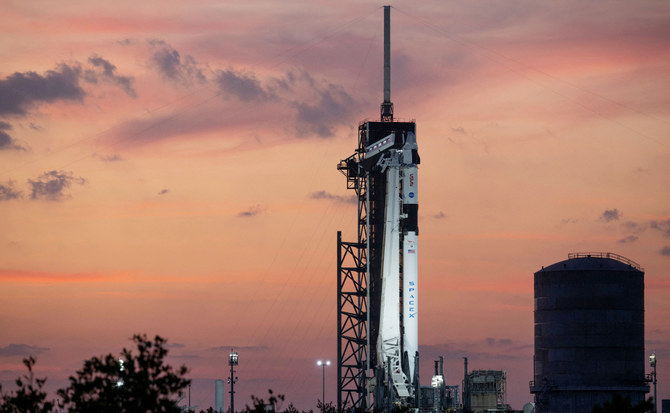
In this handout provided by the US National Aeronautics and Space Administration (NASA), A SpaceX Falcon 9 rocket with the company's Dragon spacecraft on top is seen at sunset on the launch pad at Launch Complex 39A as preparations continue for the Crew-6 mission, February 25, 2023, at NASA’s Kennedy Space Center in Florida. (AFP)
Short Url
Updated 27 February 2023
Follow

SpaceX set to launch next International Space Station crew for NASA

  • NASA said the mission’s launch readiness review was completed on Saturday, and that the flight was given a “go” to proceed to liftoff as planned

CAPE CANAVERAL, Florida: Elon Musk’s rocket company SpaceX was set to launch early on Monday the International Space Station’s next long-duration team into orbit, with an astronaut from the United Arab Emirates and a Russian cosmonaut joining two NASA crewmates for the flight.
The SpaceX launch vehicle, consisting of a Falcon 9 rocket topped with an autonomously operated Crew Dragon capsule called Endeavour, was set for liftoff at 1:45 a.m. EST (0645 GMT) from NASA’s Kennedy Space Center in Cape Canaveral, Florida.
The four-member crew should reach the International Space Station (ISS) about 25 hours later, on Tuesday morning, to begin a six-month mission in microgravity aboard the orbiting laboratory some 250 miles (420 km) above Earth.
Designated Crew 6, the mission marks the sixth long-term ISS team that NASA has flown aboard SpaceX since the private rocket venture founded by Musk — billionaire CEO of electric car maker Tesla and social media platform Twitter — began sending American astronauts to orbit in May 2020.
NASA said the mission’s launch readiness review was completed on Saturday, and that the flight was given a “go” to proceed to liftoff as planned.
“All systems and weather are looking good for launch,” Musk wrote on Twitter on Sunday.
The latest ISS crew is led by mission commander Stephen Bowen, 59, a onetime US Navy submarine officer who has logged more than 40 days in orbit as a veteran of three space shuttle flights and seven spacewalks.
Fellow NASA astronaut Warren “Woody” Hoburg, 37, an engineer and commercial aviator designated as the Crew 6 pilot, will be making his first spaceflight.
The Crew 6 mission also is notable for its inclusion of UAE astronaut Sultan Alneyadi, 41, only the second person from his country to fly to space and the first to launch from US soil as part of a long-duration space station team. UAE’s first-ever astronaut launched to orbit in 2019 aboard a Russian spacecraft.
Rounding out the four-man Crew 6 is Russian cosmonaut Andrey Fedyaev, 41, who like Alneyadi is an engineer and spaceflight rookie designated as a mission specialist for the team.
Fedyaev is the latest cosmonaut to fly aboard an American spacecraft under a ride-sharing deal signed in July by NASA and the Russian space agency Roscosmos, despite heightened tensions between Washington and Moscow over Russia’s invasion of Ukraine.
The Crew 6 team will be welcomed aboard the space station by seven current ISS occupants — three US NASA crew members, including commander Nicole Aunapu Mann, the first Native American woman to fly to space, along with three Russians and a Japanese astronaut.
The ISS, about the length of a football field and the largest artificial object in space, has been continuously operated by a US-Russian-led consortium that includes Canada, Japan and 11 European countries.
The outpost was conceived in part as a venture to improve relations between Washington and Moscow following the Soviet Union’s collapse and the end of Cold War rivalries that gave rise to the original US-Soviet space race in the 1950s and 1960s.
NASA-Roscosmos cooperation has been tested as never before since Russia invaded Ukraine a year ago, leading the United States to impose sweeping sanctions against Moscow while steadily increasing military aid to the Ukrainian government.
The Crew 6 mission also follows two recent mishaps in which Russian spacecraft docked to the orbiting laboratory sprang coolant leaks apparently caused micrometeoroids, tiny grains of space rock, streaking through space and striking the craft at high velocity.
One of the affected Russian vehicles was a Soyuz crew capsule that had carried two cosmonauts and an astronaut to the space station in September for a six-month mission now set to end in March. An empty replacement Soyuz to bring them home blasted off on Friday and arrived at the space station on Saturday.


Philippines eyes closer cooperation on advanced defense tech with UAE

Updated 58 min 40 sec ago
Follow

Philippines eyes closer cooperation on advanced defense tech with UAE

  • Philippine-UAE defense agreement is Manila’s first with a Gulf country
  • Philippines says new deal will also help modernize the Philippine military

MANILA: The Philippines is seeking stronger cooperation with the UAE on advanced defense technologies under their new defense pact — its first such deal with a Gulf country — the Department of National Defense said on Friday.

The Memorandum of Understanding on Defense Cooperation was signed during President Ferdinand Marcos Jr.’s visit to Abu Dhabi earlier this week, which also saw the Philippines and the UAE signing a comprehensive economic partnership agreement, marking Manila’s first free trade pact with a Middle Eastern nation.

The Philippines-UAE defense agreement “seeks to deepen cooperation on advanced defense technologies and strengthen the security relations” between the two countries, DND spokesperson Assistant Secretary Arsenio Andolong said in a statement.

The MoU “will serve as a platform for collaboration on unmanned aerial systems, electronic warfare, and naval systems, in line with the ongoing capability development and modernization of the Armed Forces of the Philippines,” he added.

It is also expected to further military relations through education and training, intelligence and security sharing, and cooperation in the fields of anti-terrorism, maritime security, and peacekeeping operations.

The UAE’s Ministry of Foreign Affairs has described security and defense as “very promising fields” in Philippine-UAE ties, pointing to Abu Dhabi being the location of Manila’s first defense attache office in the Middle East.

The UAE is the latest in a growing list of countries with defense and security deals with the Philippines, which also signed a new defense pact with Japan this week.

“I would argue that this is more significant than it looks on first read, precisely because it’s the Philippines’ first formal defense cooperation agreement with a Gulf state. It signals diversification,” Rikard Jalkebro, associate professor at the Anwar Gargash Diplomatic Academy in Abu Dhabi, told Arab News.

“Manila is widening its security partnerships beyond its traditional circles at a time when strategic pressure is rising in the South China Sea, and the global security environment is (volatile) across regions.”

Though the MoU is not an alliance and does not create mutual defense obligations, it provides a “framework for the practical stuff that matters,” including access, training pathways, procurement discussions and structured channels” for security cooperation, he added.

“For the UAE, the timing also makes sense, seeing that Abu Dhabi is no longer only a defense buyer; it’s increasingly a producer and exporter, particularly in areas like UAS (unmanned aerial systems) and enabling technologies. That opens a new lane for Manila to explore capability-building, technology transfer, and industry-to-industry links,” Jalkebro said.

The defense deal also matters geopolitically, as events in the Middle East and the Indo-Pacific region have ripple effects on global stability and commerce.

“So, a Philippines–UAE defense framework can be read as a pragmatic hedge, strengthening resilience and options without formally taking sides,” Jalkebro said.