

Fresh controversy as Pakistan president bypasses election tribunal to announce provincial assembly polls

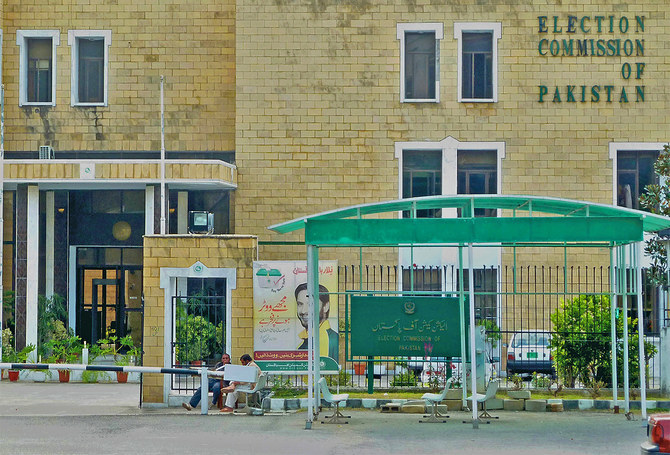
The undated photos shows people sitting outside Election Commission of Pakistan in Islamabad, Pakistan. (Photo courtesy: Radio Pakistan)
Short Url
Updated 21 February 2023
Follow

Fresh controversy as Pakistan president bypasses election tribunal to announce provincial assembly polls

  • President Alvi unilaterally fixed April 9 as election date in Punjab, KP without consulting the ECP
  • Legal experts say the matter was likely to land in the Supreme Court of Pakistan for adjudication 

ISLAMABAD: Pakistan’s electoral body on Tuesday decided to hold consultations with the attorney-general and other legal experts following President Arif Alvi’s announcement of election date in Punjab and Khyber Pakhtunkhwa provinces.

The Election Commission of Pakistan (ECP) took the decision only a day after the president unilaterally fixed April 9 as the election date for the two provincial assemblies which were dissolved by former prime minister Imran Khan’s Pakistan Tehreek-e-Insaf (PTI) party in January to force early national elections.

According to Pakistan’s constitution, elections need to be held “within a period of ninety days after the dissolution” of an assembly.

The governors of the two provinces have not announced any dates for the polls until now, though the Lahore High Court on February 10 directed the ECP to hold Punjab elections within 90 days.

In a statement issued on Tuesday, the election commission said it was prepared to hold the polls within 90 days, “but it is nowhere written in the constitution and law that the commission will give the date for the elections.”

“Albeit, after the date of elections is fixed by a lawful authority, the commission is bound to issue an election schedule and hold elections,” the statement, which was issued after a meeting chaired by chief election commissioner Sikandar Sultan Raja to discuss the situation, said.

“In this regard, the attorney-general of Pakistan has been invited for a meeting tomorrow [Wednesday] and the names of two legal experts are being finalised for the consultation,” it continued.

Prime Minister Shehbaz Sharif-led coalition government has already declared the president’s announcement for the election date as “illegal and unconstitutional,” while warning Alvi to stay away from the matter.

The announcement of election date by the president, who is also a close aide of ex-premier Khan, has generated a debate about his legal and constitutional authority to issue the instruction.

Under Article 57(1) of the Elections Act 2017, the president is empowered to “announce the date of general elections after consultation with the commission.” The president wrote two separate letters to ECPs officials, inviting them for consultations over the election dates, but the latter refused to become part of the process.

“The president has the authority to announce the election date after consultation with the ECP,” Barrister Reza Ali told Arab News, “but here, in this case, the required deliberations were not held.”

“Such situation has arisen for the first time. Therefore, the matter may ultimately land in the Supreme Court for adjudication,” he continued, adding if the president’s direction was not challenged in the courts, the ECP would be under legal obligation to follow it to hold the elections on April 9.

Syed Amjad Shah, former vice chairman of the Pakistan Bar Council, said the president had no authority to announce the election date for provincial assemblies as his authority to announce the date was limited only to the National Assembly polls.

“The provincial governors are empowered under the constitution to announce the election date in their respective provinces after dissolution of the assemblies,” he told Arab News.

“Ultimately, the Supreme Court will have to look into the matter to settle it and ensure the elections are held within 90 days,” he added.


Pakistan says defense pact with Saudi Arabia elevated brotherly ties to ‘new heights’

Updated 25 February 2026
Follow

Pakistan says defense pact with Saudi Arabia elevated brotherly ties to ‘new heights’

  • Pakistan, Saudi Arabia signed strategic defense pact last year pledging aggression against one will be treated as attack on both
  • Deputy PM Ishaq Dar says enduring bonds with Islamic and Arab nations form vital pillar of Pakistan’s foreign policy 

ISLAMABAD: Deputy Prime Minister Ishaq Dar said on Wednesday that Pakistan’s defense pact with Saudi Arabia elevated its brotherly ties with the Kingdom to “new heights,” stressing that close ties with Arab and Islamic nations form a key pillar of Islamabad’s foreign policy. 

Pakistan and Saudi Arabia signed a Strategic Mutual Defense Agreement on Sept. 17 last year, pledging that aggression against one country would be treated as an attack on both, enhancing joint deterrence and formalizing decades of military and security cooperation.

Both nations agreed in October 2025 to launch an economic cooperation framework to strengthen trade and investment ties. 

“In the Middle East, our landmark Strategic Mutual Defense Agreement with Saudi Arabia has elevated our brotherly ties to new heights,” Dar said while speaking at the Pakistan Governance Forum 2026 event in Islamabad. 

The Pakistani deputy prime minister was speaking on the topic “Navigating International Relations Amidst Changing Geo-Politics.”

Dar noted that Pakistan has reinforced partnerships with other Middle Eastern nations such as the UAE, Qatar, Jordan, Oman, Egypt and Bahrain. He said these partnerships have yielded “concrete agreements” in investment, agriculture, infrastructure, and energy sectors. 

“Our enduring bonds with Islamic and Arab nations form a vital pillar of our foreign policy, and we will continue to expand our partnerships across Asia, Latin America, and Africa,” he said. 

Dar pointed out that the presidents of Kazakhstan, Uzbekistan and Kyrgyzstan have undertaken visits to Pakistan in recent months, reflecting Central Asian nations’ desire to boost cooperation with Islamabad.

On South Asia, the Pakistani deputy PM said Pakistan has successfully transformed its fraternal ties with Bangladesh into “a substantive partnership.”

“Similarly, the trilateral mechanism involving China, Pakistan, and Bangladesh has been launched with a view to expanding and deepening regional cooperation and synergy,” the Pakistani minister said. 

He said Islamabad has strengthened its “all-weather” partnership with China via the second phase of the multi-billion-dollar China-Pakistan Economic Corridor agreement and “unwavering support” from both sides for each other’s core interests. 

Dar said Pakistan had also reinvigorated its partnership with the US, advancing cooperation in trade, technology, investment, and regional stability. 

“This calibrated approach has enhanced our ability to navigate complexity with skill and confidence, ensuring that our national interests are served without compromising our core foreign policy principles,” he said.