

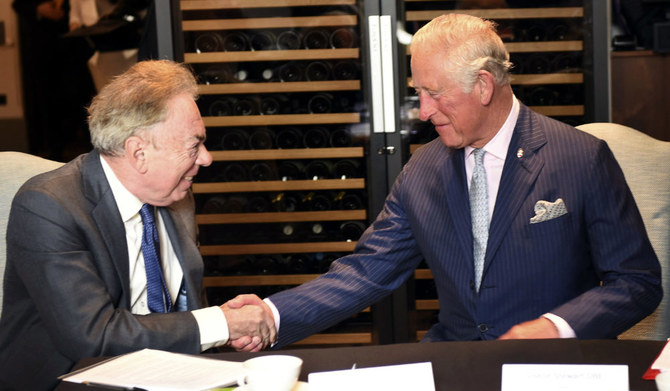
Anthem for Charles III’s coronation written by Lloyd Webber

Britain's Prince Charles meets Andrew Lloyd Webber during a visit to the Royal Albert Hall to discuss the arts and creativity in school, in London, Wednesday, Sept. 5, 2018. (AP)
Short Url
Updated 13 April 2023
Follow

Anthem for Charles III’s coronation written by Lloyd Webber

  • New pieces were composed by artists with roots in all four of the United Kingdom’s constituent nations, as well as in the Commonwealth and foreign countries that have sent so many people to its shores

LONDON: Andrew Lloyd Webber, the English composer who created the scores for blockbuster musicals such as “Cats,’’ “The Phantom of the Opera’’ and “Evita,’’ has written the anthem for King Charles III’s coronation, adapting a piece of church music that encourages singers to make a “joyful noise.”
The work by Webber is one of a dozen new pieces Charles commissioned for the grand occasion taking place May 6 at Westminster Abbey. It includes words adapted from Psalm 98 and is scored specifically for the abbey’s choir and organ.
“I hope my anthem reflects this joyful occasion,” Webber said in a statement distributed by Buckingham Palace.
The program for the king’s coronation ceremony includes older music and new compositions as the palace seeks to blend traditional and modern elements that reflect the realities of modern Britain. New pieces were composed by artists with roots in all four of the United Kingdom’s constituent nations, as well as in the Commonwealth and foreign countries that have sent so many people to its shores.
The service will include works by William Byrd (1543–1623), George Frideric Handel (1685–1759), Edward Elgar (1857–1934), Henry Walford Davies (1869–1941), William Walton (1902–1983), Hubert Parry (1848–1918) and Ralph Vaughan Williams (1872–1958), whose music has featured in previous coronations, along with a piece from the contemporary Welsh composer Karl Jenkins.
There will also be new works by Sarah Class, Nigel Hess, Paul Mealor, Tarik O’Regan, Roxanna Panufnik, Shirley J. Thompson, Judith Weir, Roderick Williams and Debbie Wiseman.
“The decision to combine old and new reflects the cultural breadth of the age in which we live,’’ said Andrew Nethsingha, the organist and master of choristers at Westminster Abbey.
“Coronations have taken place in Westminster Abbey since 1066. It has been a privilege to collaborate with his majesty in choosing fine musicians and accessible, communicative music for this great occasion,” Nethsingha said.
In all, six orchestral commissions, five choral commissions and one organ commission — spanning the classical, sacred, film, television and musical theater genres — were created for the coronation.
The program will also include personal touches, including a musical tribute to Charles’ late father, Prince Philip, who was born a Greek prince. The new monarch requested Greek Orthodox music, which will be performed by the Byzantine Chant Ensemble.
Though specifics on some of the material are being kept under wraps, one hymn will definitely be part of the service: Handel’s “Zadok the Priest.”
The hymn, with its robust chorus of “God Save the King,” has been played at every coronation since it was commissioned for the coronation of King George II in 1727.


In southeast Pakistan, Ramadan brings Hindus and Muslims closer

Updated 10 March 2026
Follow

In southeast Pakistan, Ramadan brings Hindus and Muslims closer

MITHI: Partab Shivani, a Hindu in Muslim-majority Pakistan, has fasted on and off during Ramadan for years, but this time is different as he practices abstinence for the entire holy month.
Every year, he and his friends in the southeastern city of Mithi arrange iftar, when Muslims break their daily fast, to foster peace and solidarity between the two religions.
“I believe we need to promote interfaith harmony. First, we are humans — religions came later,” Shivani, a 48-year-old social activist, told AFP, adding that he also reads the teachings of the Buddha.
“His message is about peace and ending war. Peace can spread through solidarity and by standing with one another. Distance only widens the gap between people,” he added.
Ninety-six percent of Pakistan’s 240 million people are Muslim. Just two percent are Hindu, most of them living in rural areas of Sindh province where Mithi is located.
In Mithi itself, most of the 60,000 inhabitants are Hindu.
Many of the city’s Hindus also observe Ramadan and iftar has become a social gathering where people from both faiths happily participate.
“This has been a wonderful tradition of ours for a very long time,” said Mir Muhammad Buledi, a 51-year-old Muslim friend who attended Shivani’s iftar gathering.
“It is a beautiful example of harmony between the two communities.”
Like brothers
Discrimination against minorities runs deep in Pakistan.
Following the end of British rule in South Asia in 1947, the subcontinent was partitioned into mainly Hindu India and Muslim-majority Pakistan.
That triggered widespread religious bloodshed in which hundreds of thousands were killed and millions displaced.
According to the Human Rights Commission of Pakistan, freedom of religion or belief is under constant threat, with religiously motivated violence and discrimination increasing yearly.
State authorities, often using religious unrest for political gain, have failed to address the crisis, the independent non-profit says.
But such tensions are absent in Mithi.
“I am a Hindu but I keep all the fasts during this month,” said Sushil Malani, a local politician. “I feel happy standing with my Muslim brothers.
“We celebrate Eid together as well. This tradition in the region is very old.”
Restaurants and tea stalls are closed across Pakistan during Ramadan.
Ramesh Kumar, a 52-year-old Hindu man who sells sweets and savoury items outside a Muslim shrine, keeps his push cart covered and closed until iftar.
“There is no discrimination among us if someone is Muslim or Hindu. I have been seeing this since my childhood that we all live together like brothers,” he said.
Muslim shrine, Hindu caretaker
Locals say Mithi’s peaceful religious coexistence can be traced to its remote location, emerging from the sand dunes of the Tharparkar desert, which borders the modern Indian state of Rajasthan.
Cows — considered sacred in Hinduism — roam freely in Mithi city, as they do in neighboring India.
At two Sufi Muslim shrines in the middle of the city, Hindu families arrange meals, bringing fruit, meals and juices for their Muslim neighbors to break their fasts.
“We respect Muslims,” said Mohan Lal Malhi, a Hindu caretaker of one of the shrines.
Mohan said his parents and elders taught him to respect people regardless of religion or color, and the traditions pass from one generation to the next.
Local residents said both communities consider their social relationships more important than their religious identity.
“You will see a (Sikh) gurdwara, a mosque, and a shrine standing side by side here,” Mohan said. “The atmosphere of this area teaches humanity.”