

Daesh extremist’s British mother fears ‘liberal’ parenting may have led to radicalization

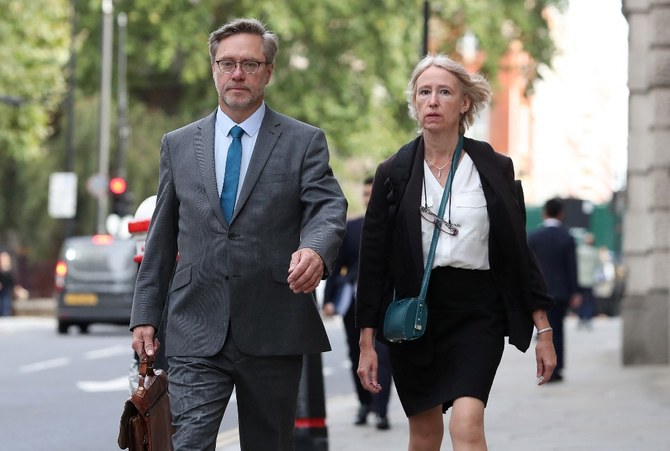
Sally Lane (R) and John Letts, parents of Jack Letts arrive at the Old Bailey court in central London for the start of their trial. (File/AFP)
Short Url
Updated 19 February 2023
Follow

Daesh extremist’s British mother fears ‘liberal’ parenting may have led to radicalization

  • In an autobiography, Sally Lane says her “over-liberal” parenting style may have led her son, Jack Letts, to leave the UK at the age of 18 bound for Syria

LONDON: The mother of a Daesh extremist known as ‘Jihadi Jack’ has said that she has “guilty thoughts” about whether his “chaotic” childhood led him to join the terrorists as a teenager.

In an autobiography, Sally Lane says her “over-liberal” parenting style may have led her son, Jack Letts, to leave the UK at the age of 18 bound for Syria.  

Lane said that she lived with a group of “lodgers, including an aggressive heroin addict whose friends regularly robbed the place” during Letts’s childhood. 

Letts, now 27, left the UK in 2014 after his parents paid for him to visit a Muslim friend in Jordan.

He had informed them that he would travel onwards to Kuwait to improve his Arabic but instead ended up in Raqqa, the seat of power for the extremist group.

He was later captured by pro-western forces and had his British citizenship revoked on national security grounds.

In her book, “Reasonable Cause to Suspect,” Lane describes a meeting about her son’s uncontrollable behavior with tutors at a further education college in Oxford.

“I wondered if they thought Jack’s problems stemmed from his over-liberal parents who hadn’t taken a firm enough hand with him,” she wrote.

“Later on, a portion of the general public certainly believed this to be the case.

“I’ve wondered this myself during my constant internal discussions. Over and over again, I’ve raked over all the incidents of his childhood where I could have been better, or acted differently.”

She said she was tormented with “self-recrimination” and criticizes herself for not taking her son’s obsessive compulsive disorder “seriously enough.”

The former charity worker questions whether Letts’s conversion to Islam at 16 was to find “another, larger family in a Muslim network” as his own relatives lived far away in North America. 

“Was he given too much agency at an early age so that he grew up with the belief that he could, as an individual, change the world?” she asks.

“Or perhaps he had been traumatized when, at the age of three, his father and I separated for a couple of years and he had spent formative years in a chaotic household that he, his younger brother and I shared with a group of lodgers, including an aggressive heroin addict whose friends regularly robbed the place?

“All these guilty thoughts and doubts I have lived with daily.”

Lane, 60, and her organic farmer husband, 62, were found guilty in 2019 of sending money to their son in Syria despite being warned by the police that it could be used to fund terrorism.

The couple, who said they were trying to help their son escape Daesh, received suspended sentences for funding terrorism. Lane said she was placed on a “no-fly” list after being convicted.

Letts has been held in an overcrowded prison managed by the Syrian Democratic Forces since 2017, but a court in Ottawa ruled that he must be repatriated to Canada because he has Canadian nationality through his father, John Letts. The Canadian government says it will appeal against the decision.

Lane left the UK in early 2020 and now lives in Ottawa.


Ice-cool Rybakina beats Sabalenka in tense Australian Open final

Updated 5 sec ago
Follow

Ice-cool Rybakina beats Sabalenka in tense Australian Open final

  • The big-serving Kazakh fifth seed held her nerve to pull through 6-4, 4-6, 6-4
  • Rybakina who was born in Moscow, adds her Melbourne triumph to her Wimbledon win in 2022
MELBOURNE: Elena Rybakina took revenge over world number one Aryna Sabalenka to win a nail-biting Australian Open final on Saturday and clinch her second Grand Slam title.
The big-serving Kazakh fifth seed held her nerve to pull through 6-4, 4-6, 6-4 at Rod Laver Arena in Melbourne in 2hrs 18mins.
It was payback after the Belarusian Sabalenka won the 2023 final between two of the hardest hitters in women’s tennis.
The ice-cool Rybakina, 26, who was born in Moscow, adds her Melbourne triumph to her Wimbledon win in 2022.
“Hard to find the words now,” said Rybakina, and then addressed her beaten opponent to add: “I know it is tough, but I hope we play many more finals together.”
Turning to some Kazakh fans in the crowd, she said: “Thank you so much to Kazakhstan. I felt the support from that corner a lot.”
It was more disappointment in a major final for Sabalenka, who won the US Open last year for the second time but lost the French Open and Melbourne title deciders.
She was into her fourth Australian Open final in a row and had been imperious until now, with tears in her eyes at the end.
“Let’s hope maybe next year will be a better year for me,” Sabalenka said ruefully.
Rybakina fights back
With the roof on because of drizzle in Melbourne, Rybakina immediately broke serve and then comfortably held for 2-0.
Rybakina faced two break points at 4-3, but found her range with her serve to send down an ace and dig herself out of trouble, leaving Sabalenka visibly frustrated.
Rybakina looked in the zone and wrapped up the set in 37 minutes on her first set point when Sabalenka fired long.
Incredibly, it was the first set Sabalenka had dropped in 2026.
The second game of the second set was tense, Rybakina saving three break points in a 10-minute arm-wrestle.
They went with serve and the seventh game was another tussle, Sabalenka holding for 4-3 after the best rally of a cagey affair.
The tension ratcheted up and the top seed quickly forged three set points at 5-4 on the Kazakh’s serve, ruthlessly levelling the match at the first chance to force a deciding set.
Sabalenka was now in the ascendancy and smacked a scorching backhand to break for a 2-0 lead, then holding for 3-0.
Rybakina, who also had not dropped a set in reaching the final, looked unusually rattled.
She reset to hold, then wrestled back the break, allowing herself the merest of smiles.
At 3-3 the title threatened to swing either way.
But a surging Rybakina won a fourth game in a row to break for 4-3, then held to put a thrilling victory within sight.
Rybakina sealed the championship with her sixth ace of the match.
The finalists were familiar foes having met 14 times previously, with Sabalenka winning eight of them.
Sabalenka came into the final as favorite but Rybakina has been one of the form players on the women’s tour in recent months.
She also defeated Sabalenka in the decider at the season-ending WTA Finals.
Rybakina beat second seed Iga Swiatek in the quarter-finals and sixth seed Jessica Pegula in the last four in Melbourne.
Rybakina switched to play under the Kazakh flag in 2018 when she was a little-known 19-year-old, citing financial reasons.