

Defense minister contradicts government’s narrative, calls Pakistan a ‘bankrupt country’

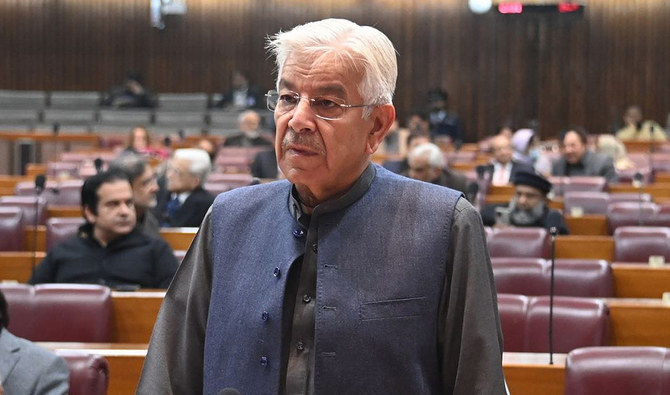
Pakistani Defense Minister Khawaja Asif addresses the National Assembly of Pakistan in Islamabad on January 31, 2023. (Photo courtesy: Twitter/NAofPakistan)
Short Url
Updated 19 February 2023
Follow

Defense minister contradicts government’s narrative, calls Pakistan a ‘bankrupt country’

  • Khawaja Asif says given the current economic situation, Pakistanis are already living in a defaulted country
  • The minister blames former rulers for rise in militancy in Pakistan and says ‘terrorism we see today is our own doing’

ISLAMABAD: Defense Minister Khawaja Asif on Saturday negated his government’s narrative and said that Pakistan was already a “bankrupt country,” as Islamabad struggles to slow down an economic meltdown.

The South Asian country is currently embroiled in one of the worst economic crises in its 75-year history with soaring inflation, a depreciating currency, and the country’s foreign exchange reserves falling to around $3 billion, barely enough to cover three weeks of imports.

Islamabad is desperately looking for external financing to keep the economy afloat, particularly a $1.2 billion loan tranche from the International Monetary Fund (IMF). The IMF has demanded Pakistan implement its conditions by withdrawing subsidies to be able to unlock the tranche. Compliance with the IMF’s prerequisites has increased the inflationary figures, adding to the woes of the cash-strapped South Asian nation.

Given the economic situation of the country, experts have warned that the country might default on its international obligations, but Finance Minister Ishaq Dar has given repeated assurances to the nation that the country would not default as “things are on track” in terms of talks with the IMF.

However, the defense minister has contradicted his government’s narrative and said that the country was not just on the verge of a default as speculated, but it has already defaulted.

“You must have heard that Pakistan was about to default, go bankrupt, or there was a meltdown taking place. It has already happened,” he said at an event at a private college in Pakistan’s Sialkot city on Saturday.

“Given the economic situation, we are living in a bankrupt country.”

The defense minister also spoke about a militant attack on a police compound in Karachi on Friday, condemned the loss of lives, and lauded the security agencies, who he said, “bravely fought the attackers all night long.” He, however, blamed former rulers for bringing the militants back to Pakistan.

“Who created terrorism in Pakistan? It was the country’s rulers who did that. The terrorism we see [in the country] today is a result of our own doing,” he said, in an apparent reference to former premier Imran Khan.

“A year or two ago, these militants were brought back to Pakistan with assurances that they have become peace-loving people and would live their lives in accordance with the country’s law and constitution.”

Pakistan has in recent months seen a surge in militant attacks across the country after the proscribed Tehreek-e-Taliban Pakistan (TTP), which also claimed Friday’s attack in Karachi, ended a months-long truce with the Pakistani government in November last year.

The truce was brokered by the Afghan Taliban in May last year after months of talks between Khan’s government and the TTP, whose leaders and fighters share a common lineage with the Afghan Taliban and are believed to be hiding in Afghanistan.

Since the end of the cease-fire, the TTP has waged a number of attacks against Pakistani security forces and police, particularly in the northwestern and southwestern regions that border Afghanistan.


Pakistan sets expectations for Trump-backed Gaza Board of Peace at UN

Updated 4 sec ago
Follow

Pakistan sets expectations for Trump-backed Gaza Board of Peace at UN

  • The country calls for ceasefire enforcement and reconstruction of the war-ravaged territory
  • Pakistani diplomat warns Gaza recovery must proceed without annexation or forced displacement

ISLAMABAD: Pakistan on Wednesday highlighted its expectations of US President Donald Trump’s Board of Peace (BoP) in Gaza, saying it joined the United Nations-backed body alongside other Muslim nations since it expected concrete steps toward a permanent ceasefire, reconstruction of Gaza and a lasting and just peace grounded in the Palestinian right to statehood.

Prime Minister Shehbaz Sharif signed the Gaza Board of Peace charter earlier this week along with other world leaders on the sidelines of the 56th Annual Meeting of the World Economic Forum in Davos.

Pakistan’s Permanent Representative to the UN, Ambassador Asim Iftikhar Ahmad, told an open Security Council debate on the Middle East that the decision was driven by the need to address the “unresolved Palestinian question,” which he described as “the core of the instability” in the region.

“We hope that the BoP under the framework of resolution 2803 will lead to concrete steps toward the implementation of a permanent ceasefire, further scaling up of humanitarian aid, reconstruction of Gaza, and realization of the right to self-determination of the people of

Palestine through a credible, time-bound political process, consistent with international legitimacy and relevant UN resolutions resulting in an independent, sovereign and contiguous state of Palestine based on pre-1967 borders with Al-Quds Al-Sharif as its capital,” Ahmad said while addressing the council.

“That is the ultimate goal supported by the international community,” he added. “Palestinian-led governance and institutional strengthening, with a central role of the Palestinian Authority, are indispensable in this regard.”

Ahmad maintained Pakistan was deeply concerned about the fragile situation in Gaza, pointing to Israel’s continued ceasefire violations that he said were putting civilian lives at risk. He stressed that the ceasefire must be fully respected with a view to a permanent cessation of hostilities.

The Pakistani diplomat said recovery and reconstruction should begin without delay and must proceed without annexation, forced displacement or any alteration of the territorial unity of the Occupied Palestinian Territory.

“The contiguity of Gaza and the West Bank is indispensable for the viability of the Palestinian state,” he said.

Ahmad also called for a credible, irreversible and time-bound political process culminating in the realization of Palestinian statehood in accordance with international legitimacy.

“The international community, particularly this council, bears the responsibility to translate renewed engagement into measurable change on the ground for the betterment of the Palestinian people,” he said, adding that Pakistan was ready to work with “members of the council, regional and international partners, and the United States to advance a just and lasting solution to the Palestinian question, and comprehensive peace in the Middle East.”