At Munich conference, Pakistan calls for Afghanistan’s capacity building to counter ‘terrorism’

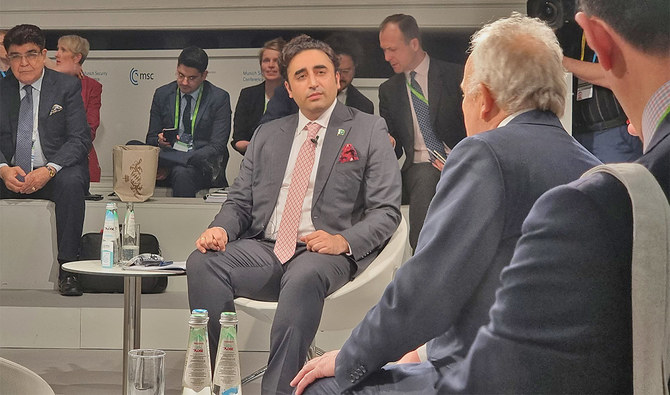
Pakistan foreign minister Bilawal Bhutto-Zardari attends a panel discussion at the Munich Security Conference (MSC) in Munich, southern Germany, on February 18, 2023. (@BBhuttoZardari/Twitter)
Short Url
Updated 19 February 2023
Follow

At Munich conference, Pakistan calls for Afghanistan’s capacity building to counter ‘terrorism’

  • The development comes amid an uptick in militant violence in Pakistan in recent months
  • Bhutto-Zardari says the world must engage with the Taliban, Afghan society and women

ISLAMABAD: Pakistan’s Foreign Minister Bilawal Bhutto-Zardari on Saturday urged the international community to help build capacity of the Afghan interim authorities to take on the threat of “terrorism,” Pakistani state media reported. 

The statement by the Pakistani foreign minister came during a panel discussion at the two-day Munich Security Conference being held from February 17 till February 19 to debate international security policy. It is a venue for diplomatic initiatives to address the world’s most pressing security concerns. 

Bhutto-Zardari said that if this issue was not taken seriously, militant groups could conduct their activities from Afghanistan as had been witnessed recently from incidents in Pakistan. 

“The interim government neither had a standing army, a counter-terrorism force and even a border force, nor have the capacity,” he was quoted as saying by the state-run APP news agency. 

“The global community should convince the Afghan interim government to take on the threat of terrorism and demonstrate its will.” 

The development comes amid an uptick in militant violence in Pakistan in recent months. Most of these attacks have been claimed by the Pakistani Taliban, who share common lineage and ideals with the Afghan Taliban. 

Islamabad has repeatedly demanded the interim Afghan authorities to prevent militant groups from using their soil to launch attacks against other countries. 

“Terrorism not only posed threat to immediate neighbors of Afghanistan but also to the West,” Bhutto-Zardari cautioned. 

Bhutto-Zardari urged the world to continue its humanitarian support, unfreeze Afghanistan’s assets, open up banking channels and engage with the Taliban, and the Afghan society and women. 

“The continuation of economic activities and progress in the war-weary Afghanistan was must for peace and stability and would help the interim Afghan authorities to run affairs of the country,” he added. 


Pakistan plans to cut Islamabad entry points to 25 in major security overhaul

Updated 5 sec ago
Follow

Pakistan plans to cut Islamabad entry points to 25 in major security overhaul

  • The development follows two suicide blasts in the capital as well as deadly protests over Iranian Supreme Leader Ali Khamenei’s killing
  • Authorities earlier enforced an electronic tagging system in Islamabad to regulate traffic, improve record-keeping and enhance surveillance

ISLAMABAD: Authorities have decided to reduce the number of entry points in Islamabad to 25 as part of a major security overhaul of the Pakistani capital, the interior ministry said on Friday.

The development follows a suicide blast that last month killed at least 32 people and injured more than 100 others at a mosque in Islamabad. In November last year, a suicide bomber struck outside a court in the capital, killing 12 people.

The Islamabad Capital Territory (ICT) introduced an electronic tagging system late last year as part of a broader effort to regulate traffic, improve record-keeping and enhance surveillance in a city that hosts the country’s main government institutions, foreign missions and diplomatic enclaves.

On Friday, Interior Minister Mohsin Naqvi presided over a meeting to review law and order situation in the capital and directed officials formulate an effective strategy in this regard, according to his ministry.

“The number of entry points in Islamabad will be reduced from 109 to 25 gradually,” the ministry said, adding that officials were asked to make the Red Zone, which houses key government institutions and foreign missions, practically active.

The directives also come days after deadly protests against the killing of Iranian Supreme Leader Ali Khamenei in Islamabad, when several protesters were injured in clashes with police after they had barged into the Red Zone.

Naqvi ordered foolproof security in the city through strict monitoring at checkpoints and entry points.

“Law and order will have to be ensured in the federal capital at all costs,” he added.

Late last year, the Islamabad Capital Territory (ICT) administration also introduced an electronic tagging system as part of a effort to regulate traffic, improve record-keeping and enhance surveillance in Islamabad.

Under the system, vehicles are fitted with electronic tags that can be read automatically by scanners installed at checkpoints across the capital, allowing authorities to identify unregistered vehicles without manual inspections. Vehicles already equipped with a motorway tag, or m-tag, are exempt from the requirement.