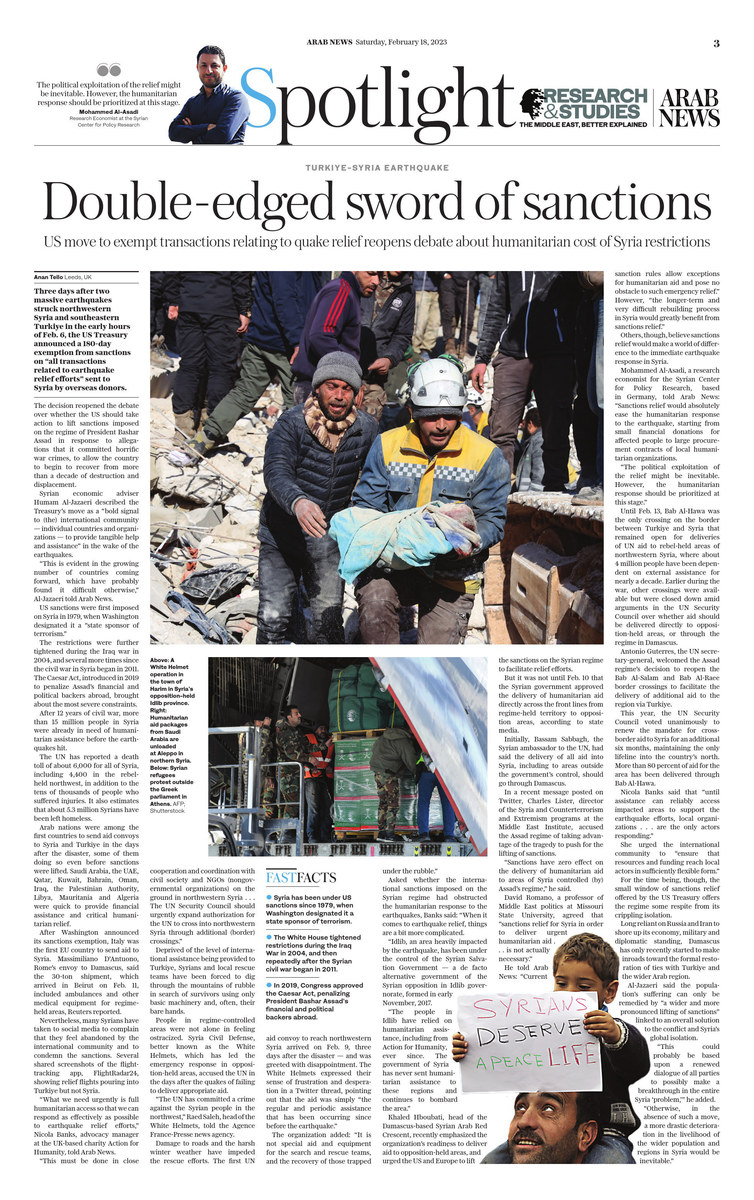

LEEDS, UK: Three days after two massive earthquakes struck northwestern Syria and southeastern Turkiye in the early hours of Feb. 6, the US Treasury announced a 180-day exemption from sanctions on “all transactions related to earthquake relief efforts” sent to Syria by overseas donors.
The decision reopened the debate over whether the US should take action to lift sanctions imposed on the regime of President Bashar Assad in response to allegations that it committed horrific war crimes, to allow the country to begin to recover from more than a decade of destruction and displacement.
Syrian economic adviser Humam Al-Jazaeri described the Treasury’s move as a “bold signal to (the) international community — individual countries and organizations — to provide tangible help and assistance” in the wake of the earthquakes.
“This is evident in the growing number of countries coming forward, which have probably found it difficult otherwise,” Al-Jazaeri told Arab News.
US sanctions were first imposed on Syria in 1979, when Washington designated it a “state sponsor of terrorism.”
The restrictions were further tightened during the Iraq war in 2004, and several more times since the civil war in Syria began in 2011. The Caesar Act, introduced in 2019 to penalize Assad’s financial and political backers abroad, brought about the most severe constraints.

After 12 years of civil war, more than 15 million people in Syria were already in need of humanitarian assistance before the earthquakes hit.
As of Feb. 17, at least 5,800 people have been confirmed dead in Syria as a result of the disaster and tens of thousands were injured. The UN estimates about 5.3 million Syrians have been left homeless.
Arab nations were among the first countries to send aid convoys to Syria and Turkiye in the days after the disaster, some of them doing so even before sanctions were lifted. Saudi Arabia, the UAE, Qatar, Kuwait, Bahrain, Oman, Iraq, the Palestinian Authority, Libya, Mauritania and Algeria were quick to provide financial assistance and critical humanitarian relief.
After Washington announced its sanctions exemption, Italy was the first EU country to send aid to Syria. Massimiliano D’Antuono, Rome’s envoy to Damascus, said the 30-ton shipment, which arrived in Beirut on Feb. 11, included ambulances and other medical equipment for regime-held areas, Reuters reported.
Nevertheless, many Syrians have taken to social media to complain that they feel abandoned by the international community and to condemn the sanctions. Several shared screenshots of the flight-tracking app, FlightRadar24, showing relief flights pouring into Turkiye but not Syria.
“What we need urgently is full humanitarian access so that we can respond as effectively as possible to earthquake relief efforts,” Nicola Banks, advocacy manager at the UK-based charity Action for Humanity, told Arab News.
“This must be done in close cooperation and coordination with civil society and NGOs (nongovernmental organizations) on the ground in northwestern Syria … The UN Security Council should urgently expand authorization for the UN to cross into northwestern Syria through additional (border) crossings.”
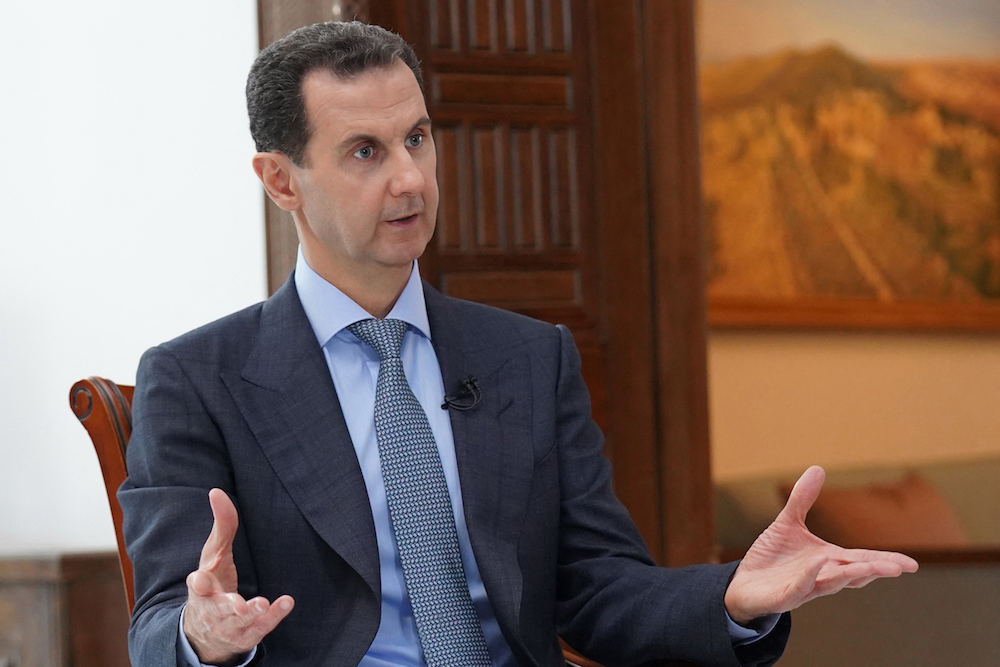
The Caesar Act, introduced in 2019 to penalize Syrian leader Bashar Assad’s financial and political backers abroad, brought about the most severe constraints. (AFP/File Photo)
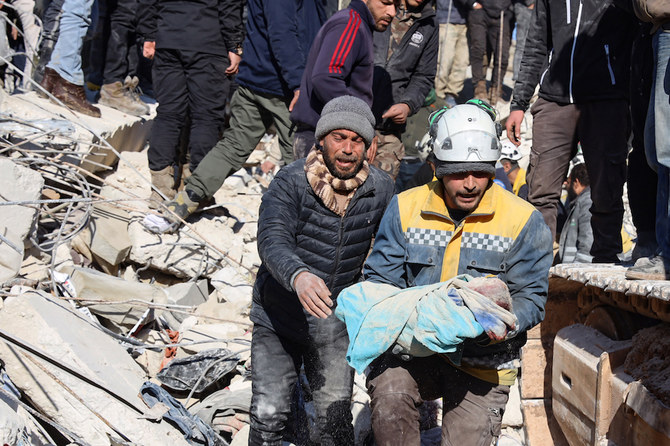
Deprived of the level of international assistance being provided to Turkiye, Syrians and local rescue teams have been forced to dig through the mountains of rubble in search of survivors using only basic machinery and, often, their bare hands.
People in regime-controlled areas were not alone in feeling ostracized. Syria Civil Defense, better known as the White Helmets, which has led the emergency response in opposition-held areas, accused the UN in the days after the quakes of failing to deliver appropriate aid.
“The UN has committed a crime against the Syrian people in the northwest,” Raed Saleh, head of the White Helmets, told the Agence France-Presse news agency.
Damage to roads and the harsh winter weather have impeded the rescue efforts. The first UN aid convoy to reach northwestern Syria arrived on Feb. 9, three days after the disaster — and was greeted with disappointment. The White Helmets expressed their sense of frustration and desperation in a Twitter thread, pointing out that the aid was simply “the regular and periodic assistance that has been occurring since before the earthquake.”
The organization added: “It is not special aid and equipment for the search and rescue teams, and the recovery of those trapped under the rubble.”
Asked whether the international sanctions imposed on the Syrian regime had obstructed the humanitarian response to the earthquakes, Banks said: “When it comes to earthquake relief, things are a bit more complicated.
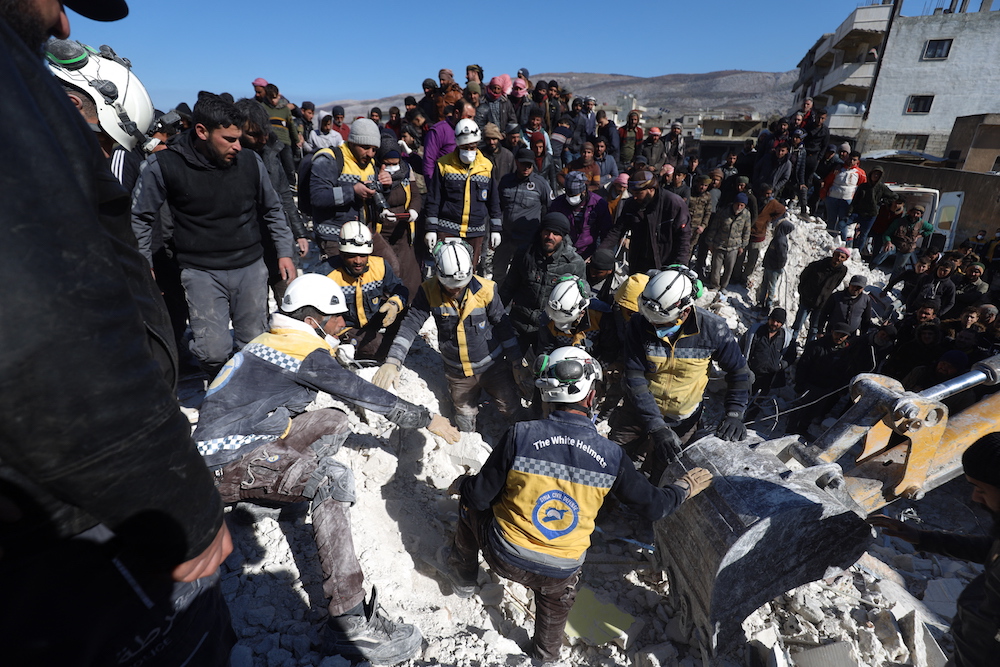
Arab nations were among the first countries to send aid convoys to Syria and Turkiye in the days after the earthquake disaster, some of them doing so even before sanctions were lifted. (AFP)
“Idlib, an area heavily impacted by the earthquake, has been under the control of the Syrian Salvation Government — a de facto alternative government of the Syrian opposition in Idlib governorate, formed in early November, 2017.
“The people in Idlib have relied on humanitarian assistance, including from Action for Humanity, ever since. The government of Syria has never sent humanitarian assistance to these regions and continues to bombard the area.”
Khaled Hboubati, head of the Damascus-based Syrian Arab Red Crescent, recently emphasized the organization’s readiness to deliver aid to opposition-held areas, and urged the US and Europe to lift the sanctions on the Syrian regime to facilitate relief efforts.
But it was not until Feb. 10 that the Syrian government approved the delivery of humanitarian aid directly across the front lines from regime-held territory to opposition areas, according to state media.
FASTFACTS
* Syria has been under US sanctions since 1979, when Washington designated it a state sponsor of terrorism.
* The White House tightened restrictions during the Iraq War in 2004, and then repeatedly after the Syrian civil war began in 2011.
* In 2019, Congress approved the Caesar Act, penalizing President Bashar Assad’s financial and political backers abroad.
Initially, Bassam Sabbagh, the Syrian ambassador to the UN, had said the delivery of all aid into Syria, including to areas outside the government’s control, should go through Damascus.
In a recent message posted on Twitter, Charles Lister, director of the Syria and Counterterrorism and Extremism programs at the Middle East Institute, accused the Assad regime of taking advantage of the tragedy to push for the lifting of sanctions.
“Sanctions have zero effect on the delivery of humanitarian aid to areas of Syria controlled (by) Assad’s regime,” he said.
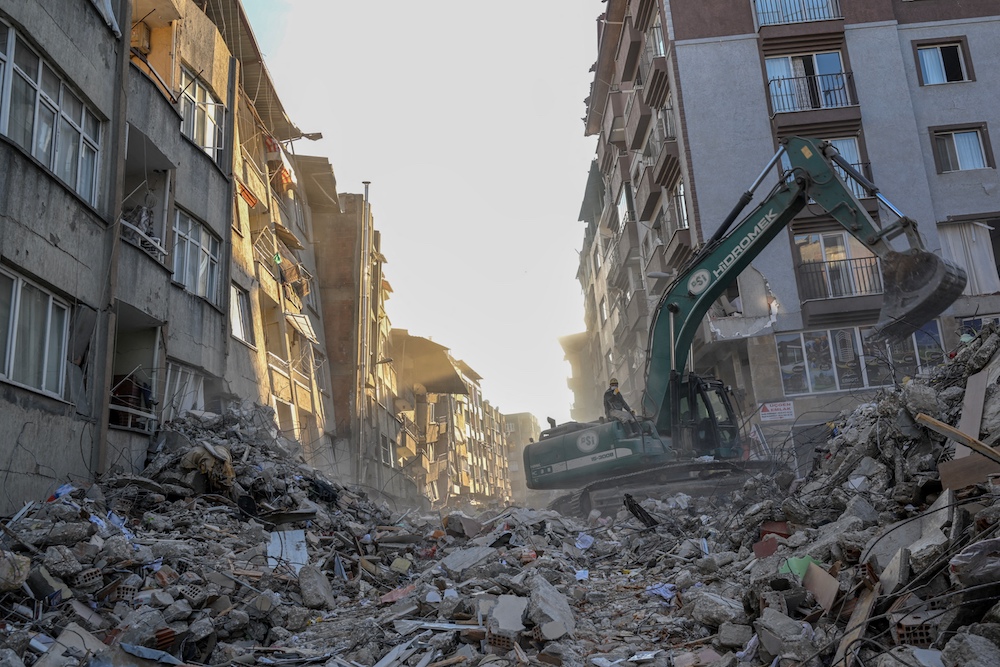
After 12 years of civil war, more than 15 million people in Syria were already in need of humanitarian assistance before the earthquakes hit. (AFP)
David Romano, a professor of Middle East politics at Missouri State University, agreed that “sanctions relief for Syria in order to deliver urgent humanitarian aid … is not actually necessary.”
He told Arab News: “Current sanction rules allow exceptions for humanitarian aid and pose no obstacle to such emergency relief.” However, “the longer-term and very difficult rebuilding process in Syria would greatly benefit from sanctions relief.”
Others, though, believe sanctions relief would make a world of difference to the immediate earthquake response in Syria.
Mohammed Al-Asadi, a research economist for the Syrian Center for Policy Research, based in Germany, told Arab News: “Sanctions relief would absolutely ease the humanitarian response to the earthquake, starting from small financial donations for affected people to large procurement contracts of local humanitarian organizations.
“The political exploitation of the relief might be inevitable. However, the humanitarian response should be prioritized at this stage.”
Until Feb. 13, Bab Al-Hawa was the only crossing on the border between Turkiye and Syria that remained open for deliveries of UN aid to rebel-held areas of northwestern Syria, where about 4 million people have been dependent on external assistance for nearly a decade. Earlier during the war, other crossings were available but were closed down amid arguments in the UN Security Council over whether aid should be delivered directly to opposition-held areas, or through the regime in Damascus.
Antonio Guterres, the UN secretary-general, welcomed the Assad regime’s decision to reopen the Bab Al-Salam and Bab Al-Raee border crossings to facilitate the delivery of additional aid to the region via Turkiye.
This year, the UN Security Council voted unanimously to renew the mandate for cross-border aid to Syria for an additional six months, maintaining the only lifeline into the country’s north. More than 80 percent of aid for the area has been delivered through Bab Al-Hawa.
Nicola Banks said that “until assistance can reliably access impacted areas to support the earthquake efforts, local organizations … are the only actors responding.”
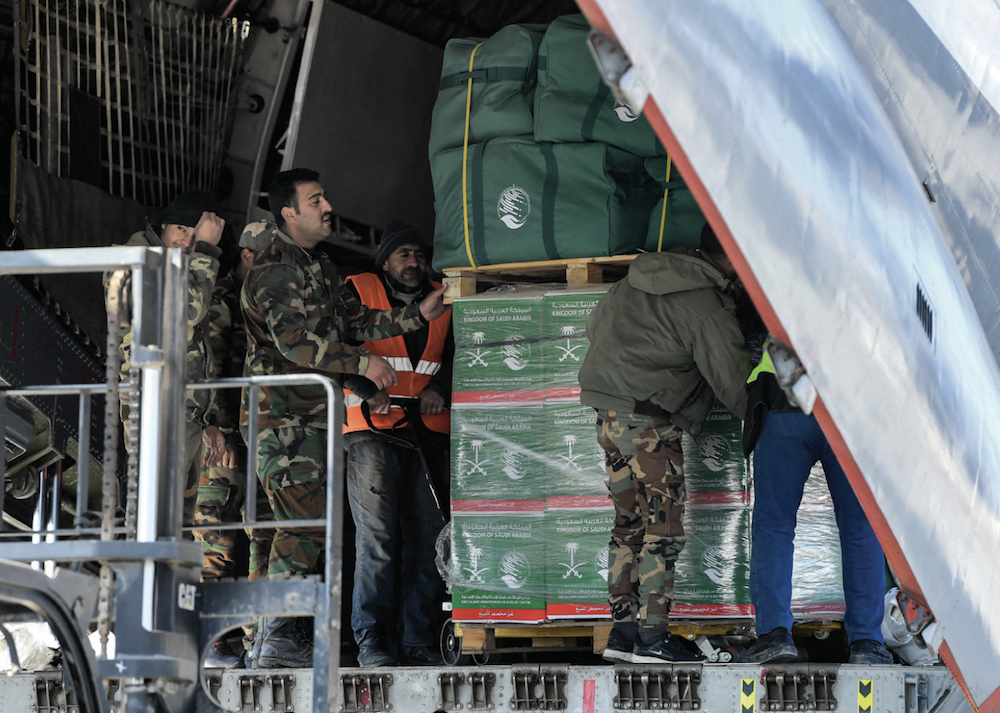
Saudi Arabia (Saudi aid pictured), the UAE, Qatar, Kuwait, Bahrain, Oman, Iraq, the Palestinian Authority, Libya, Mauritania and Algeria were quick to provide financial assistance and critical humanitarian relief following the earthquake. (Shutterstock)
She urged the international community to “ensure that resources and funding reach local actors in sufficiently flexible form.”
For the time being, though, the small window of sanctions relief offered by the US Treasury offers the regime some respite from its crippling isolation.
Long reliant on Russia and Iran to shore up its economy, military and diplomatic standing, Damascus has only recently started to make inroads toward the formal restoration of ties with Turkiye and the wider Arab region.
Al-Jazaeri said the population’s suffering can only be remedied by “a wider and more pronounced lifting of sanctions” linked to an overall solution to the conflict and Syria’s global isolation.
“This could probably be based upon a renewed dialogue of all parties to possibly make a breakthrough in the entire Syria ‘problem,’” he added.
“Otherwise, in the absence of such a move, a more drastic deterioration in the livelihood of the wider population and regions in Syria would be inevitable.”