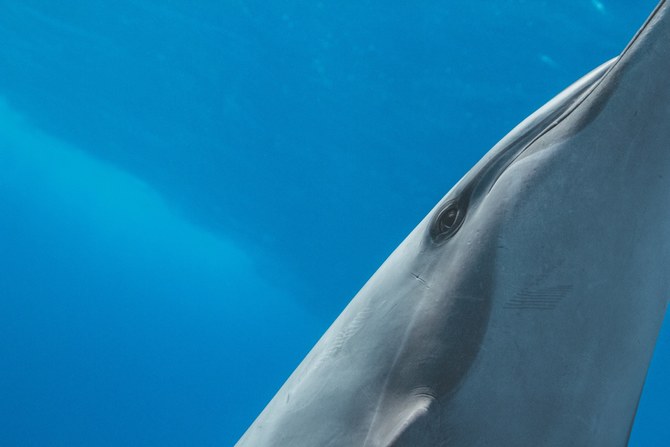
The Breakdown – Prince Hussain Aga Khan discusses his underwater photograph ‘Spinner Dolphin Portrait’ 

Prince Hussain Aga Khan's 'Spinner Dolphin Portrait' (Supplied)
Short Url
Updated 21 February 2023
Follow

The Breakdown – Prince Hussain Aga Khan discusses his underwater photograph ‘Spinner Dolphin Portrait’ 

DUBAI: The Swiss-born photographer talks about his underwater photograph from 2014, which was displayed at Florida's Palm Beach Show, via Galerie Gmurzynska, from Feb. 16-21. 


Prince Hussain Aga Khan. (Simone Piccoli)

I'm entirely self-taught, I just picked up a camera at some point and loved it. I've always loved wildlife photography; I’d buy books on it and watch David Attenborough and Jacques Cousteau documentaries when I was younger. I'm living the dream I had as a kid.   

I'm not interested in just taking photographs for photographs' sake. I'm really into wildlife and the environment, and trying to help them. I've kept animals at home since I was eight. I think I know animals better than most people. 

Giraffes and koalas are now endangered — animals that you and I never would have imagined 20 years ago would be endangered. For me, part of what I’m doing is just recording what we're losing.  

What's always important for me is the animals themselves, and some animals are much more curious and interactive than others. I've had turtles stay with me for 45 minutes and I've had whale calves lock eyes with me.  

I took this photograph in Sataya, Egypt. I was running out of breath. I went below the surface a bit and this dolphin was rising up to my feet. My camera wasn't working. Finally, he was at my chest and the camera still didn't shoot. He went just above me and I looked up, arched my back, and I clicked. It worked. I had zero air left in my lungs. 

Swimming back to the boat, I was 100-percent sure that I'd missed it. The fact that I got the whole face and the eye is really fantastic. It was some sort of serendipity — having a camera that didn’t seem to work and all of a sudden it worked with a really beautiful animal.  

You know what I see in the picture? I see the scratch marks and I don't know if they’re from mating or rubbing itself on coral. One of the marks looks like a barcode in a supermarket. I love the image, but I always look at the barcode and think how funny it is.  


Hamza Hawsawi on headlining The Fridge in Riyadh

Updated 14 February 2026
Follow

Hamza Hawsawi on headlining The Fridge in Riyadh

DUBAI: Saudi R&B artist Hamza Hawsawi headlined The Fridge’s “Concert Series KSA Season 1” over the weekend, performing a show in Riyadh’s JAX District as part of a two-day program spotlighting emerging talent.

Hawsawi’s performance followed “The Fridge Open Mic,” which took place at the same venue the night before. The open mic offered rising artists a professional stage to perform original material in front of a live audience, creating space for experimentation and discovery within the local music scene.

Speaking during the event, Hawsawi highlighted the importance of platforms such as open mics for artists. “I think it is important because an open mic is an opportunity to get to know new artists,” he said. “For industry professionals, like Fridge, it is an eye-opener to the scene, and it lets you understand how the scene is going, what kind of artists you’re gonna be dealing with in the future.”

From an artist’s standpoint, he added, the format remains essential for growth. “We do need open mics. We do need to be out there and to try different things, and to sing to different people, and to test our art and find out if people are gonna gravitate towards it or not.”

Hawsawi has spent more than 15 years developing a sound rooted in R&B, soul and pop, building an audience that now spans the region and beyond. He has accumulated more than 33 million global views and collaborated with a range of regional and international artists. 

His track “Million Miles” was selected as the official Rally Dakar anthem, while his live performances have included stages such as MDLBeast and the Abu Dhabi Grand Prix.

Asked whether he feels a responsibility to help shape the Saudi R&B scene, Hawsawi described a fluid relationship with that role. “Sometimes I feel that sense of responsibility,” he said. “Other times I feel like I’m just a human being trying to express my feelings … But we’re just artists at the end of the day.”

He added that while he sometimes embraces being a beacon for the genre, “other times I feel like I want to be low-key, and I don’t even want to be seen or heard.”

Hawsawi also reflected on one of his personal challenges as an artist in the Kingdom: writing and performing primarily in English. 

“That has been the biggest challenge to face,” he said. 

While Arabic remains the most widely spoken language in Saudi Arabia, Hawsawi explained that English allows him to express what he feels more clearly, particularly when it comes to emotion and meaning.

“The nuances of what I feel and all the metaphors for me trying to say something but not saying it, you know, not a lot of people get that,” he said, noting that his work often reaches a niche audience. “But I’m happy with that.”