

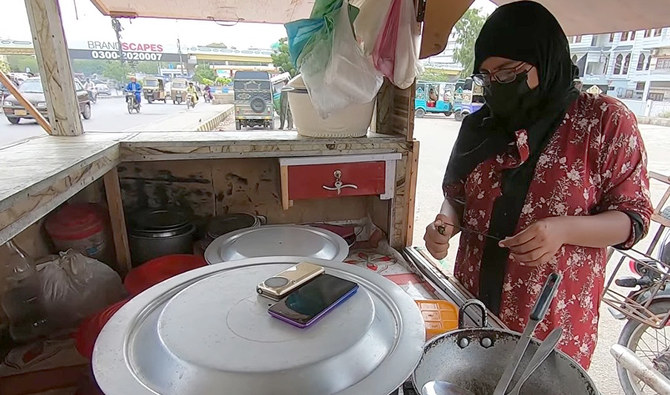

KARACHI: When a 30-year-old single mother decided to quit her job in a multinational food chain to start her own roadside food stall, even her family was against it.
Nazia, who prefers to go by her first name only, gave up the long work hours at her old job almost a year ago to give more time to her only child. But familial disapproval meant that her brother blocked her on his phone when he found out. And social taboos were not the only hurdle Nazia had to face. She also had to sell her own jewelry to purchase a cart and enough crockery to start setting up her stall.
Just within a few months, however, Nazia’s ‘Baji Daal Chawal Wali’ had attracted a multitude of customers in an area that already had the Shandar Shinwari Hotel for competition, a famous eatery in Karachi’s Gulshan-e-Jamal area. Daal Chawal is a simple but popular dish mixing lentils and rice, and Nazia was so masterful at it that the praise she earned even made her brother come around to her life choices. Every day laborers, shopkeepers, families, and even office-going people all flock to her establishment.
“Today the same brother and sister-in-law stand by me because the path I adopted [was proven] right,” Nazia, popularly known as Baji, told Arab News at her stall, which started off as a food cart but has now turned into a proper, permanently placed kiosk. The food she makes is quite popular in her family, so branching out was a natural progression.
With a huge silver cauldron filled with boiled rice placed inside a portable stand, and three yellow buckets containing daal and other dishes hanging from her motorbike, Nazia rides through narrow streets, a thin lane under the railway track and a jam-packed road for more than six kilometers daily to reach her roadside kiosk in Gulshan-e-Jamal, in front of the city’s Millennium Mall, to show the world her culinary skills.
The ride, with nearly 100 kilograms of weight attached to her old 70cc motorbike carrying essential items, is not an easy journey through Karachi’s bumpy, often hazardous traffic. But this new entrepreneur needed to save the money, roughly around Rs500 or $1.89, she would otherwise be paying to auto-rickshaw drivers as return fare.
“I had not [even] ridden a bicycle [in my life] but when I started working my income was not that much that I could pay for conveyance,” she said, adding that an acquaintance got her the motorcycle on credit. “I took the bike, then learned to ride while tumbling and crashing but Alhamdulillah I [finally] got the hang of it,” she said.
Nazia has since started adding several other dishes to her original menu of Daal Chawal and has not raised the prices or decreased the quantity, though the cost of her ingredients has gone up.
“Inflation has tripled, which has distressed me. Previously, I would get forty percent, sometimes thirty percent [profit], now I work on twenty percent. If I have spent Rs5,000 I hardly get Rs800-1,000 [in return],” she said with a sense of disappointment.
The challenges are not just inflationary. Nazia, like her fellow Karachi denizens, is not immune to traffic accidents in the biggest megalopolis in Pakistan where hundreds of road incidents occur on a daily basis.
“There is a problem due to traffic…but what can I do?” Nazia added that earlier this week a vehicle hit her bike from the back which left her bike reeling. “Had I not controlled [the bike], nothing would be left of us [me and my child].” There were buses coming right behind her and her bike’s brakes had malfunctioned on impact. At the end of it all she had crashed into a wall, and was just sitting by the road, shivering in panic and fear.
Undaunted by these ordeals, Nazia has called upon other women to be strong and take steps for themselves to embark on steps of self-empowerment and independence.
“You experience a tragedy and [are] single. [If you are] facing problems in running a household, facing issues in raising your child, facing difficulties in paying house rent, then what is better for you, to choose the wrong way, choose a shortcut, or [choose the] right path? To feel shame, or do work?”
She advises women not to care about what the world thinks. “Don’t care about anyone, the path should be the right one. It’s better to have courage instead of begging, [and] spreading your hands,” she said.
Nazia said she is not intending on limiting her great recipes to herself. “I have created my YouTube channel with the name of Baji Daal Chawal, BDC, and I will upload videos and invite [other] people [on it],” she said.
“Believe me, I don’t use external recipes. This is simple homemade clean food. The basic thing is the taste that God has bestowed upon me. I [can] prepare good food in a very short time and I will teach [other] people [to do the same].”


