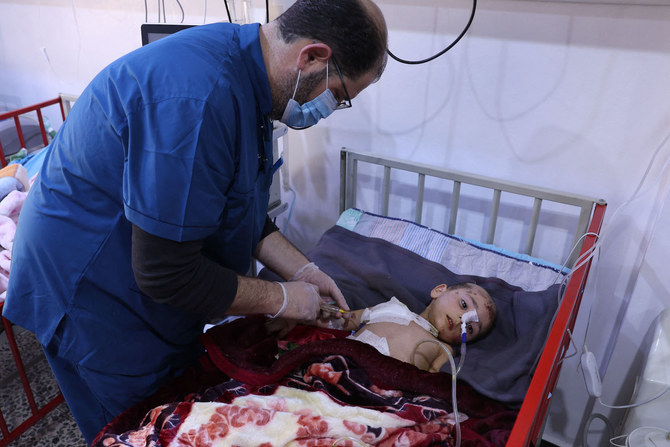

IDLIB: Northwestern Syria’s worn-out healthcare sector is struggling to treat the thousands injured in the 7.8 magnitude earthquake that devastated the region last week.
Pressure is mounting on doctors and staff in Idlib province after the massive quake caused extensive damage to hospitals and medical facilities.
“The number of wounded individuals who came in during the first 24 hours exceeded the capacity of all the hospitals and medical centers,” Dr. Zuhair Al-Qarat, of the Idlib health directorate, told Arab News.
Around 12 to 16 medical facilities, hospitals and medical centers were badly damaged in the disaster, according to Al-Qarat.
Some staff are working in empty storage rooms, and relying on local charities, individuals and organizations.
“As for the international assistance, provided by the UN agencies in general, it was five or six days late. Even now, when the assistance does reach northwestern Syria, it barely covers 5 to 10 percent of the needs,” he said.
The UN is facing growing criticism over what some observers say has been its slow response to Syria’s quake.
Medical personnel In northwestern Syria faced a healthcare crisis even before the quake hit. The country’s 12-year war has left medical facilities struggling to cope, making it increasingly difficult to respond to the earthquake disaster.
Dr. Omar Ali, a pediatrician at Sham Hospital in Idlib, told Arab News: “Most hospitals are working at 200, 300 and even 400 percent capacity when it comes to admissions and the number of hospital beds they have.”
He said that his staff are working nonstop, with the maternity department just one example of the sacrifices made.
“They stopped neither during nor after the earthquake. We had a lot of infants on ventilators, and they were not removed.
“We just wish for a bit of humanity,” Ali said.
The quake has also placed strain on Syrians’ mental health.
According to a report by the UN Office for the Coordination of Humanitarian Affairs, cases of nervous breakdown, shock and panic are particularly prevalent among the elderly, women and children.
Al-Qarat told Arab News that his governorate urgently needs life-saving medical equipment.
“We need medical consumables, bone supplies, general surgery kits, dialysis kits, and ventilators, as we now have a lot of ICU patients and patients requiring dialysis sessions. Bone surgery and neurosurgery consumables, along with diesel, are also needed. We are suffering from a lack of ambulances as well.”
In northwestern Syria, the earthquake has so far claimed the lives of over 4,400 people and injured more than 7,600, according to reports. However, Al-Qarat believes the number of injured now exceeds 11,000.