Saudi Ministry of Environment allocates $104.7bn for development projects in the water sector

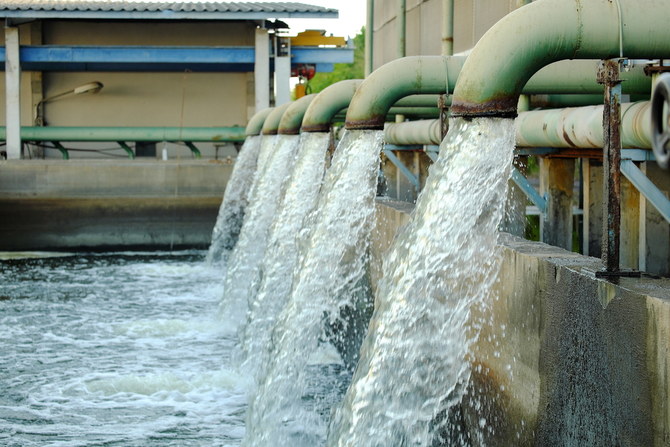
Around 2,000 projects have already been financed at a total cost of SR210 billion (Shutterstock)
Short Url
Updated 16 February 2023
Follow

Saudi Ministry of Environment allocates $104.7bn for development projects in the water sector

RIYADH: Saudi Arabia’s Ministry of Environment, Water, and Agriculture has allocated as much as SR393 billion ($104.7 billion) for 3,300 development projects in the water sector, according to the minister Abdul Rahman bin Abdul Mohsen Al-Fadhli.

The projects are set to include all stages of the supply chain and work is currently underway to either implement them, award them, or purchase the service from the private sector, Al-Fadhli explained.

Around 2,000 of the projects have already been financed at a total cost of SR210 billion, he noted.

These developments come as the Kingdom’s agriculture sector sees a remarkable development which is evident in the increase in its contribution to the gross domestic product by SR72 billion in 2021, Al-Fadhli highlighted during his participation in Al-Ahsa Forum 2023.

In addition to this, the agriculture sector has approved as much as SR91 billion to implement initiatives, programs and incentives for farmers, the minister disclosed.

Those initiatives are projected to further propel the development of the agricultural and food sector and raise its efficiency, he clarified.

Moreover, the initiatives will also contribute to attracting investments estimated at more than SR159 billion, Al-Fadhli said.

This poses an opportunity for the active partners from the private sector to take advantage of the investment opportunities provided by these new directions in the environment, water and agricultural sectors, the minister stressed.

There is work underway regarding the implementation of a desalinated water production system in the eastern region which is set to boost production by about 800,000 cubic meters per day, he added.

Furthermore, the ministry has also adopted the National Environment Strategy which entails up to 64 diverse initiatives and an investment of around SR52 billion solely dedicated to achieving its objectives and goals.

The new adopted strategy will also create investments for the private sector that will add more than SR120 billion to the GDP and will contribute to creating more than 100,000 job opportunities.


Saudi Arabia leads outcome-based education to prepare future-ready generations: Harvard Business Review

A Harvard sign is seen at the Harvard University campus in Boston, Massachusetts, on May 27, 2025. (AFP)
Updated 10 February 2026
Follow

Saudi Arabia leads outcome-based education to prepare future-ready generations: Harvard Business Review

  • The Riyadh-based school group developed a strategy that links every classroom activity to measurable student competencies, aiming to graduate learners equipped for the digital economy and real-world contexts

RIYADH: Saudi Arabia’s education system is undergoing a sweeping transformation aligned with Vision 2030, shifting from traditional, input-focused methods to outcome-based education designed to equip students with future-ready skills, Harvard Business Review Arabic reported.

The transformation is being adopted and spearheaded by institutions such as Al-Nobala Private Schools, which introduced the Kingdom’s first national “learning outcomes framework,” aimed at preparing a generation of leaders and innovators for an AI-driven future, the report said.

Al-Nobala has leveraged international expertise to localize advanced learning methodologies.

The Riyadh-based school group developed a strategy that links every classroom activity to measurable student competencies, aiming to graduate learners equipped for the digital economy and real-world contexts. The school’s group approach combines traditional values with 21st-century skills such as critical thinking, communication, innovation and digital fluency.

According to the report, the shift addresses the growing gap between outdated models built for low-tech, resource-constrained environments and today’s dynamic world, where learners must navigate real-time information, virtual platforms, and smart technologies.

“This is not just about teaching content, it’s about creating impact,” the report noted, citing how Al-Nobala’s model prepares students to thrive in an AI-driven world while aligning with national priorities.

The report noted that Saudi Arabia’s Ministry of Education has paved the way for this shift by transitioning from a centralized controller to a strategic enabler, allowing schools such as Al-Nobala to tailor their curriculum to meet evolving market and societal needs. This is part of the long-term goal to place the Kingdom among the top 20 global education systems.

Al-Nobala’s work, the report stated, has succeeded in serving the broader national effort to link education outcomes directly to labor market demands, helping to fulfill the Vision 2030 pillar of building a vibrant society with a thriving economy driven by knowledge and innovation.

Last February, Yousef bin Abdullah Al-Benyan, Saudi Arabia’s minister of education, said that the Kingdom was making “an unprecedented investment in education,” with spending aligned to the needs of growth and development. He said that in 2025, education received the second-largest share of the state budget, totaling $53.5 billion.