

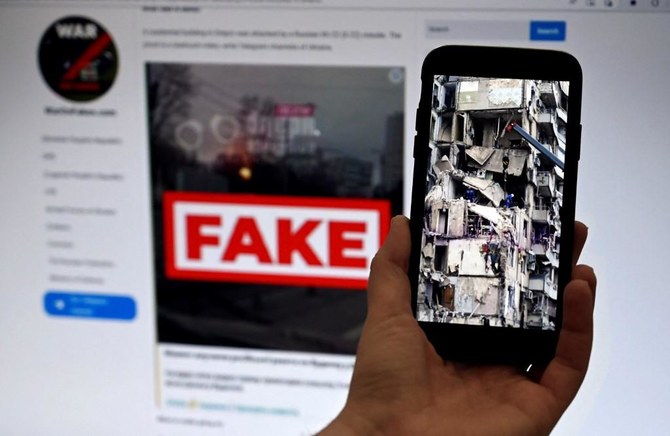

LONDON: The war in Ukraine has been accompanied by a ferocious battle of disinformation, waged in particular by pro-Russian agitators seeking to distort and shift the blame for many atrocities on the ground.
These agitators have sought to depict the Ukrainian side as Nazis or suggest that Western support for Kyiv is evaporating.
Here are some of the main narratives, false or misleading, that have been fact-checked over the past year by AFP's digital verification teams.
Russian authorities themselves have propagated the idea that some of the worst atrocities -- such as the massacre of civilians in Bucha not far from Kyiv in April 2022 -- were staged.
In this case, two clips of poor-quality video footage were used to imply that people were only pretending to be dead, which AFP was able to debunk thanks to its teams on the ground.
Many other videos have been spread widely on social media with similar allegations that some horrific crimes were staged.
But the accompanying footage turned out to be completely unrelated, such as a rap video, a sci-fi film or a Russian TV series.
Many of the accusations point the finger at the world's major media organisations. Countless doctored screenshots have been shared on this theme, for example, claiming to show that CNN used old footage completely unrelated to the war in its coverage.
Other internet users have taken aim at television channels, accusing them of broadcasting images of people bandaged and bloodied, but only pretending to be wounded. In fact, they were very real victims of Russian attacks.
A flood of false claims online parrot Moscow's narrative that Ukrainian President Volodymyr Zelensky is the head of a gang of "Nazis" or "drug users".
Thus, social media posts have been shared worldwide saying that a man covered in Nazi tattoos was a chief of police in Kyiv or that Zelensky had been photographed in a football shirt imprinted with a swastika.
The drug accusations have circulated alongside manipulated video footage of questionable quality, claiming to prove Zelensky's cocaine addiction.
Ukrainian refugees have also been targeted, particularly in neighbouring countries such as Poland and Slovakia.
Manipulated or misleading photos or videos have proliferated online purporting to show refugees as neo-Nazis, criminals or the source of trails of garbage on public transport.
Other misleading messages, shared in different European nations, claim that Ukrainian refugees are paid more in social benefits than pensioners or veterans in the host countries.
Another recurrent theme is the alleged betrayal of Ukraine by its neighbour and ally, Poland.
Thus, weather maps are manipulated to suggest that Poland wants to annex part of Ukrainian territory, or documents are falsified to show that Warsaw is planning to establish a protectorate in western Ukraine.
Other social media posts suggest that support for Kyiv is not as watertight as the West would like to believe.
There are photoshopped images of anti-refugee posters in Prague or Warsaw; manipulated photos of anti-Zelensky street art in major cities around the world; or fake front pages of the French satirical weekly, Charlie Hebdo, mocking Zelensky.
Disinformation has also focused on energy issues against the backdrop of Western sanctions against Russia, and skyrocketing oil and electricity prices.
In addition to countless incorrect claims about prices or supplies, posts say the EU's top diplomat Josep Borrell wants to ban homes from being heated above 17 degrees Celsius (63 degrees Fahrenheit).
A massive campaign came to light in Europe in which leading news sites -- mainly in Germany but also other European countries -- were being imitated to pump out pro-Moscow messages.
The website of Germany's top tabloid, Bild, for example, appeared to feature an article about a boy killed in a cycling accident in Berlin after streetlights were turned off at night, as Europe's top economy faced an energy crunch.
But the news site and the article were fake.


