LONDON: Britain said on Wednesday it was issuing two new licenses to make it easier for aid agencies helping earthquake relief efforts to operate in Syria without breaching sanctions aimed at the government of President Bashar Assad and its backers.
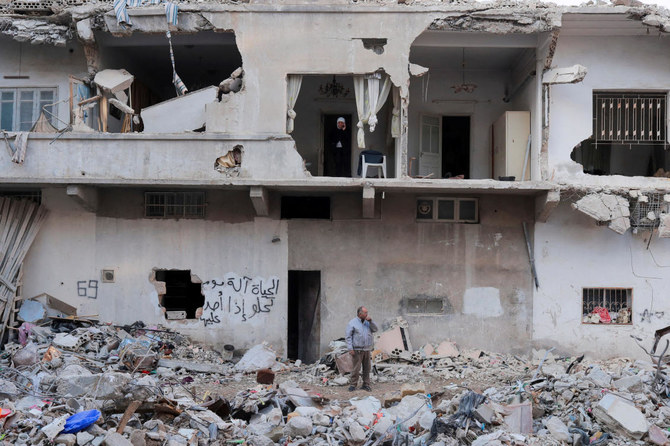
The combined death toll in Turkiye and Syria from last week’s earthquake has climbed above 41,000, and millions are in need of humanitarian aid, with many survivors having been left homeless in near-freezing winter temperatures.
In Syria, relief efforts have been hampered by a civil war that has splintered the country and divided regional and global powers.
The British government said the temporary new licenses would “strengthen the timely and effective delivery of relief efforts by removing the need for individual license applications.”
“UK sanctions do not target humanitarian aid, food, or medical supplies, but we recognize that the current requirements for individual licencing are not always practical during a crisis response,” Minister of State for International Development Andrew Mitchell said in a statement.
The licenses provide broad protection to organizations to allow them to operate by authorizing activities which would have otherwise been prohibited.
Earlier Britain announced a further 25 million pounds ($30 million) of aid to help the earthquake recovery effort. ($1 = 0.8328 pounds)

UK makes it easier for aid agencies in Syria to avoid breaching sanctions
https://arab.news/rrfqn
UK makes it easier for aid agencies in Syria to avoid breaching sanctions
- The licenses provide broad protection to organizations to allow them to operate by authorizing activities which would have otherwise been prohibited
Iraqi army fully takes over key base following US withdrawal
BAGHDAD: US forces have fully withdrawn from an air base in western Iraq in implementation of an agreement with the Iraqi government, Iraqi officials said Saturday.
Washington and Baghdad agreed in 2024 to wind down a US-led coalition fighting the Daesh group in Iraq by September 2025, with US forces departing bases where they had been stationed.
However, a small unit of US military advisers and support personnel remained. Iraqi Prime Minister Mohammed Shia Al-Sudani in October told journalists that the agreement originally stipulated a full pullout of US forces from the Ain Al-Asad air base in western Iraq by September. But “developments in Syria” since then required maintaining a “small unit” of between 250 and 350 advisers and security personnel at the base.
Now all US personnel have departed.
Iraqi Army Chief of Staff Lt. Gen. Abdul Amir Rashid Yarallah oversaw the assignment of tasks and duties to various military units at the base on Saturday following the withdrawal of US forces and the Iraqi Army’s full assumption of control over the base, the military said in a statement.
The statement added that Yarallah “instructed relevant authorities to intensify efforts, enhance joint work, and coordinate between all units stationed at the base, while making full use of its capabilities and strategic location.”
A Ministry of Defense official who spoke on condition of anonymity because he was not authorized to comment publicly confirmed that all US forces had departed the base and had also removed all American equipment from it.
There was no statement from the US military on the withdrawal.
US forces have retained a presence in the semi-autonomous Kurdish region in northern Iraq and in neighboring Syria.
The departure of US forces may strengthen the hand of the government in discussions around disarmament of non-state armed groups in the country, some of which have used the presence of US troops as justification for keeping their own weapons.
Al-Sudani said in a July interview with The Associated Press that once the coalition withdrawal is complete, “there will be no need or no justification for any group to carry weapons outside the scope of the state.”


