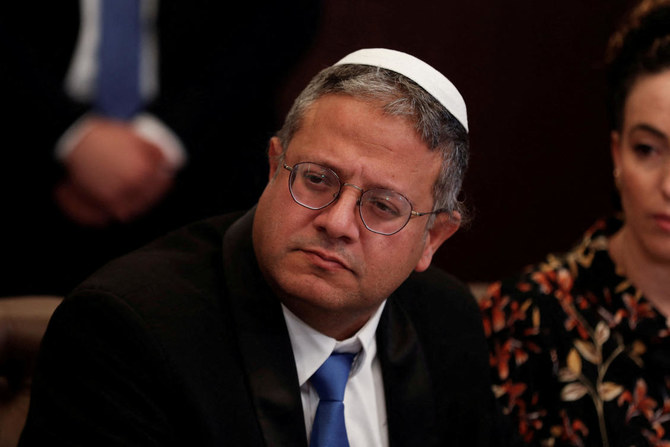
RAMALLAH: Israel’s far-right national security minister Itamar Ben-Gvir, long accused of inflaming Jewish-Arab tensions, has set his sights on one of the conflict’s most sensitive issues: Palestinian prisoners.
Since joining Israel’s new government led by veteran Prime Minister Benjamin Netanyahu late last year, Ben-Gvir has pledged to ensure Palestinian inmates are not being treated too comfortably.
After a visit to Nafha prison in the Negev desert last month, he told Israeli media he had wanted “to ensure that the murderers of Jews are not getting better conditions” as a result of the construction of new cells.
Ben-Gvir has also said he would make sure Palestinian prisoners — “terrorists,” according to him — no longer received “fresh pita (bread)... every morning, as if they were in a restaurant.”
“Not on my watch,” he vowed, ordering the closure of what he said were bakeries being run at two Israeli jails, speaking after a Palestinian gunman killed seven people outside a synagogue in annexed east Jerusalem last month.
Israel’s prison service declined to comment on whether such facilities exist or indeed make daily pita for prisoners.
While there is doubt over whether Ben-Gvir’s claims about Palestinian prisoner life match reality — and over his capacity to implement some of his proposals — his incendiary statements have provoked strong reactions.
In the Hamas-controlled Gaza Strip, protesters have waved placards reading: “Ben-Gvir, go to hell.”
In a letter addressed to Jerusalem-based foreign diplomats seen by AFP, the militant group warned that moves to curb prisoners’ rights “crossed all red lines” and labelled the issue “a detonator.”
“Every family in the West Bank has at least had one person who was detained, arrested, or brought before a military court system,” said Milena Ansari, an advocacy officer at prisoner support group Addameer.
“So it’s an issue that deeply hits the core of the Palestinian identity,” she told AFP.
Addameer estimates that some 800,000 Palestinians have been through Israeli prisons since the occupation of Palestinian territories following the 1967 Six-Day War.
Ben-Gvir, who heads the Jewish Power party, has been convicted of incitement to racism and supporting a terrorist organization over his ties to a banned Jewish extremist group.
Earlier in his career, he called for Arabs to be expelled from Israel.
He has also called for Palestinians convicted of terrorism to face the death penalty — a matter that falls outside his portfolio responsibilities.
Some 4,700 Palestinian prisoners are currently in Israeli jails including 190 who are under 18, Addameer has reported.
Basil Farraj, a researcher who specializes in Palestinian prisoners, said jail fostered unity between members of different groups, including Hamas and president Mahmud Abbas’s secular Fatah movement.
Farraj said what unites the prisoners is their shared “resistance against Israeli policies” and that Ben-Gvir “wants to dismantle that sense of political organization.”
The son of jailed Marwan Barghouti — an inmate who often tops opinion polls as the most popular Palestinian leader — told AFP it had been three months since he was allowed contact with his father.
Barghouti was sentenced to multiple life sentences over his role in orchestrating attacks on Israelis.
“The Israelis like to create symbols and destroy these symbols to create the illusion of victories,” Qassam Barghouti told AFP.
But he warned: “Whatever they do to him will only increase his support among Palestinians.”


![]()

Far-right Israeli minister Ben-Gvir targets Palestinian prisoners
Short Url
https://arab.news/2sjtc
Far-right Israeli minister Ben-Gvir targets Palestinian prisoners
- Ben-Gvir has pledged to ensure Palestinian inmates are not being treated too comfortably


Latest updates


© 2026 SAUDI RESEARCH & PUBLISHING COMPANY, All Rights Reserved And subject to Terms of Use Agreement.