

IAEA chief in Pakistan on two-day visit to discuss peaceful use of nuclear technology

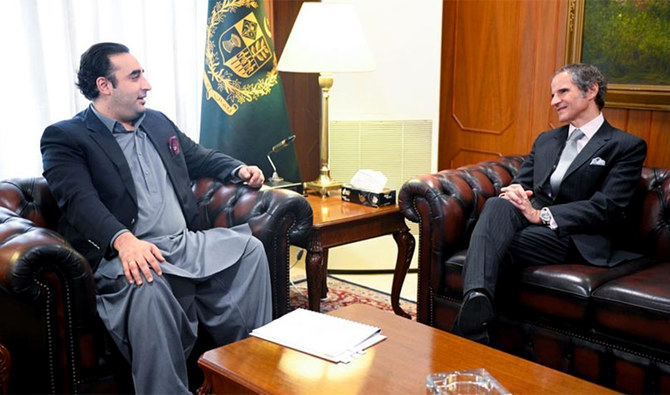
Director General of the International Atomic Energy Agency (IAEA) Rafael Mariano Grossi (right) meets Pakistan's foreign minister Bilawal Bhutto-Zardari in Islamabad, Pakistan, on February 15, 2023. (Government of Pakistan)
Short Url
Updated 15 February 2023
Follow

IAEA chief in Pakistan on two-day visit to discuss peaceful use of nuclear technology

  • Rafael Mariano Grossi is expected to see several health facilities using advanced nuclear technology
  • Experts say the IAEA chief’s presence highlights Pakistan’s track record of safe use of atomic power

ISLAMABAD: Director General of International Atomic Energy Agency (IAEA) Rafael Mariano Grossi on Wednesday arrived in Pakistan on two-day visit to attend bilateral meetings and visit different institutions using nuclear technology in the fields of health, agriculture, industry and power generation, the foreign office said in a statement.

The IAEA, an intergovernmental body, promotes safe and peaceful nuclear technology internationally. As a collaborative effort with its members and partners, it focuses on advancing the development of nuclear energy while ensuring its security and safety.

According to the foreign office, Pakistan is one of the founding members of the agency since 1957 and enjoys longstanding and mutually beneficial collaboration with it.

“The visit will provide an opportunity to Pakistan and the IAEA to explore avenues for further strengthening their ongoing cooperation in the area of peaceful applications of nuclear technology for the socioeconomic development of the country,” the official statement released by the foreign office said.

Speaking to Arab News, a Pakistan Atomic Energy Commission (PAEC) spokesperson, Shahid Riaz Khan, called the visit significant while pointing out it would highlight the country’s contribution when it came to the peaceful use of nuclear energy.

“During this visit, bilateral issues will be discussed with the IAEA which will focus on the use of nuclear technology for peaceful purposes,” he said while pointing out that Pakistan was the biggest recipient of the agency’s technical projects.

“The DG IAEA will inaugurate CyberKnife technology at the Nuclear Medicine Oncology and Radiotherapy Institute (NORI) today and tomorrow,” Khan added. “He will also inaugurate Zodac Lab in Faisalabad which is doing research on zoonotic diseases which are spread by animals.”

The IAEA delegation is also scheduled to visit the Nuclear Institute for Agriculture and Biology (NIAB) and National Institute for Biotechnology and Genetics Engineering (NIBGE) in Faisalabad.

“Pakistan is actively contributing in nuclear science and its application in the area of human benefit like agriculture, medicine, energy production and other fields,” the PAEC official said, adding the IAEA gave a lot of importance to Pakistan.

He maintained it was Grossi’s first visit, though the international agency’s previous heads had also been to Pakistan during their respective tenures.

Dr. Samar Mubarakmand, a nuclear scientist, said the visit showed the IAEA appreciated Pakistan’s nuclear safety since the country’s track record in this area was “spotless.”

“The IAEA is confident that Pakistan’s nuclear control system is well designed,” he said while speaking to Arab News.


Pakistan says CPEC has helped bridge cultural and language barriers with China

Updated 10 sec ago
Follow

Pakistan says CPEC has helped bridge cultural and language barriers with China

  • Ataullah Tarar suggests Pakistan-China digital platform to counter ‘disinformation’ around CPEC
  • People-to-people ties have remained limited between the two states despite strong official relations

ISLAMABAD: Federal Minister for Information and Broadcasting Ataullah Tarar said on Wednesday the China-Pakistan Economic Corridor (CPEC) has brought about a “cultural change,” helping break barriers of language and bringing the two countries closer together.

Pakistan and China have longstanding strategic relations, though much of their interactions have traditionally occurred at the government-to-government level through diplomatic, strategic and economic engagements. People-to-people ties between them have mostly remained limited, though the Pakistani minister said there was a gradual shift in the trend in the wake of the multibillion-dollar economic, infrastructure development and regional connectivity initiative.

Launched in 2015, CPEC includes investments in energy, transport, and industrial zones, and has since become a cornerstone of bilateral ties and Pakistan’s long-term development strategy.

“CPEC in Pakistan has broken a lot of barriers. It has broken the barrier of language, and it has broken the barriers of division. It has brought harmony,” Tarar said while addressing a ceremony organized by the Pakistan-China Institute, a local think tank.

“This corridor brought about a cultural change where we had investments coming in, where we had infrastructure being built, where we had industry being built, where we had airports and seaports being developed.”

He said it was “heartening” to see cultural change in Pakistan, such as a Chinese citizen speaking fluent Urdu or a Pakistani citizen speaking Mandarin.

Tarar said the cultural shift had become part of Pakistan’s ethos as the two countries move forward, describing Chinese President Xi Jinping’s 2015 visit as a turning point in reviving the economy.

He also maintained CPEC was targeted by a disinformation campaign, suggesting a digital media platform between Pakistan and China to counter the problem.

“I would suggest that maybe the Pakistan-China Institute can come up with a digital media platform to call out fake news and to label fake news circulating around CPEC,” he said, adding the government would fully support the endeavor.

“I think that will go a long way in not only strengthening the media cooperation but also in getting rid of misinformation and stating the correct facts in a very timely manner,” he added.

Tarar said the initiative will help promote a positive narrative around CPEC 2.0, referring to the next phase of the initiative that aims to focus on industrial development in Pakistan.